Creative Biolabs has a tradition of commitment. To achieve efficient execution and regulatory approval, we offer careful considerations of your program for the development of a cellular or gene therapy product – now and in the future.
EXPLORE MORE HighlightsWe focus on unmet needs and develop novel cellular and gene drugs and solutions that offer significant benefits over existing options.
EXPLORE MORE HighlightsThe advent of Chimeric Antigen Receptor T-cell (CAR-T) therapies has revolutionized the field of oncology, providing new avenues for treating various forms of cancer. Our 20 years of experience in the biotechnology sector have equipped us with the expertise and technological capabilities to support the entire lifecycle of CAR-T products, from early development to commercialization.
EXPLORE MORETo accelerate advanced breakthroughs of your projects, we offer broad range of platforms which enable our clients be free to tackle problems with cutting-edge technologies from different angles and in different methods.
EXPLORE MORE HighlightsUse the resources in our library to help you understand your options and make critical decisions for your study. We offer oncolytic virus, CAR-T, and dendritic cell related documents, as well as newsletter. If you don't find the answers you're looking for, contact us for additional assistance.
EXPLORE MORE HighlightsGet a real taste and understanding of the business and culture of one of the world's great research-based cellular and gene therapy discovery and development companies.
EXPLORE MORE
Although CAR-T therapies have shown notable clinical efficacy, off-tumor toxicities continue to pose major safety hurdles, largely owing to incomplete knowledge of their in vivo distribution and unintended accumulation in healthy tissues. In response, we introduce Flow Cytometry-Based Biodistribution Studies: Mapping In vivo CAR-T Off-target Risks, an advanced service for high-resolution, organ-wide tracing of CAR-T cell localization. By employing sensitive flow cytometry, our method quantifies viable CAR-T cells across both anticipated and atypical sites, facilitating accurate risk profiling. With enhanced detection sensitivity relative to traditional PCR or imaging platforms, our service provides interpretable biodistribution insights, helping clients mitigate lead candidate risks and inform early regulatory safety decisions.
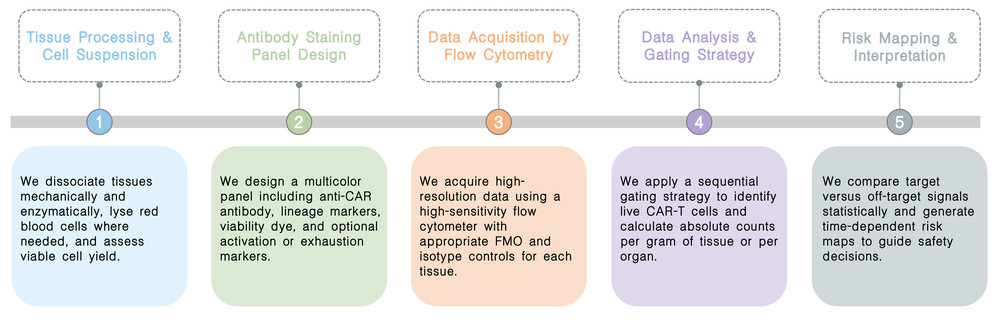
CAR-T cells administered in vivo may accumulate in healthy organs rather than solely targeting malignant tissues, posing off-target hazards that include recognition of shared antigens on normal cells or cytokine-driven tissue inflammation. Flow cytometry addresses this challenge by simultaneously tracking CAR signals across anatomical sites and profiling T-cell functional states at the individual cell level within biodistribution frameworks.
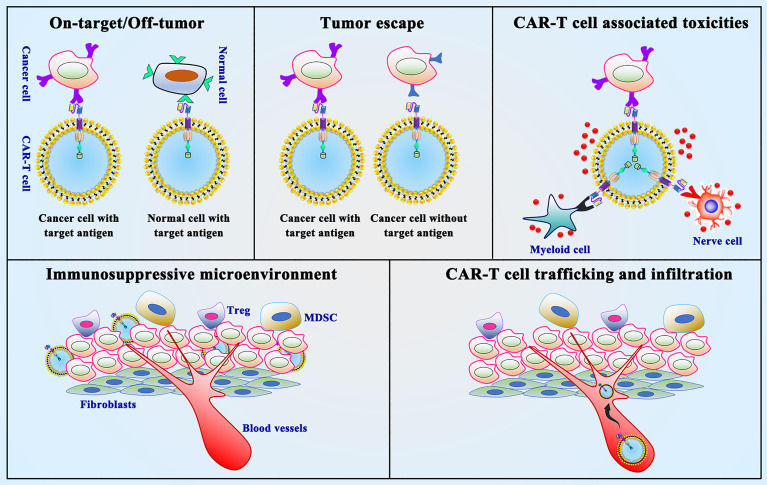 Fig.1 Shortcomings and persistent obstacles in the application of CAR-T cell therapy.1
Our Flow Cytometry-Based Biodistribution Studies map CAR-T cell localization across organs with high resolution. By quantifying viable cells in both target and off-target sites, this service uncovers hidden toxicities early. Outperforming traditional PCR and imaging, it delivers high-sensitivity risk profiles that empower safer lead candidate selection and regulatory decision-making.
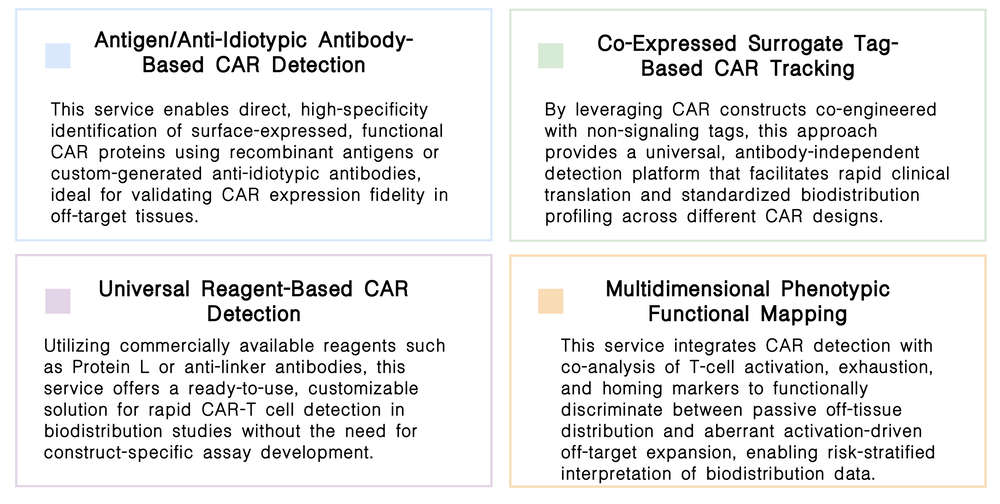
Our portfolio offers four complementary flow cytometry-based strategies for in vivo CAR-T off-target risk assessment, ranging from high-specificity CAR detection to functional phenotyping, enabling precise biodistribution mapping tailored to different CAR architectures and study needs.
Q1: What is the core advantage of flow cytometry over qPCR or imaging in CAR-T biodistribution studies?
A1: Flow cytometry provides high resolution and distinguishes live vs. dead CAR-T cells, whereas qPCR detects DNA from dead cells and cannot confirm cell viability, and imaging lacks quantitative precision across deep tissues.
Q2: Which tissues/organs are routinely analyzed in your off-target mapping panel?
A2: Our standard panel includes blood, bone marrow, spleen, liver, lung, kidney, heart, brain, reproductive organs, and lymph nodes. Custom panels are available based on your CAR-T product's known risk profile.
Q3: How do you ensure that detected signals are from functional CAR-T cells rather than CAR protein or fragments?
A3: We use anti-idiotype or anti-CAR antibodies targeting extracellular domains combined with viability dyes. This ensures specific detection of membrane-bound CAR on intact live cells, excluding soluble CAR protein or cellular debris.
We deliver high-resolution, viable cell-specific CAR-T tracking across all major organs, outperforming conventional PCR or imaging. Our validated flow cytometry panels detect rare off-target events with exceptional sensitivity, providing regulatory-ready biodistribution data that enables confident lead selection.
"We had previously used qPCR for biodistribution, which gave us false positives in liver and spleen due to DNA from dead cells. Switching to this flow cytometry-based service allowed us to distinguish live CAR-T cells from debris. The team detected rare but concerning signals in the lung at Day 7, which we had missed before. This directly guided our lead optimization." Director of Preclinical Safety, Biotech Company.
"Our CAR-T showed unexpected neurological symptoms in pilot studies. This service quantified extremely low numbers of CAR-T cells in the brain and CSF below the detection limit of imaging. With their data, we redesigned our safety switch and moved forward confidently. Highly recommend for any program with unknown tropism risks." Senior Director, Immuno-Oncology.
Interested in our off-target mapping service? Contact us now to discuss your specific CAR-T program, request pricing, or schedule a scientific consultation. Our specialists are available to answer technical questions and design a study tailored to your needs.
Reference
For any technical issues or product/service related questions, please leave your information below. Our team will contact you soon.
All products and services are For Research Use Only and CANNOT be used in the treatment or diagnosis of disease.
 NEWSLETTER
The latest newsletter to introduce the latest breaking information, our site updates, field and other scientific news, important events, and insights from industry leaders
LEARN MORE NEWSLETTER NEW SOLUTION
CellRapeutics™ In Vivo Cell Engineering: One-stop in vivo T/B/NK cell and macrophage engineering services covering vectors construction to function verification.
LEARN MORE SOLUTION NOVEL TECHNOLOGY
Silence™ CAR-T Cell: A novel platform to enhance CAR-T cell immunotherapy by combining RNAi technology to suppress genes that may impede CAR functionality.
LEARN MORE NOVEL TECHNOLOGY NEW SOLUTION
Canine CAR-T Therapy Development: From early target discovery, CAR design and construction, cell culture, and transfection, to in vitro and in vivo function validation.
LEARN MORE SOLUTION









