Creative Biolabs has a tradition of commitment. To achieve efficient execution and regulatory approval, we offer careful considerations of your program for the development of a cellular or gene therapy product – now and in the future.
EXPLORE MORE HighlightsWe focus on unmet needs and develop novel cellular and gene drugs and solutions that offer significant benefits over existing options.
EXPLORE MORE HighlightsThe advent of Chimeric Antigen Receptor T-cell (CAR-T) therapies has revolutionized the field of oncology, providing new avenues for treating various forms of cancer. Our 20 years of experience in the biotechnology sector have equipped us with the expertise and technological capabilities to support the entire lifecycle of CAR-T products, from early development to commercialization.
EXPLORE MORETo accelerate advanced breakthroughs of your projects, we offer broad range of platforms which enable our clients be free to tackle problems with cutting-edge technologies from different angles and in different methods.
EXPLORE MORE HighlightsUse the resources in our library to help you understand your options and make critical decisions for your study. We offer oncolytic virus, CAR-T, and dendritic cell related documents, as well as newsletter. If you don't find the answers you're looking for, contact us for additional assistance.
EXPLORE MORE HighlightsGet a real taste and understanding of the business and culture of one of the world's great research-based cellular and gene therapy discovery and development companies.
EXPLORE MORE
Creative Biolabs provides Genomic Insertional Mutagenesis & Oncogenesis Mapping Services for In Vivo CAR to address key safety concerns in gene therapy development, including vector integration behavior, clonal expansion risk, insertion-associated oncogenic activation, and the need for high-resolution genomic safety evidence. This service enables characterization of integration landscapes and the detection of potential genotoxicity signals through high-resolution insertion-site profiling and clonal architecture analysis using Linear Amplification-Mediated PCR (LAM-PCR) combined with advanced sequencing technologies. By integrating genomic mapping with bioinformatics-driven safety assessment, Creative Biolabs supports robust evaluation of insertional risks and translational safety for in vivo CAR programs.
Insertional mutagenesis remains a critical safety consideration in integrating gene delivery systems used for CAR engineering. Genomic integration events may influence transcriptional regulation, activate proto-oncogenes, or disrupt tumor suppressor genes, potentially leading to clonal dominance. Recent studies in gene-modified immune cell therapies highlight that integration site preferences and clonal selection contribute significantly to long-term safety outcomes. Therefore, high-resolution mapping of integration landscapes is essential for advancing safe and controllable in vivo CAR technologies.
Creative Biolabs provides integration site mapping and oncogenic risk profiling designed for in vivo CAR development and integrating vector systems. Our service enables detailed characterization of vector integration distribution, hotspot identification, and clonal expansion dynamics across target tissues.
Our key deliverables provide essential data for preclinical safety evaluation, vector optimization, and risk mitigation. We deliver genome-wide integration site profiling along with clonal abundance estimation. Our analysis identifies insertion hotspots near regulatory regions and annotates oncogenic risks linked to proto-oncogene proximity. Furthermore, we provide longitudinal tracking of clonal expansion patterns in vivo. These insights combine into a clear integration landscape interpretation that directly supports your regulatory submissions.
Discover How We Can Help - Request a Consultation.
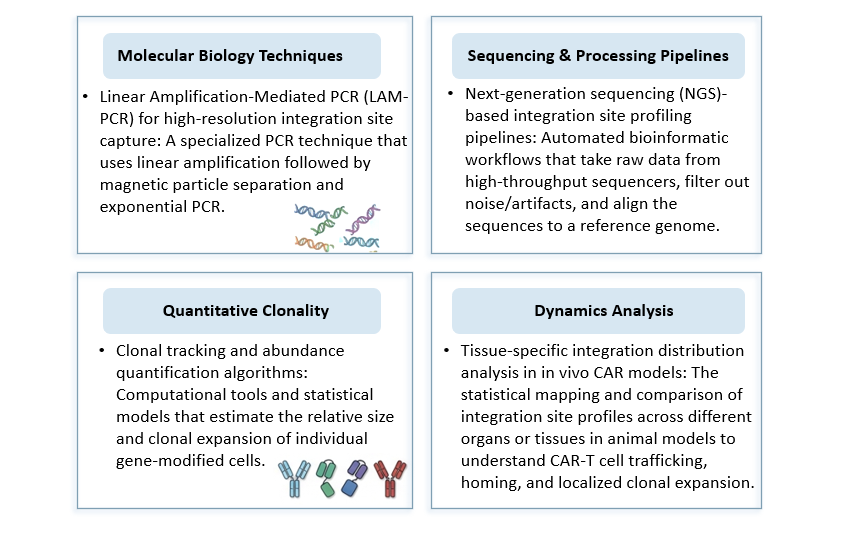
Creative Biolabs delivers multi-layered analytical solutions for integration site characterization and oncogenesis risk assessment. Our core technology platforms include LAM-PCR for high-resolution integration site capture and NGS-based profiling pipelines. We also utilize advanced algorithms for clonal tracking and abundance quantification. Furthermore, our bioinformatics tools handle genome annotation for hotspot mapping and calculate oncogenic proximity scoring systems. Finally, we perform tissue-specific integration distribution analysis in in vivo CAR models.
Clients will receive a full integration site mapping report, clonal expansion frequency datasets, oncogenic risk annotation with gene-level analysis, together with raw sequencing data and processed bioinformatic files.
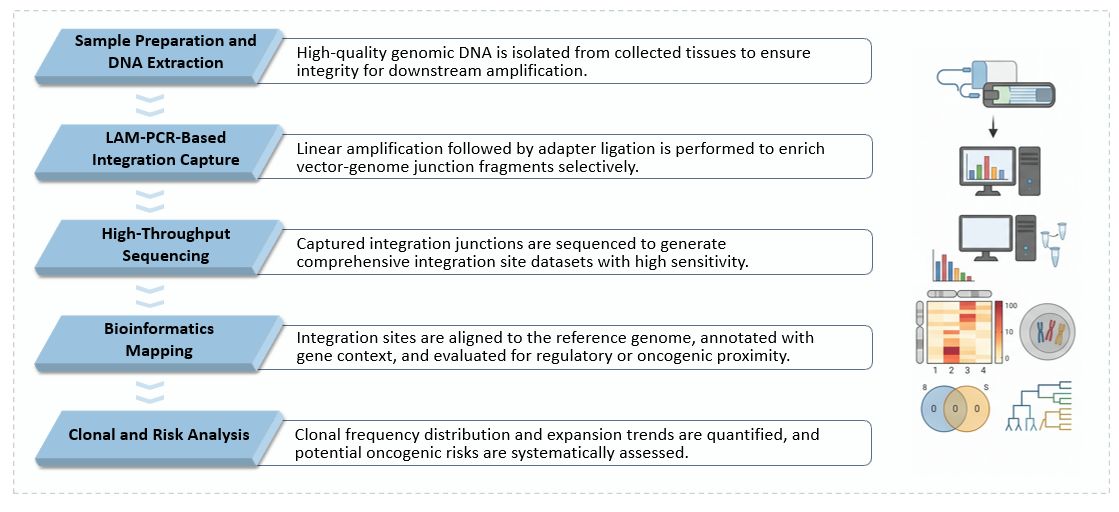
Clients need to provide in vivo CAR vector design details, organ and blood tissue biopsy samples, and experimental metadata covering dosing regimens, sampling timepoints, and animal model specifications.
Utilizing gold-standard LAM-PCR and targeted NGS, this high-resolution service precisely identifies the exact genomic locations of vector integration. It delivers unmatched sensitivity in mapping insertion sites, providing crucial data to ensure the safety and predictability of your cell therapy products.
Learn More →How randomly do your vectors integrate? This unbiased, genome-wide platform evaluates insertion distribution across the entire chromatin landscape, identifying hazardous hotspots and clonal dominance to mitigate insertional mutagenesis risks and satisfy stringent regulatory safety benchmarks.
Learn More →Establishing a pristine genetic blueprint before therapy, this screening maps the patient's baseline genomic background, including pre-existing mutations and clonal hematopoiesis. This vital dataset allows clinical developers to accurately differentiate therapy-induced changes from background genetic variations.
Learn More →Q1: Why is integration site mapping important for in vivo CAR systems?
A1: It provides critical insight into where vectors integrate into the genome, helping assess risks of gene activation or disruption that may affect safety and long-term stability.
Q2: Can this service detect early signs of clonal expansion?
A2: Yes, clonal abundance analysis can identify dominant integration events that may indicate early expansion signals in vivo models.
Q3: Is LAM-PCR suitable for low-frequency integration detection?
A3: LAM-PCR enables sensitive capture of rare integration events, making it suitable for detecting low-abundance clones in complex tissue samples.
Q4: How does this service support regulatory submissions?
A4: It generates structured genomic safety data, including integration profiles and risk annotations, which can support preclinical safety documentation.
Creative Biolabs delivers high-precision genomic safety assessment solutions tailored for in vivo CAR and integrating vector systems. We combine advanced insertion site profiling, robust bioinformatics, and flexible study design to support both discovery research and preclinical safety evaluation. Our services are fully customizable to match different vector types, tissue models, and study scales, ensuring actionable insights for genomic stability and oncogenic risk control. For detailed project consultation, technical discussion, or customized study design, please reach out to our scientific team.
For any technical issues or product/service related questions, please leave your information below. Our team will contact you soon.
All products and services are For Research Use Only and CANNOT be used in the treatment or diagnosis of disease.
 NEWSLETTER
The latest newsletter to introduce the latest breaking information, our site updates, field and other scientific news, important events, and insights from industry leaders
LEARN MORE NEWSLETTER NEW SOLUTION
CellRapeutics™ In Vivo Cell Engineering: One-stop in vivo T/B/NK cell and macrophage engineering services covering vectors construction to function verification.
LEARN MORE SOLUTION NOVEL TECHNOLOGY
Silence™ CAR-T Cell: A novel platform to enhance CAR-T cell immunotherapy by combining RNAi technology to suppress genes that may impede CAR functionality.
LEARN MORE NOVEL TECHNOLOGY NEW SOLUTION
Canine CAR-T Therapy Development: From early target discovery, CAR design and construction, cell culture, and transfection, to in vitro and in vivo function validation.
LEARN MORE SOLUTION









