Creative Biolabs has a tradition of commitment. To achieve efficient execution and regulatory approval, we offer careful considerations of your program for the development of a cellular or gene therapy product – now and in the future.
EXPLORE MORE HighlightsWe focus on unmet needs and develop novel cellular and gene drugs and solutions that offer significant benefits over existing options.
EXPLORE MORE HighlightsThe advent of Chimeric Antigen Receptor T-cell (CAR-T) therapies has revolutionized the field of oncology, providing new avenues for treating various forms of cancer. Our 20 years of experience in the biotechnology sector have equipped us with the expertise and technological capabilities to support the entire lifecycle of CAR-T products, from early development to commercialization.
EXPLORE MORETo accelerate advanced breakthroughs of your projects, we offer broad range of platforms which enable our clients be free to tackle problems with cutting-edge technologies from different angles and in different methods.
EXPLORE MORE HighlightsUse the resources in our library to help you understand your options and make critical decisions for your study. We offer oncolytic virus, CAR-T, and dendritic cell related documents, as well as newsletter. If you don't find the answers you're looking for, contact us for additional assistance.
EXPLORE MORE HighlightsGet a real taste and understanding of the business and culture of one of the world's great research-based cellular and gene therapy discovery and development companies.
EXPLORE MORE
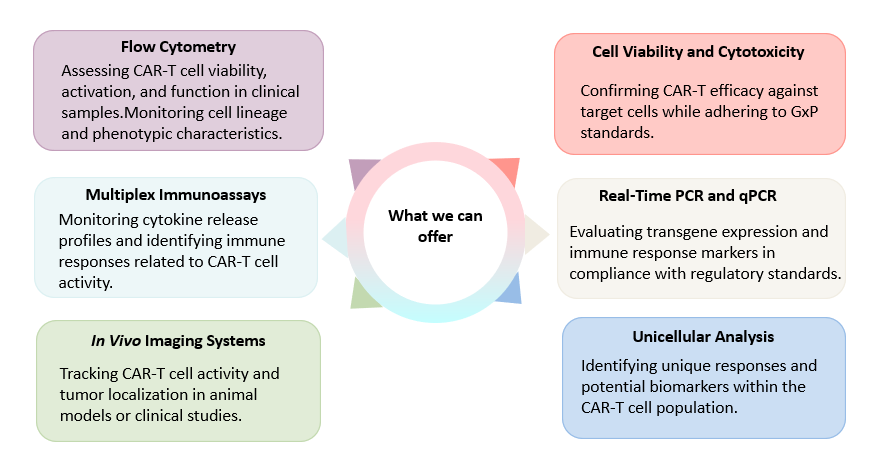
Creative Biolabs delivers GxP-compliant flow cytometry solutions to resolve practical challenges encountered throughout CAR-T clinical trials. We conduct targeted analytical validation and refine multi-marker assay panels to streamline your drug development workflows. Leveraging state-of-the-art spectral unmixing techniques, we set robust quantitative thresholds and keep monitoring low-abundance CAR-T cell populations over extended study periods. All generated data meets global regulatory criteria, which simplifies daily trial operations and speeds up the clinical translation of your in vivo CAR-T candidates. Our service helps your research deliver more dependable and reproducible results.
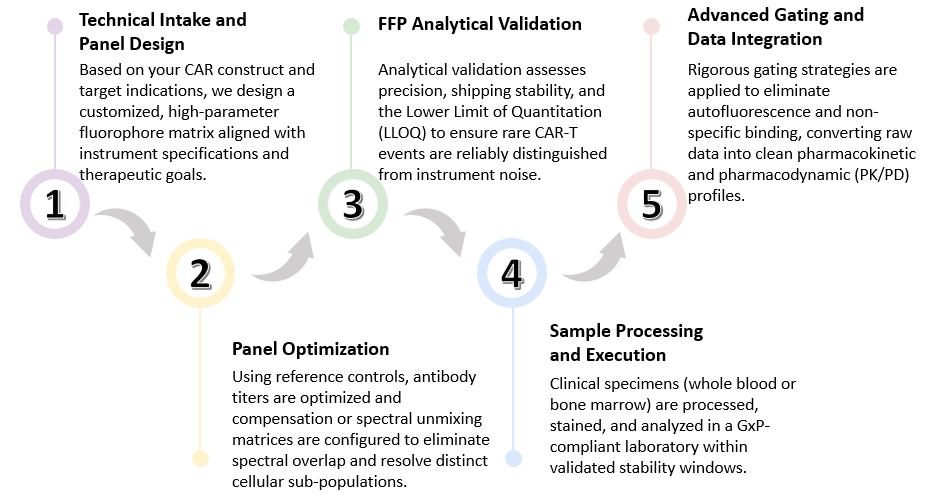
Modern next-generation cell therapies require sophisticated analytical tools to track intricate cell profiles and multi-antigen CAR-T designs in highly variable clinical specimens. Because conventional low-parameter assays often suffer from spectral crosstalk and lack the sensitivity to distinguish therapeutic expansion from phenotypic exhaustion, high-dimensional detection is essential. Following CLSI H62 guidelines, we perform fit-for-purpose method validation to establish solid analytical benchmarks and generate repeatable data acceptable for regulatory reviews.
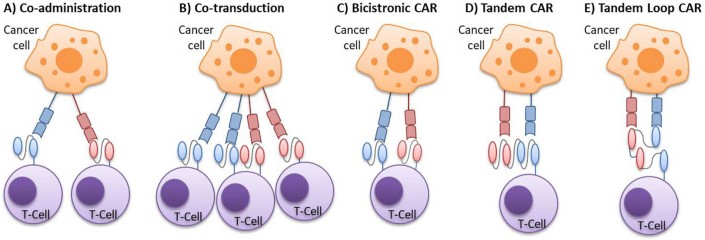 Fig.1 The schematic structures of dual-targeted CAR-T cells.1
Translating CAR-T research from laboratory settings to formal clinical trials is a complicated process that demands strict and reliable cell monitoring tools. At Creative Biolabs, we fully understand that high-quality analytical data underpins the entire bench-to-clinic progression. We build full-spectrum flow cytometry workflows that adhere to regulatory rules, exclusively optimized for CAR-T clinical development. Our team can document real-time cellular dynamics in living subjects, allowing you to trace phenotypic shifts and overall safety performance across every stage of clinical research.
All assay protocols we develop satisfy the strict standards. Our experienced technical staff ensures every set of cellular kinetic data is credible and can withstand thorough regulatory audits. By partnering with our team, you gain access to cutting-edge testing methodologies, enabling you to tackle clinical validation challenges with confidence and ultimately expedite the research progress and official approval of your innovative cell therapy products.
Discover How We Can Help – Request a Consultation
Whether you are moving forward from late-stage preclinical assessment to large-scale multi-center clinical trials, Creative Biolabs provides fully customized high-parameter bioanalytical services. Our GxP-compliant flow cytometry platform can be flexibly adjusted to match your unique CAR vector designs and established clinical trial protocols.
Q1: How do you validate the LLOQ for rare CAR-T populations?
A: We evaluate assay precision using serial dilutions of CAR-positive cells in untransduced PBMCs. The LLOQ is defined as the lowest cell frequency where the coefficient of variation (CV) remains within 20% to 30%, distinguishing rare events from instrument background.
Q2: Can your platforms differentiate dual versus tandem multi-antigen CAR configurations?
A: Yes. Using high-parameter spectral unmixing alongside custom anti-idiotype antibodies and fluorophore-labeled target proteins, we can separately track distinct extracellular binding domains whether expressed via independent vectors or as a single tandem protein.
Q3: What steps ensure clinical sample stability during transit from global sites?
A: During validation, we establish sample stability under various temperatures and durations (e.g., up to 72 hours at 2–8 °C or room temperature). We provide logistics partners with clear specifications to preserve cell viability, receptor density, and biomarker expression.
Q4: How does your service address high autofluorescence in patient bone marrow or cytopenic blood?
A: We use full-spectrum flow cytometry to capture complete emission spectra. Our unmixing algorithms treat autofluorescence as an independent channel and extract it from specific antibody signals, significantly improving assay sensitivity.
Q5: What documentation do you provide to support regulatory filings?
A: We supply a complete GxP-compliant package, including full Method Validation Reports, sample-handling SOPs, instrument QA/QC records, and fully audited Clinical Sample Analysis Reports, ensuring complete traceability for bioanalytical submissions.
We have developed professional GxP-compliant flow cytometry services dedicated to in vivo CAR-T research, focusing on standardized analytical monitoring for complex clinical trials. Our advanced testing tools can accurately record cellular dynamics and safety profiles, solving technical obstacles in tracking phenotypic evolution and guaranteeing reliable data output. With optimized multi-parameter panels and strict method validation, our platform helps researchers distinguish valid therapeutic signals from background interference, especially when analyzing low-frequency cell populations.
Our professional support simplifies clinical trial data collection and analysis work, and further elevates the safety and therapeutic potency of CAR-T products. Contact our team to discuss your project requirements, customized assay designs and comprehensive support solutions for your CAR-T therapy development programs.
Reference
For any technical issues or product/service related questions, please leave your information below. Our team will contact you soon.
All products and services are For Research Use Only and CANNOT be used in the treatment or diagnosis of disease.
 NEWSLETTER
The latest newsletter to introduce the latest breaking information, our site updates, field and other scientific news, important events, and insights from industry leaders
LEARN MORE NEWSLETTER NEW SOLUTION
CellRapeutics™ In Vivo Cell Engineering: One-stop in vivo T/B/NK cell and macrophage engineering services covering vectors construction to function verification.
LEARN MORE SOLUTION NOVEL TECHNOLOGY
Silence™ CAR-T Cell: A novel platform to enhance CAR-T cell immunotherapy by combining RNAi technology to suppress genes that may impede CAR functionality.
LEARN MORE NOVEL TECHNOLOGY NEW SOLUTION
Canine CAR-T Therapy Development: From early target discovery, CAR design and construction, cell culture, and transfection, to in vitro and in vivo function validation.
LEARN MORE SOLUTION









