Creative Biolabs has a tradition of commitment. To achieve efficient execution and regulatory approval, we offer careful considerations of your program for the development of a cellular or gene therapy product – now and in the future.
EXPLORE MORE HighlightsWe focus on unmet needs and develop novel cellular and gene drugs and solutions that offer significant benefits over existing options.
EXPLORE MORE HighlightsThe advent of Chimeric Antigen Receptor T-cell (CAR-T) therapies has revolutionized the field of oncology, providing new avenues for treating various forms of cancer. Our 20 years of experience in the biotechnology sector have equipped us with the expertise and technological capabilities to support the entire lifecycle of CAR-T products, from early development to commercialization.
EXPLORE MORETo accelerate advanced breakthroughs of your projects, we offer broad range of platforms which enable our clients be free to tackle problems with cutting-edge technologies from different angles and in different methods.
EXPLORE MORE HighlightsUse the resources in our library to help you understand your options and make critical decisions for your study. We offer oncolytic virus, CAR-T, and dendritic cell related documents, as well as newsletter. If you don't find the answers you're looking for, contact us for additional assistance.
EXPLORE MORE HighlightsGet a real taste and understanding of the business and culture of one of the world's great research-based cellular and gene therapy discovery and development companies.
EXPLORE MORE
Tracking the in vivo kinetics and long-term persistence of CAR-T cells remains challenging due to the limited sensitivity of conventional methods, their inability to provide absolute quantification across diverse tissues, and potential interference from reporter gene integration. We offer a robust solution using quantitative flow cytometry to precisely monitor CAR-T cell biodistribution, expansion, and durability over time. Our service delivers standardized, high-throughput analysis of both peripheral blood and enzyme-digested tissue samples. Our approach ensures reproducible, cost-effective, and multi-parameter longitudinal tracking without genetic modification, empowering your preclinical and clinical studies with reliable data for optimizing dosing schedules and predicting therapeutic outcomes.
CAR-T cell behavior after infusion involves expansion, tissue distribution, and subsequent decline, key aspects summarized by pharmacokinetic metrics including peak level, time to peak, and total exposure over time. Their sustained presence in the body as functional memory cells can last many months or even years, largely shaped by the proportion of early memory subsets (TSCM/TCM) and the degree of exhaustion. Measuring these features is critical for forecasting antitumor responses, detecting early toxicity signals such as cytokine release syndrome, and uncovering biological factors linked to enduring remission or tumor reappearance.
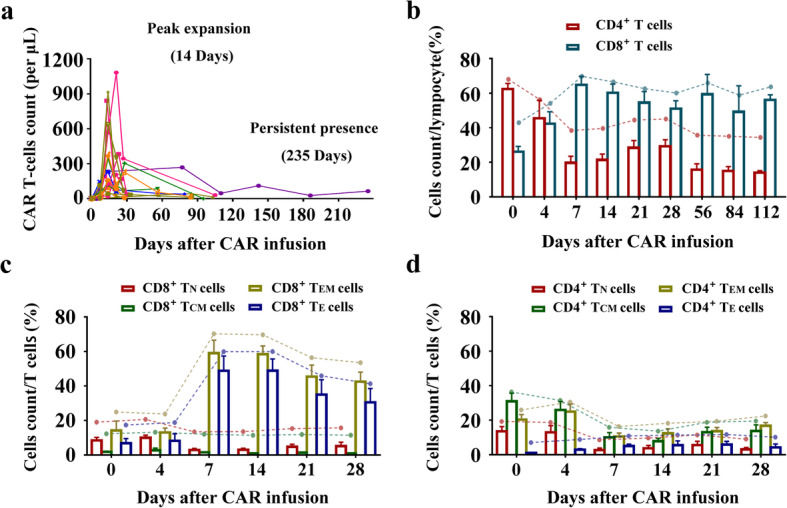 Fig.1 The growth kinetics of CAR-T cells and heterogeneous T cell subsets.1
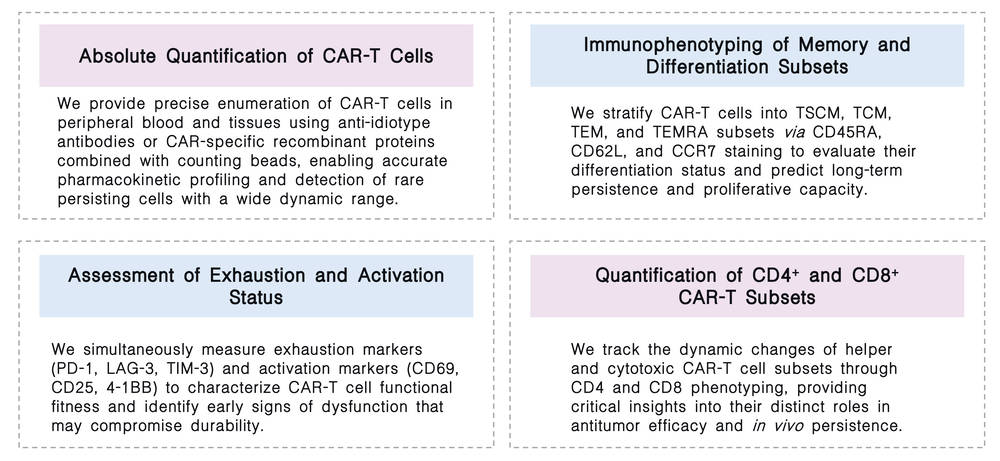
Our quantitative flow cytometry service precisely tracks CAR-T cell kinetics and long-term persistence in vivo. We provide absolute cell counts, memory subset discrimination (TSCM/TCM), exhaustion/activation profiling, and CD4/CD8 dynamics. This enables accurate pharmacokinetic monitoring, early safety prediction, and functional fitness assessment, empowering clients to optimize CAR-T product performance and clinical outcomes.
We offer comprehensive flow cytometry-based solutions to quantitatively track CAR-T cell kinetics, including absolute counting, memory differentiation, exhaustion/activation profiling, and CD4/CD8 subset analysis for evaluating long-term persistence and functional fitness.

Q1: Why is it necessary to track CAR-T cells using flow cytometry?
A1: As a "living drug," the in vivo expansion peak, persistence duration, and functional status of CAR-T cells directly determine therapeutic efficacy and toxicity. Flow cytometry enables the monitoring of pharmacokinetics (PK), predicts safety events such as cytokine release syndrome (CRS), and helps assess the risk of long-term relapse.
Q2: How should one select the appropriate detection reagent for CAR-T cell tracking?
A2: The selection depends on the specific assay requirements. The antigen/ligand binding method using biotinylated recombinant target antigens is recommended due to its high specificity and low background noise. Anti-idiotype antibodies offer high specificity but lack generalizability across different CAR constructs. Protein L is universal but may result in higher background due to non-specific IgG binding.
Choose us for unparalleled precision in CAR-T tracking. Our quantitative flow cytometry delivers absolute cell counts, high sensitivity, and multi-parameter phenotyping across blood and tissues. Benefit from standardized, cost-effective protocols ideal for longitudinal studies, no reporter genes required. Accelerate your CAR-T development with reliable, reproducible data.
"Tracking CAR-T cell kinetics in our Phase I/II trials required a method that balances sensitivity, throughput, and clinical relevance. This quantitative flow cytometry solution delivered on all three fronts. The limit of detection down to 0.01% allowed us to monitor persistence beyond six months, and the absolute quantification enabled direct comparison of pharmacokinetic parameters across different CAR constructs. Most importantly, the longitudinal immunophenotyping revealed that patients maintaining a higher TCM fraction at day 28 had significantly longer remission. This assay is now a core component of our correlative science package." Pharmaceutical Company.
"As we optimized our novel 4-1BB-based CAR-T candidate, we needed a method to distinguish between functional persistence and exhaustion-driven dormancy. This quantitative flow cytometry service provided exactly that. The ability to track CD62L and CCR7 expression over time allowed us to demonstrate that our manufacturing process enriches for TSCM cells, which translated into superior in vivo expansion and prolonged B-cell aplasia in our mouse models. The data package generated from this assay was instrumental in our successful IND filing." Biotechnology Startup.
We'd love to discuss how our quantitative flow cytometry platform can support your CAR-T development. For technical details, customized panel design, or pricing inquiries, please reach out. Our team is ready to help accelerate your in vivo kinetic studies and long-term persistence tracking.
Reference
For any technical issues or product/service related questions, please leave your information below. Our team will contact you soon.
All products and services are For Research Use Only and CANNOT be used in the treatment or diagnosis of disease.
 NEWSLETTER
The latest newsletter to introduce the latest breaking information, our site updates, field and other scientific news, important events, and insights from industry leaders
LEARN MORE NEWSLETTER NEW SOLUTION
CellRapeutics™ In Vivo Cell Engineering: One-stop in vivo T/B/NK cell and macrophage engineering services covering vectors construction to function verification.
LEARN MORE SOLUTION NOVEL TECHNOLOGY
Silence™ CAR-T Cell: A novel platform to enhance CAR-T cell immunotherapy by combining RNAi technology to suppress genes that may impede CAR functionality.
LEARN MORE NOVEL TECHNOLOGY NEW SOLUTION
Canine CAR-T Therapy Development: From early target discovery, CAR design and construction, cell culture, and transfection, to in vitro and in vivo function validation.
LEARN MORE SOLUTION









