Creative Biolabs has a tradition of commitment. To achieve efficient execution and regulatory approval, we offer careful considerations of your program for the development of a cellular or gene therapy product – now and in the future.
EXPLORE MORE HighlightsWe focus on unmet needs and develop novel cellular and gene drugs and solutions that offer significant benefits over existing options.
EXPLORE MORE HighlightsThe advent of Chimeric Antigen Receptor T-cell (CAR-T) therapies has revolutionized the field of oncology, providing new avenues for treating various forms of cancer. Our 20 years of experience in the biotechnology sector have equipped us with the expertise and technological capabilities to support the entire lifecycle of CAR-T products, from early development to commercialization.
EXPLORE MORETo accelerate advanced breakthroughs of your projects, we offer broad range of platforms which enable our clients be free to tackle problems with cutting-edge technologies from different angles and in different methods.
EXPLORE MORE HighlightsUse the resources in our library to help you understand your options and make critical decisions for your study. We offer oncolytic virus, CAR-T, and dendritic cell related documents, as well as newsletter. If you don't find the answers you're looking for, contact us for additional assistance.
EXPLORE MORE HighlightsGet a real taste and understanding of the business and culture of one of the world's great research-based cellular and gene therapy discovery and development companies.
EXPLORE MORE
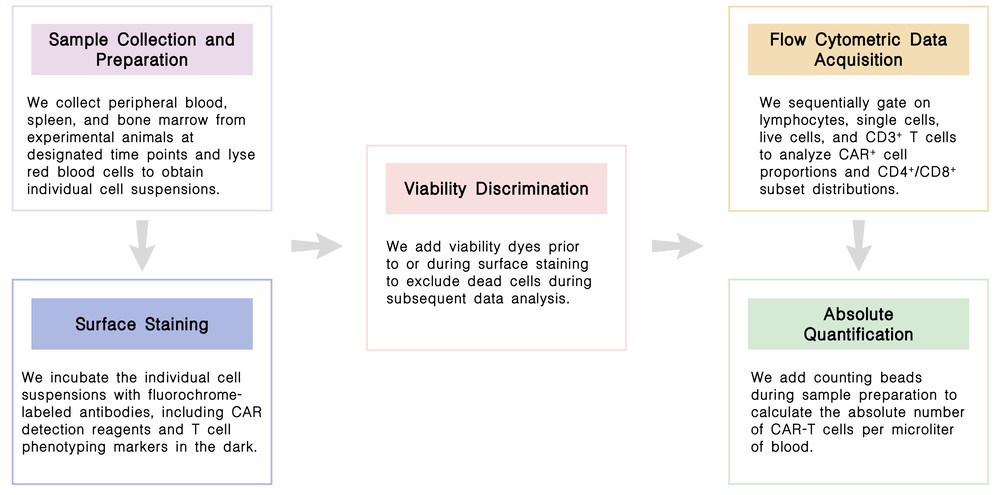
The current challenge in CAR-T therapy is the lack of real-time, in vivo methods to confirm successful transduction, as conventional assays are endpoint-based and fail to capture dynamic transduction efficiency. Our solution, Real-time Monitoring of In vivo CAR-T Transduction Success via Advanced Flow Cytometry, enables continuous tracking of CAR expression directly within the living subject. Our service combines high-parameter flow cytometry with specialized sample handling and data analysis tailored for in vivo samples. It offers unparalleled sensitivity and temporal resolution, allowing you to assess transduction success at multiple time points, reduce animal use, and accelerate process optimization with actionable, quantitative insights.
In vivo CAR-T transduction represents a paradigm shift from ex vivo engineering, enabling the direct conversion of a patient's endogenous T cells into tumor-targeting effectors through the systemic delivery of viral or non-viral gene vectors. Real-time monitoring of this process using advanced flow cytometry provides dynamic, high-resolution data on CAR expression kinetics, transduction efficiency, and T cell activation status directly within the living host, thereby replacing static endpoint measurements with actionable longitudinal insights for optimizing safety and efficacy.
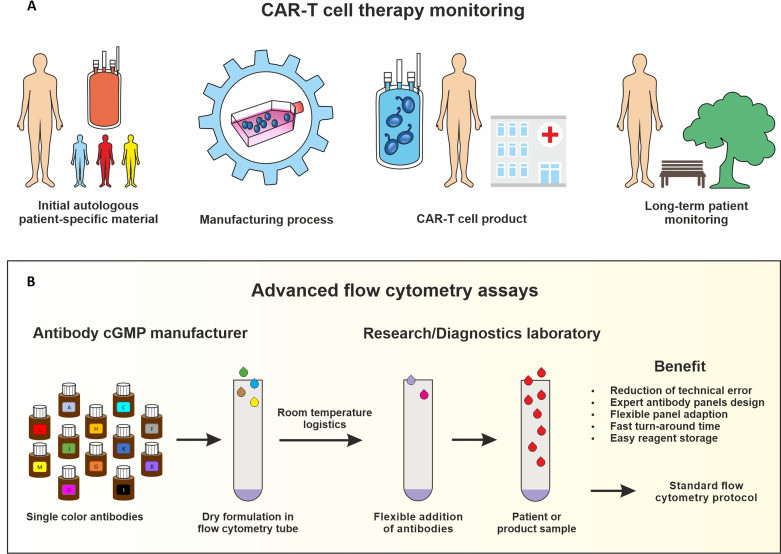 Fig.1 Monitoring platforms for immune parameters throughout CAR-T cell manufacturing and patient treatment.1
Our service enables real-time, in vivo tracking of CAR-T transduction success using advanced flow cytometry. It provides dynamic monitoring of CAR expression, overcoming endpoint assay limitations. With high sensitivity and temporal resolution, it supports multi-time-point assessment, reduces animal use, and delivers actionable insights to accelerate optimization of CAR-T therapies.
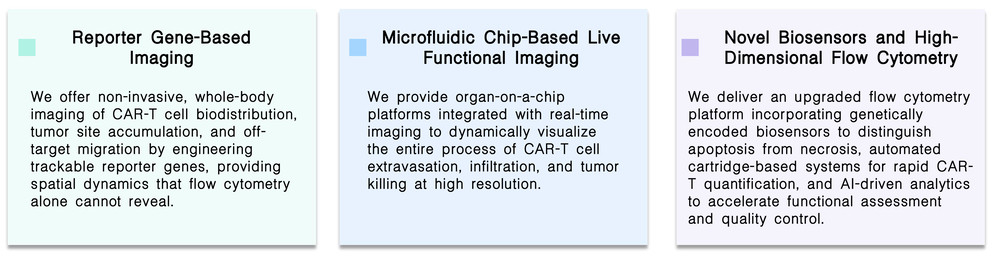
We offer a comprehensive suite of advanced platforms to monitor CAR-T cell performance in real time, integrating reporter gene-based whole-body imaging, microfluidic live-cell assays, and biosensor-enhanced high-dimensional flow cytometry to capture spatial distribution, dynamic killing processes, and functional mechanisms.
Q1: What is the definition of real-time monitoring in CAR-T cell tracking and how does it differ from conventional flow cytometry?
A1: Real-time monitoring involves serial blood draws from live animals at dense time points post-infusion, such as hours, day one, and day two, with automated processing delivering results in under four hours. Conventional flow cytometry relies on single endpoint sampling at fixed days like seven, fourteen, or twenty-eight, providing only static snapshots rather than continuous kinetic data.
Q2: How should transduction success be distinguished from CAR expression positivity in CAR-T cell analysis?
A2: Transduction success requires viral vector integration into the T cell genome and subsequent CAR expression. CAR positivity by surface flow cytometry may yield false negatives due to CAR internalization or shedding. Accurate distinction demands combined detection of intracellular CAR, surface CAR, and transduction marker genes such as truncated NGFr or EGFRt.
Choose us for real-time, in vivo validation of CAR-T transduction success using advanced flow cytometry. Our platform delivers high-sensitivity detection, kinetic tracking, and early functional profiling, enabling faster iterations, reduced animal use, and confident translation from bench to bedside.
"Traditional PCR methods require cell lysis and cannot reveal functional dynamics. This advanced flow cytometry enables live-animal tracking of CAR expression on CD3+ T cells without euthanasia. Its specific probes detect <0.5% transduced cells within 48 hours post-infusion. The rare-cell enrichment algorithm successfully distinguishes vector integration from surface CAR expression, which is critical for optimizing lentiviral dosing and predicting cytokine release syndrome windows." Head of Tumor Immunology Lab.
"Conventional flow cytometry relies on discrete time points and often misses early CAR-T expansion peaks. This spectral flow cytometry with high-content time-series analysis allows simultaneous, continuous monitoring across multiple sites using minimal blood volumes. The automated module generates real-time transduction kinetic curves and corrects background fluorescence. In a solid tumor study, the system predicted tumor regression tipping points 48 hours earlier than endpoint methods." Senior Scientist.
"Our core service faces the challenge of providing universal monitoring for various CAR constructs. The live-cell affinity capture module improves detection of low-copy CAR molecules by threefold compared to standard methods. It processes complex matrices without lengthy red blood cell lysis and washing, preserving fragile T cell viability. Over three months, we applied this to over 15 in vivo models with no false positives induced by sample handling." Director, Flow Cytometry Core.
To request a quote or discuss your specific CAR-T monitoring needs, please reach out via our online inquiry form. Our specialists will provide customized protocols, platform specifications, and pricing details. Let us help accelerate your in vivo efficacy studies with confidence.
Reference
For any technical issues or product/service related questions, please leave your information below. Our team will contact you soon.
All products and services are For Research Use Only and CANNOT be used in the treatment or diagnosis of disease.
 NEWSLETTER
The latest newsletter to introduce the latest breaking information, our site updates, field and other scientific news, important events, and insights from industry leaders
LEARN MORE NEWSLETTER NEW SOLUTION
CellRapeutics™ In Vivo Cell Engineering: One-stop in vivo T/B/NK cell and macrophage engineering services covering vectors construction to function verification.
LEARN MORE SOLUTION NOVEL TECHNOLOGY
Silence™ CAR-T Cell: A novel platform to enhance CAR-T cell immunotherapy by combining RNAi technology to suppress genes that may impede CAR functionality.
LEARN MORE NOVEL TECHNOLOGY NEW SOLUTION
Canine CAR-T Therapy Development: From early target discovery, CAR design and construction, cell culture, and transfection, to in vitro and in vivo function validation.
LEARN MORE SOLUTION









