Creative Biolabs has a tradition of commitment. To achieve efficient execution and regulatory approval, we offer careful considerations of your program for the development of a cellular or gene therapy product – now and in the future.
EXPLORE MORE HighlightsWe focus on unmet needs and develop novel cellular and gene drugs and solutions that offer significant benefits over existing options.
EXPLORE MORE HighlightsThe advent of Chimeric Antigen Receptor T-cell (CAR-T) therapies has revolutionized the field of oncology, providing new avenues for treating various forms of cancer. Our 20 years of experience in the biotechnology sector have equipped us with the expertise and technological capabilities to support the entire lifecycle of CAR-T products, from early development to commercialization.
EXPLORE MORETo accelerate advanced breakthroughs of your projects, we offer broad range of platforms which enable our clients be free to tackle problems with cutting-edge technologies from different angles and in different methods.
EXPLORE MORE HighlightsUse the resources in our library to help you understand your options and make critical decisions for your study. We offer oncolytic virus, CAR-T, and dendritic cell related documents, as well as newsletter. If you don't find the answers you're looking for, contact us for additional assistance.
EXPLORE MORE HighlightsGet a real taste and understanding of the business and culture of one of the world's great research-based cellular and gene therapy discovery and development companies.
EXPLORE MORE
High clinical failure rates, inaccurate blood-brain barrier (BBB) penetration data, and the limitations of animal models in replicating human tumor microenvironments are major challenges in glioblastoma (GBM) CAR-T development. Our Preclinical Trial-on-Chip Glioblastoma Special Customization Service addresses these challenges by providing high-fidelity, patient-specific microfluidic platforms that enable precise validation of therapeutic efficacy and safety. By integrating 3D bioprinting and dynamic microfluidic technology, we simulate the complex GBM landscape, streamlining CAR-T development and minimizing R&D risk for a more efficient path toward clinical success.
GBM is a highly aggressive and treatment-resistant brain tumor, posing significant challenges for both traditional and immunotherapies. As a cutting-edge approach, the Preclinical Trial-on-Chip models mimic the tumor microenvironment (TME) of GBM, allowing researchers to test CAR-T cell efficacy in a controlled, in vitro system. Studies have shown that these models provide a more predictive platform for understanding CAR-T therapy dynamics, such as immune infiltration and tumor-targeting specificity, compared to conventional animal models.
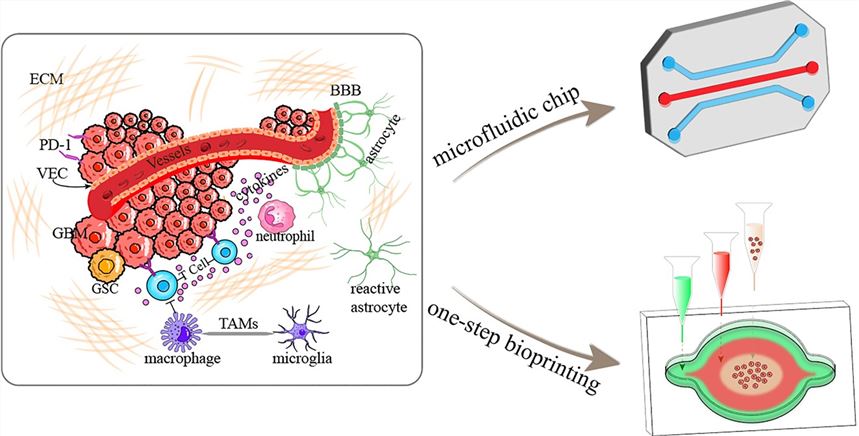 Fig.1 A diagram depicting the GBM tumor microenvironment and the construction of a GBM-on-a-chip.1
Creative Biolabs provides a transformative solution for assessing the potency and extravasation capabilities of CAR-T cells within a human-centric system. Our specialized "GBM-on-a-chip" models offer high-resolution data on how your engineered T-cells interact with the immunosuppressive tumor microenvironment, the blood-brain barrier, and heterogeneous tumor populations.
Our service offers a customized approach to developing CAR-T therapies for glioblastoma, using innovative tumor-on-a-chip models that replicate the complexities of the human GBM tumor microenvironment. Clients can expect a highly controlled and scalable testing platform that evaluates CAR-T cell efficacy in real-time, including immune response, tumor cell interaction, and potential side effects.
Discover How We Can Help - Request a Consultation to design a chip model.
At Creative Biolabs, we provide specialized tumor-on-a-chip platforms designed to emulate the GBM microenvironment in a way that supports precise CAR-T evaluation. The platforms we use allow for the incorporation of microfluidic channels, vascularization, and immune cell infiltration, ensuring that the models reflect the complexity of GBM. Our service includes customizable models for GBM with real-time analysis of CAR-T cell action, tumor cell interactions, and cytokine profiles, offering insights into immune responses and tumor suppression.
Mainstream Technology Platforms Available:
These platforms enable accurate modeling and comprehensive testing of immune-oncology treatments, such as CAR-T.
Required Starting Materials:
GBM cell line details: Provide the specific GBM cell lines for tumor modeling.
CAR-T construct specifications: Submit detailed information on the CAR-T design, including target antigen, scFv sequences, and co-stimulatory domain preferences.
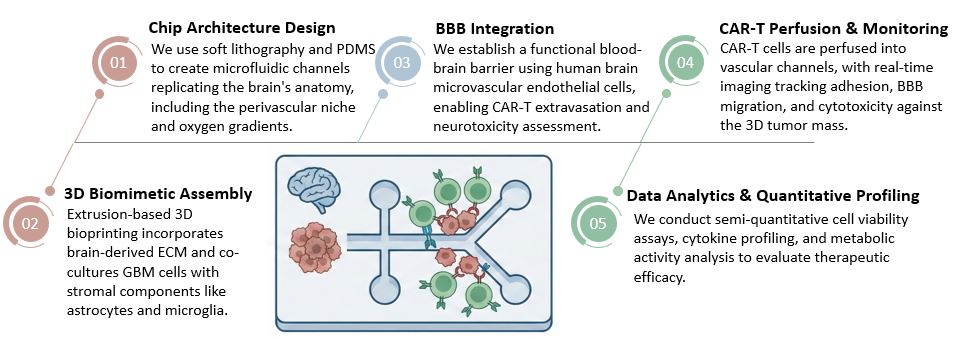
Final Deliverables: Clients receive a Comprehensive Efficacy & Safety Report, including high-resolution microscopy images of CAR-T infiltration, extravasation efficiency data, and a Cytokine Release Profile indicating potential inflammatory responses.
Q1: Can your GBM-on-a-chip platform handle different GBM subtypes?
A1: Yes. We can customize the platform using molecularly distinct patient-derived cells to help you understand how your CAR-T candidate performs across the diverse landscape of GBM. Please contact us to discuss specific subtype requirements.
Q2: How do you verify the integrity of the BBB in the chip?
A2: We monitor the barrier function through molecular permeability tests and immunohistochemical staining for tight junction markers. This ensures the extravasation data for your CAR-T cells is accurate and reliable.
Q3: Is it possible to test combination therapies on the same chip?
A3: Absolutely. Our microfluidic design allows for the simultaneous administration of CAR-T cells and small-molecule inhibitors or checkpoint blockers to evaluate synergistic effects in a controlled 3D environment.
Q4: What is the primary advantage of this service over 2D co-culture assays?
A4: 2D assays lack the fluid dynamics, 3D architecture, and mechanical cues of the brain. Our chip technology provides the 3D spatial organization and shear stress necessary for realistic CAR-T behavior and efficacy assessment.
Creative Biolabs provides the world's most advanced Preclinical Trial-on-Chip GBM Special Customization Service, specifically engineered to empower the next generation of CAR-T therapeutics. By bridging the gap between benchtop research and clinical reality, we help you deliver life-saving treatments to patients faster and with higher confidence. Ready to revolutionize your GBM research? Our team of scientific experts is available to design a custom platform tailored to your specific project needs. Please contact our team to discuss your project and for further information.
Reference
For any technical issues or product/service related questions, please leave your information below. Our team will contact you soon.
All products and services are For Research Use Only and CANNOT be used in the treatment or diagnosis of disease.
 NEWSLETTER
The latest newsletter to introduce the latest breaking information, our site updates, field and other scientific news, important events, and insights from industry leaders
LEARN MORE NEWSLETTER NEW SOLUTION
CellRapeutics™ In Vivo Cell Engineering: One-stop in vivo T/B/NK cell and macrophage engineering services covering vectors construction to function verification.
LEARN MORE SOLUTION NOVEL TECHNOLOGY
Silence™ CAR-T Cell: A novel platform to enhance CAR-T cell immunotherapy by combining RNAi technology to suppress genes that may impede CAR functionality.
LEARN MORE NOVEL TECHNOLOGY NEW SOLUTION
Canine CAR-T Therapy Development: From early target discovery, CAR design and construction, cell culture, and transfection, to in vitro and in vivo function validation.
LEARN MORE SOLUTION