Creative Biolabs has a tradition of commitment. To achieve efficient execution and regulatory approval, we offer careful considerations of your program for the development of a cellular or gene therapy product – now and in the future.
EXPLORE MORE HighlightsWe focus on unmet needs and develop novel cellular and gene drugs and solutions that offer significant benefits over existing options.
EXPLORE MORE HighlightsThe advent of Chimeric Antigen Receptor T-cell (CAR-T) therapies has revolutionized the field of oncology, providing new avenues for treating various forms of cancer. Our 20 years of experience in the biotechnology sector have equipped us with the expertise and technological capabilities to support the entire lifecycle of CAR-T products, from early development to commercialization.
EXPLORE MORETo accelerate advanced breakthroughs of your projects, we offer broad range of platforms which enable our clients be free to tackle problems with cutting-edge technologies from different angles and in different methods.
EXPLORE MORE HighlightsUse the resources in our library to help you understand your options and make critical decisions for your study. We offer oncolytic virus, CAR-T, and dendritic cell related documents, as well as newsletter. If you don't find the answers you're looking for, contact us for additional assistance.
EXPLORE MORE HighlightsGet a real taste and understanding of the business and culture of one of the world's great research-based cellular and gene therapy discovery and development companies.
EXPLORE MORE
Creative Biolabs provides a TCR/CD3 Integration & Phenotype Analysis Service to address key challenges in TRuC-T and next-generation T-cell engineering, including antibody, TCR fusion instability, unpredictable cytokine release, and limited T-cell persistence in solid tumor microenvironments. This service enables the identification of high-potency, low-toxicity therapeutic candidates by reprogramming the intact TCR complex through proprietary TRuC-based screening and multi-parametric phenotyping platforms. By delivering detailed physiological signaling insights, Creative Biolabs supports efficient lead optimization and selection while overcoming the functional limitations commonly observed in traditional CAR-T approaches.
TRuC-based T cell therapies utilize fusion constructs designed to integrate with the endogenous TCR/CD3 complex, enabling antigen recognition while maintaining physiological T cell signaling pathways. Recent research highlights the importance of proper receptor assembly and stable integration within the TCR signaling machinery to ensure safety and functionality. Systematic evaluation of receptor integration and immune phenotype is therefore essential for verifying construct performance and guiding engineering optimization in next-generation T cell therapy development.
Creative Biolabs provides a suite of analytical tools designed to validate the successful incorporation of synthetic constructs into the endogenous T cell receptor (TCR) complex. Our service ensures that your therapeutic leads utilize the full signaling machinery of the TCR, providing a more regulated and "gentler" activation profile compared to traditional CAR-T cells. We solve the critical problem of "tonic signaling", the spontaneous activation that leads to premature T cell exhaustion, by verifying that your constructs maintain an auto-inhibited state in the absence of antigens. Our key capabilities include assessing engineered construct integration into the TCR/CD3 complex, characterizing T cell phenotypes, optimizing TRuC constructs in parallel, and evaluating functional readiness for downstream assays and preclinical development.
Discover How We Can Help - Request a Consultation.
Creative Biolabs provides a suite of analytical technologies designed to evaluate engineered T cells from structural integration to immune phenotype characterization.
| TCR/CD3 Complex Integration Analysis | Linker and spatial configuration optimization |
|
|
| Engineered T Cell Population Characterization | Receptor Stability and Expression Analysis |
|
|
Required Starting Materials: To initiate the service, clients typically provide the sequence of the target binder and the specific TCR subunit preference. Alternatively, frozen aliquots of pre-transduced primary T cells or Jurkat lines can be submitted for standalone phenotype analysis.
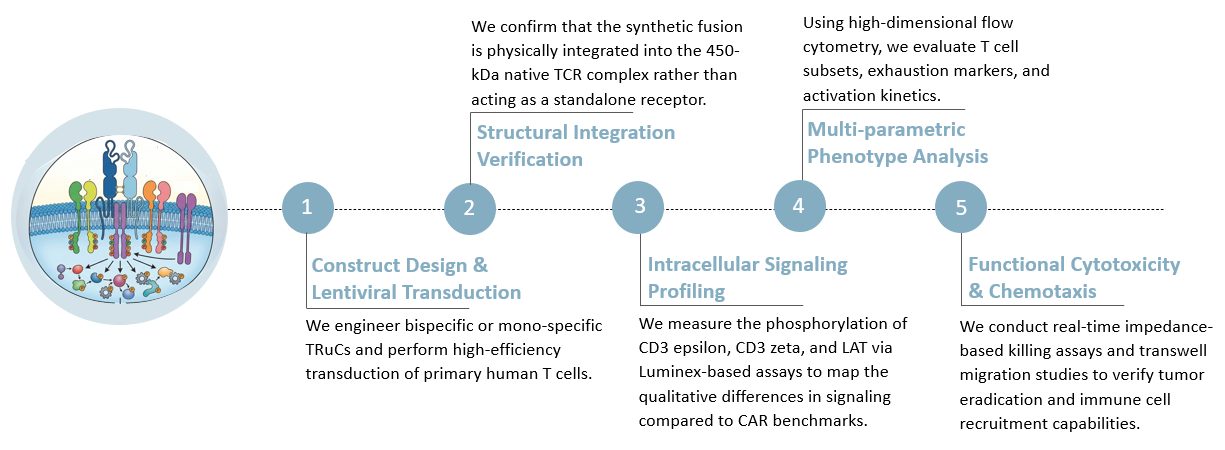
Final Deliverables: Clients receive a Molecular Integration Report (verifying subunit stoichiometry), a Functional Potency Profile (cytokine release and lysis kinetics), and a raw data package including all flow cytometry and Western blot imaging files.
Q1: How does TRuC integration differ from standard CAR-T signaling?
A1: TRuCs integrate into the entire TCR/CD3 complex, utilizing all ten ITAMs across six subunits, whereas CARs rely solely on an isolated CD3 zeta chain and a single co-stimulatory domain. This leads to more regulated, sustained signaling.
Q2: What is the primary safety advantage of the TRuC platform?
A2: The primary advantage is the significant reduction in pro-inflammatory cytokine release during tumor lysis, which may substantially lower the risk of Cytokine Release Syndrome (CRS) in clinical settings.
Q3: Is this service applicable to solid tumor targets?
A3: We have successfully designed TRuCs for targets, demonstrating that TRuCs often outperform CAR-T cells in penetrating and surviving within solid tumor microenvironments.
Q4: Do TRuC-T cells require exogenous co-stimulation like IL-2?
A4: While TRuCs can function via the native TCR, we often recommend our "armored" variants that co-secrete IL-7 and CCL21 to enhance survival and recruit endogenous immune cells.
Creative Biolabs brings over two decades of expertise in therapeutic protein engineering to support the development of advanced TRuC-T cell therapies. We provide an integrated platform covering construct design, TCR/CD3 integration analysis, and high-dimensional phenotypic characterization to ensure optimized receptor performance. Our team specializes in subunit pairing optimization, including stable configurations, to improve receptor surface expression and signaling efficiency. In addition, we offer customizable "armored" TRuC strategies incorporating cytokine or chemokine support modules to enhance T cell expansion, persistence, and tumor infiltration. For detailed project discussions and customized quotations, feel free to contact us.
For any technical issues or product/service related questions, please leave your information below. Our team will contact you soon.
All products and services are For Research Use Only and CANNOT be used in the treatment or diagnosis of disease.
 NEWSLETTER
The latest newsletter to introduce the latest breaking information, our site updates, field and other scientific news, important events, and insights from industry leaders
LEARN MORE NEWSLETTER NEW SOLUTION
CellRapeutics™ In Vivo Cell Engineering: One-stop in vivo T/B/NK cell and macrophage engineering services covering vectors construction to function verification.
LEARN MORE SOLUTION NOVEL TECHNOLOGY
Silence™ CAR-T Cell: A novel platform to enhance CAR-T cell immunotherapy by combining RNAi technology to suppress genes that may impede CAR functionality.
LEARN MORE NOVEL TECHNOLOGY NEW SOLUTION
Canine CAR-T Therapy Development: From early target discovery, CAR design and construction, cell culture, and transfection, to in vitro and in vivo function validation.
LEARN MORE SOLUTION