Creative Biolabs has a tradition of commitment. To achieve efficient execution and regulatory approval, we offer careful considerations of your program for the development of a cellular or gene therapy product – now and in the future.
EXPLORE MORE HighlightsWe focus on unmet needs and develop novel cellular and gene drugs and solutions that offer significant benefits over existing options.
EXPLORE MORE HighlightsThe advent of Chimeric Antigen Receptor T-cell (CAR-T) therapies has revolutionized the field of oncology, providing new avenues for treating various forms of cancer. Our 20 years of experience in the biotechnology sector have equipped us with the expertise and technological capabilities to support the entire lifecycle of CAR-T products, from early development to commercialization.
EXPLORE MORETo accelerate advanced breakthroughs of your projects, we offer broad range of platforms which enable our clients be free to tackle problems with cutting-edge technologies from different angles and in different methods.
EXPLORE MORE HighlightsUse the resources in our library to help you understand your options and make critical decisions for your study. We offer oncolytic virus, CAR-T, and dendritic cell related documents, as well as newsletter. If you don't find the answers you're looking for, contact us for additional assistance.
EXPLORE MORE HighlightsGet a real taste and understanding of the business and culture of one of the world's great research-based cellular and gene therapy discovery and development companies.
EXPLORE MORE
Despite the transformative potential of CAR therapies, clinical success is often hindered by the inability to reliably detect residual malignant cells at extremely low abundance, leading to delayed intervention and ambiguous prognostic stratification. To address this critical gap, we offer ultra-sensitive minimal residual disease (MRD) evaluation services specifically designed for CAR-T and CAR-NK cell therapy programs. Our service integrates high-parameter flow cytometry and next-generation sequencing with custom-designed CAR-targeted molecular barcodes, enabling quantification down to individual cell levels.
CAR-T cell therapy has revolutionized the treatment of hematological malignancies by harnessing engineered T cells to selectively eliminate tumor cells, yet achieving durable remission remains a formidable challenge for a substantial proportion of patients. Minimal residual disease (MRD), defined as the persistence of submicroscopic malignant cells below conventional detection thresholds, has emerged as the most reliable prognostic biomarker, with sustained MRD negativity strongly correlating with prolonged progression-free and overall survival across multiple disease contexts. The precise and ultrasensitive evaluation of MRD following CAR-T infusion is therefore of paramount clinical importance, as it enables early risk stratification, facilitates timely therapeutic intervention, and provides a dynamic molecular compass for guiding personalized treatment decisions to preempt overt relapse
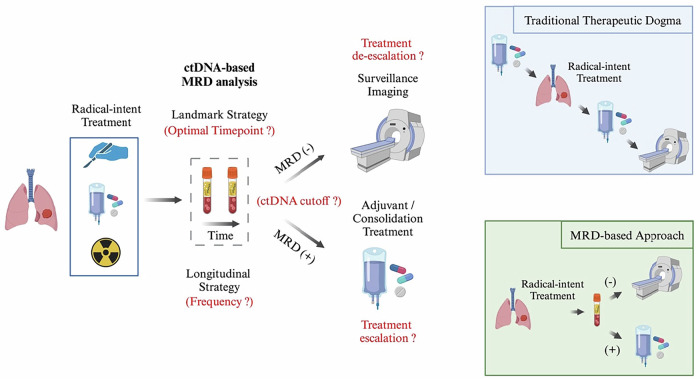 Fig.1 An operational framework that utilizes MRD to direct the treatment of early-stage NSCLC. 1
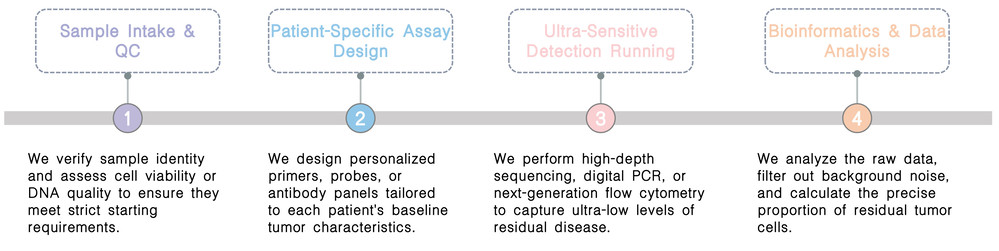
Our Ultra-Sensitive MRD Evaluation Service for CAR Therapy leverages next-generation sequencing and digital PCR to detect trace cancer cells at high sensitivity level. By precisely tracking therapeutic efficacy, clonal evolution, and disease recurrence, we provide high-resolution kinetic reports and robust raw data to accelerate cellular therapy development and optimize patient management.
We offer advanced MRD evaluation tailored for CAR‑T cell therapies, leveraging high‑sensitivity assays to detect residual malignant cells well below conventional thresholds. Our platform enables precise risk stratification, early relapse prediction, and longitudinal treatment response monitoring, empowering actionable data to optimize patient management and therapeutic outcomes.
Our signature NGS‑Based Companion Ultra‑Sensitive MRD Tracking service integrates next‑generation sequencing with proprietary error‑suppression algorithms to track clonal rearrangements and CAR‑engineered cells simultaneously. This dual‑readout approach delivers unparalleled sensitivity and specificity, distinguishing true residual disease from bystander signals, while providing a dynamic molecular compass for real‑time intervention decisions throughout the CAR‑T treatment continuum.
Q1: What types of starting materials are required for the assay?
A1: We accept bone marrow aspirates, peripheral blood, cryopreserved PBMCs, or extracted genomic DNA. For personalized assay design, a baseline/diagnostic tumor sample or predefined genetic marker data is highly recommended.
Q2: Can this service track CAR-T cell persistence and MRD simultaneously?
A2: Yes. We offer co-testing options that simultaneously monitor CAR-T transgene copy numbers or cell frequencies alongside MRD tracking, providing a comprehensive kinetic correlation to evaluate CAR-T cellular kinetics and anti-tumor efficacy.
We combine individual cell detection sensitivity with CAR‑tailored assay design, delivering earlier relapse alerts than conventional methods. Our standardized workflows ensure rapid turnaround, while flexible customization accommodates both common and novel targets. Backed by dedicated scientific support, we provide actionable data that empowers precise clinical decisions, transforming MRD monitoring from a passive readout into a proactive therapeutic guide.
"We chose this service for its ability to simultaneously track CAR-T persistence and MRD kinetics. The comprehensive analytical reports and clean, regulatory-compliant raw data seamlessly integrated into our IND submission package, saving us weeks of documentation time." M* V*, PhD.
"For our complex lymphoma study, standard MRD assays were insufficient. The team’s ability to design custom, patient-specific NGS primers based on baseline diagnostic data gave us the precise tracking we needed to map out clonal evolution post-infusion." Prof. S* J*.
Our scientific team is ready to discuss your specific CAR therapy project, from early‑phase development to post‑infusion monitoring. Whether you need assay customization, technical consultation, or a tailored pricing plan, we invite you to reach out through our website or dedicated inquiry portal. Tell us your target, your sample type, and your sensitivity requirements – we will respond with a feasibility assessment and a preliminary proposal.
Reference
For any technical issues or product/service related questions, please leave your information below. Our team will contact you soon.
All products and services are For Research Use Only and CANNOT be used in the treatment or diagnosis of disease.
 NEWSLETTER
The latest newsletter to introduce the latest breaking information, our site updates, field and other scientific news, important events, and insights from industry leaders
LEARN MORE NEWSLETTER NEW SOLUTION
CellRapeutics™ In Vivo Cell Engineering: One-stop in vivo T/B/NK cell and macrophage engineering services covering vectors construction to function verification.
LEARN MORE SOLUTION NOVEL TECHNOLOGY
Silence™ CAR-T Cell: A novel platform to enhance CAR-T cell immunotherapy by combining RNAi technology to suppress genes that may impede CAR functionality.
LEARN MORE NOVEL TECHNOLOGY NEW SOLUTION
Canine CAR-T Therapy Development: From early target discovery, CAR design and construction, cell culture, and transfection, to in vitro and in vivo function validation.
LEARN MORE SOLUTION









