
Scientific Rationale: Why SLPs are the Gold Standard for Neoantigen Research
Mandatory Processing: A Guard Against Immune Tolerance
Synthetic Long Peptides (SLPs), typically comprising 25–35 amino acids, have emerged as a critical technology in neoantigen vaccine development. Unlike short peptides (8–11 aa) that can bind directly to MHC Class I molecules on any cell type—including those lacking co-stimulatory signals—SLPs are too long to bind directly. They require active internalization and processing by professional Antigen-Presenting Cells (APCs), particularly Dendritic Cells (DCs). This intracellular processing ensures that T-cell activation occurs exclusively in a "licensing" context, significantly reducing the risk of peripheral tolerance or immune anergy.
Synergizing CD4+ and CD8+ Immune Responses through Multi-Epitope Display
An effective anti-tumor response necessitates a dual-pronged attack. SLPs are strategically designed to encompass the target mutation along with optimal flanking sequences, allowing them to carry multiple MHC Class I and Class II epitopes simultaneously. This unique architecture facilitates the recruitment of CD4+ T-helper cells, which provide the essential cytokines and "help" signals (such as IL-2 and CD40L) required for the robust expansion and sustained activity of CD8+ cytotoxic T lymphocytes. This synergy is a prerequisite for overcoming the immunosuppressive tumor microenvironment and generating durable memory cell formation in in vivo models.
Overcoming the Technical Bottlenecks of Peptide Research
Personalized neoantigen research is often hindered by the physical properties of mutational sequences. Somatic mutations frequently result in highly hydrophobic peptide cores that are prone to aggregation and rapid enzymatic degradation. Our solution focuses on "Intelligent SLP Engineering," which optimizes sequence solubility while ensuring the strategic placement of cathepsin-sensitive cleavage sites. This ensures that the minimal epitope is efficiently liberated within the phagolysosome, maximizing the density of antigen presentation on the cell surface.
Core Preclinical Services for SLP Development
We provide a comprehensive preclinical path that systematically addresses the fundamental challenges of personalized immunotherapy.
1. Multi-Omics Neoantigen Identification & Prioritization
We provide a high-precision discovery service that converts raw NGS data into a prioritized list of actionable neoepitopes. By integrating Whole Exome Sequencing (WES) and Transcriptome Sequencing (RNA-seq), we filter out silent mutations and focus only on expressed nonsynonymous variants (SNVs and Indels). Our pipeline evaluates not just the binding affinity, but also the stability of the peptide-MHC complex, ensuring that selected candidates have the highest probability of triggering a T-cell response.
Key Techniques
- Precision WES & RNA-seq discovery
- HLA-A/B/C and DRB1 allele typing
- Stability-based ranking algorithms
Our multi-parameter filters prioritize "stable" complexes over mere "binding" affinity, significantly reducing the downstream synthesis of non-immunogenic peptides.
2. Intelligent SLP Engineering & Precision Synthesis
We specialize in the design and custom synthesis of long peptides (25–35aa) that are often considered "undruggable" due to hydrophobicity. Our engineering team incorporates specialized linkers (e.g., AAY, GGS) and optimizes flanking sequences to improve solubility and stability. Every peptide undergoes rigorous HPLC and Mass Spectrometry validation to ensure research-grade purity (>98%) and the removal of truncated species that could interfere with immunological assays.
Key Techniques
- Solid-Phase Peptide Synthesis (SPPS)
- HPLC Purified & MS-verified batches
- Solubility & Stability Profiling
Proprietary sequence modifications and buffer optimization ensure that even the most hydrophobic neoantigens remain stable for in vivo administration.
3. Advanced Adjuvant Screening & Nano-Formulation
The effectiveness of an SLP is amplified by its delivery system. we offer a library of TLR agonists (e.g., Poly:IC, TLR7/8) and advanced encapsulation technologies (such as LNPs or liposomes) to enhance lymphatic targeting. Our formulations are designed to protect the SLP from extracellular proteases while promoting rapid accumulation in draining lymph nodes, where primary immune priming occurs.
Key Techniques
- Particle size & Zeta-potential analysis
- LNP Encapsulation Efficiency (EE%)
- Adjuvant-SLP synergistic screening
Our lymphatic-targeted delivery matrices ensure that the SLP dose is concentrated within the APC-rich nodes rather than being lost to systemic circulation.
4. In Vitro & In Vivo Potency Validation
We provide a full suite of functional assays to confirm the vaccine's potency. In vitro, we measure DC maturation and T-cell activation using autologous PBMC models. In vivo, we utilize syngeneic models (e.g., CT26) or humanized mice to track tumor volume inhibition and analyze tumor-infiltrating lymphocytes (TILs). Our data provides the definitive proof-of-concept required for advancing a candidate to the next stage of development.
Key Techniques
- IFN-γ ELISpot & Flow Cytometry
- TIL Infiltration Profiling (FACS)
- Tumor Growth Inhibition (TGI) Analysis
Our sophisticated humanized immune models and multi-color FACS panels provide deep mechanistic insights that traditional rodent models lack.
Integrated Workflow for SLP Vaccine Research
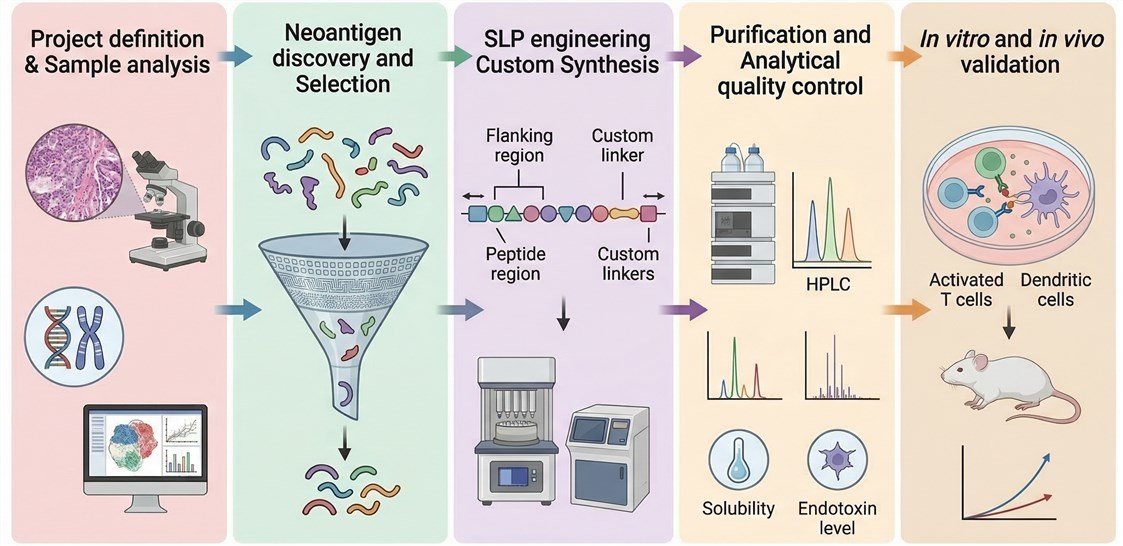
Step 1 — Project Definition & Sample Profiling
Establishing tumor sample context, HLA-allele profiling, and available genomic data analysis to align research objectives.
Preclinical SLP Biotechnology Platforms
Deep-Learning Neoepitope Ranking System
Integrating multi-dimensional data including peptide-MHC stability (half-life), TAP transport probability, and TCR accessibility scores to minimize preclinical failure rates.
Precision Proteolytic Linker Engineering
Customized design of SLPs that are highly sensitive to DC-specific proteases (e.g., Cathepsin S). Ensuring rapid and efficient epitope release to maximize presentation density.
Lymphatic-Targeted Delivery Matrix
Novel delivery platforms designed to shield SLPs from systemic degradation while promoting accumulation in draining lymph nodes for optimal APC interaction.
Research Insight: SLP Neoantigen Success in Aggressive Cancers
Therapeutic Potential in Hepatocellular Carcinoma (HCC)
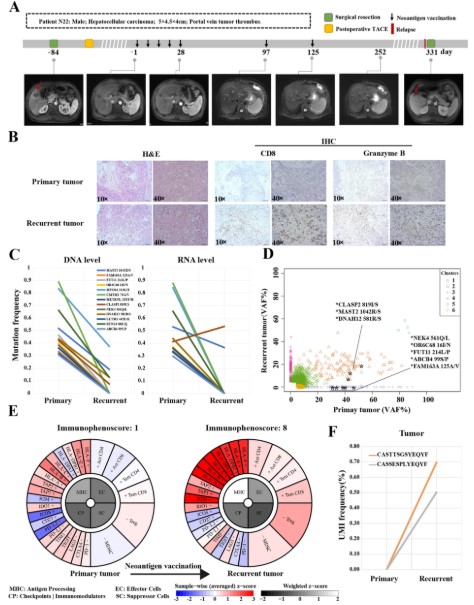
In a study focusing on HCC patients with vascular invasion (Cai et al., 2021), personalized neoantigen long peptide vaccines (27-mer) were evaluated as a prophylactic strategy to prevent postoperative recurrence. The results highlighted the clinical feasibility and potent immunogenicity of the SLP platform.
-
ctDNA for MRD Monitoring: Tracking neoantigen mutations in Circulating Tumor DNA (ctDNA) allowed for real-time evaluation of clinical response, providing a sensitive window into minimal residual disease (MRD) dynamics.
-
T-Cell Infiltration: Post-vaccination recurrent tumors showed increased infiltration of CD8+ T cells and granzyme B secretion, indicating the vaccine's ability to turn "cold" tumors "hot."
-
Survival Outcomes: Patients with robust neoantigen-induced specific IFN-γ responses demonstrated significantly longer Recurrence-Free Survival (RFS) compared to controls.