Preclinical IL-2-Secreting Tumor Cell Vaccine (TCV) Development Solution
Creative Biolabs offers a specialized, integrated platform for the development of IL-2-secreting tumor cell vaccines. By genetically engineering autologous or allogeneic tumor cells to continuously secrete Interleukin-2 (IL-2), we transform "silent" tumor cells into potent immune stimulators. Our preclinical solution bridges the gap between basic cell engineering and IND-enabling studies, providing a comprehensive data package that ensures your vaccine candidate is optimized for potency, safety, and stability.
Strategic Rationale: Why IL-2-Secreting Cell Carriers?
Bypassing Systemic Cytokine Toxicity
Standard high-dose systemic IL-2 therapy is often limited by severe vascular leak syndrome. Our IL-2-secreting TCV approach converts the vaccine injection site into a "bio-factory," delivering IL-2 locally where it is needed most—to the antigen-presenting cells (APCs) and tumor-specific T cells recruited to the vaccine site.
- Core Preclinical Challenges We Solve:
- Optimizing IL-2 secretion levels to prevent immune exhaustion.
- Ensuring complete proliferation arrest via precise irradiation protocols.
- Establishing in vitro potency assays that correlate with in vivo efficacy.
Comparative Edge: Engineered IL-2 Secreting vs. Conventional TCV
| Parameter | Conventional TCV (Irradiated Only) | IL-2-Secreting TCV Solution |
|---|---|---|
| Adjuvant Mechanism | Relies on endogenous cytokines or external adjuvants. | Integrated IL-2 "Local Adjuvant" effect. |
| T-cell Proliferation | Passive, often insufficient in "cold" tumors. | Direct stimulation of effector T and NK cells. |
| Systemic Toxicity | Low, but often lacks potency. | Ultra-low (localized secretion) with high potency. |
| Preclinical Data Requirements | Simple antigen profiling. | Complex "Potency Matrix" (Secretory + Functional). |
Comprehensive Preclinical Service Modules
Cell Engineering & IL-2 Transduction
Developing stable secretory lineages with high fidelity.
- IL-2 expression cassette design & vector construction (Retro/Lenti/Adeno).
- Non-viral transduction (Electroporation/Liposome) for transient expressions.
- Stable cell line screening and copy number variations (CNV) assessment.
- Characterization of tumor-associated antigen (TAA) retention after modification.
Irradiation & Inactivation Validation
The critical balance between safety and immunogenicity.
- Dose-response curve mapping (γ-ray or X-ray irradiators).
- Inactivation confirmation via clonogenic assays and proliferation monitoring.
- Post-irradiation IL-2 secretion window assessment (Time-course ELISA).
- Membrane integrity and metabolic activity (MTT/XTT) preservation studies.
Analytical & Potency Matrix
Defining "Biological Activity" through a multi-assay approach.
- IL-2 quantification (high-sensitivity ELISA/MSD) per 10^6 cells/24h.
- Biological activity assay (CTLL-2 cell proliferation or STAT5 phosphorylation).
- Identity & Purity: STR profiling, surface marker (FACS) validation.
- Stability testing: Thaw-and-inject windows and long-term cryopreservation data.
In Vivo & In Vitro Immunology
Proof-of-Concept (PoC) in specialized animal models.
- In vitro: DC phagocytosis, PBMC co-culture, and CTL killing assays.
- In vivo: Syngeneic mouse tumor models and humanized mouse models.
- Immune profiling: TIL analysis (CD8/Treg ratio), cytokine storm monitoring.
- Mechanistic pathology: IHC/IF for immune infiltration and tumor regression.
Standard Development Pipeline for IL-2-Secreting TCV
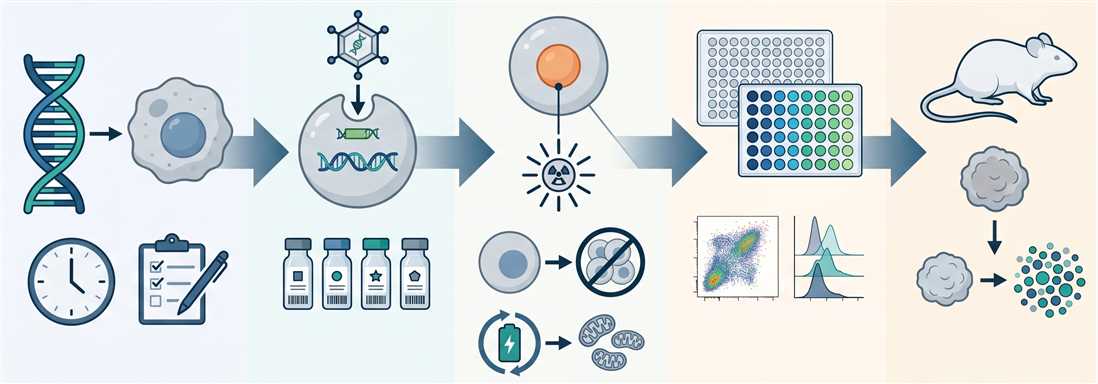
Phase 1 — Project Feasibility & TPP Definition
Selection of autologous or allogeneic strategies based on indication. We define Target Product Profiles (TPP) including secretion goals, residual activity limits, and release criteria.
Unique Technology Platforms for IL-2 TCV
Why Creative Biolabs?
Deep understanding of cytokine kinetics ensures IL-2 is a driver of immunity, not a trigger for systemic inflammation.
All data—from cell engineering to toxicology—is compiled in a format ready for preclinical regulatory submissions.
Proprietary inactivation validation that guarantees 100% proliferation arrest without compromising secretory potency.
Full support for both autologous primary cells and allogeneic "off-the-shelf" tumor cell lines.
Research Insight: Local IL-2 Secretion vs. Systemic Administration
Mechanistic Remodeling of the Tumor Microenvironment (TME)
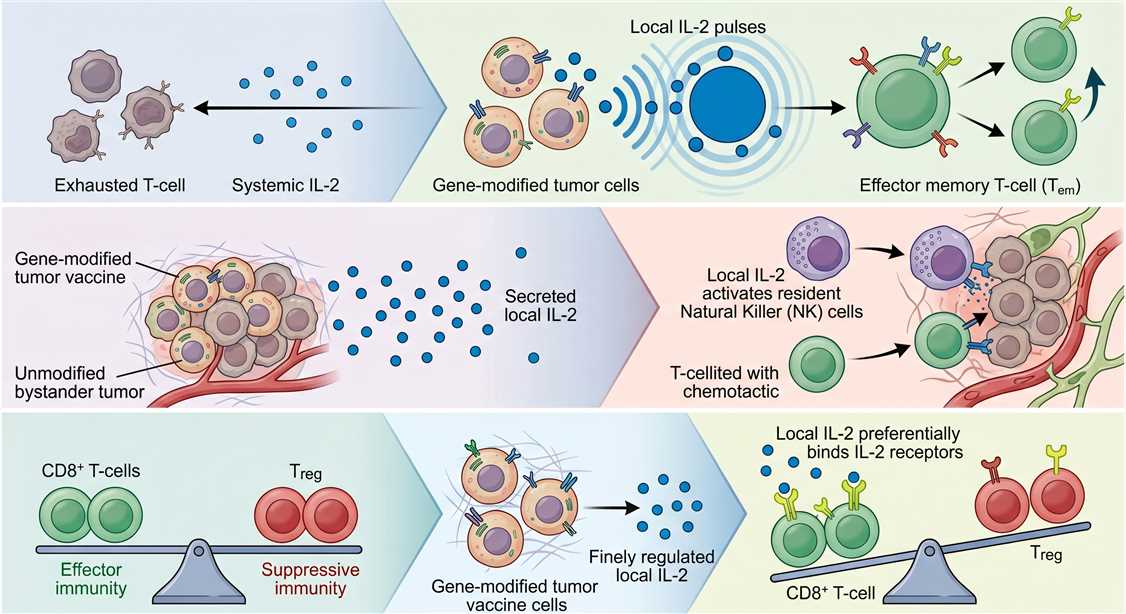
The "paracrine" delivery of IL-2 by genetically modified tumor cells represents a paradigm shift in cancer vaccination. Unlike systemic IL-2, which is diluted in circulation and causes high toxicity, IL-2-secreting TCVs achieve several unique endpoints:
-
T-cell Exhaustion Reversal: Localized IL-2 pulses can reinvigorate exhausted T cells and promote the differentiation of effector memory T cells (Tem).
-
Recruitment of Bystander Effect: Secreted IL-2 activates resident NK cells and recruits circulating T cells to the tumor site, creating a sustained immune response even against cells not directly targeted by the vaccine antigens.
-
Optimal CD8/Treg Balance: By fine-tuning secretion levels, our platform prioritizes the activation of high-affinity IL-2 receptors on CD8+ T cells over the high-basal receptors on Treg cells.