Creative Biolabs has a tradition of commitment. To achieve efficient execution and regulatory approval, we offer careful considerations of your program for the development of a cellular or gene therapy product – now and in the future.
EXPLORE MORE HighlightsWe focus on unmet needs and develop novel cellular and gene drugs and solutions that offer significant benefits over existing options.
EXPLORE MORE HighlightsThe advent of Chimeric Antigen Receptor T-cell (CAR-T) therapies has revolutionized the field of oncology, providing new avenues for treating various forms of cancer. Our 20 years of experience in the biotechnology sector have equipped us with the expertise and technological capabilities to support the entire lifecycle of CAR-T products, from early development to commercialization.
EXPLORE MORETo accelerate advanced breakthroughs of your projects, we offer broad range of platforms which enable our clients be free to tackle problems with cutting-edge technologies from different angles and in different methods.
EXPLORE MORE HighlightsUse the resources in our library to help you understand your options and make critical decisions for your study. We offer oncolytic virus, CAR-T, and dendritic cell related documents, as well as newsletter. If you don't find the answers you're looking for, contact us for additional assistance.
EXPLORE MORE HighlightsGet a real taste and understanding of the business and culture of one of the world's great research-based cellular and gene therapy discovery and development companies.
EXPLORE MORE
Creative Biolabs provides a Comparative Cytokine Release Profiling Service to support accurate safety and potency evaluation in cell therapy development. This service addresses challenges such as inconsistent immune activation data, difficulty in comparing CAR construct performance, and uncertainty surrounding cytokine-related safety risks during preclinical studies. Through advanced multiplex immunoassays, standardized co-culture systems, and quantitative cytokine analysis platforms, Creative Biolabs enables reliable cytokine response profiling and comprehensive assessment of immune effector functionality, facilitating informed candidate selection and optimized immunotherapy development.
Cytokine release profiling has become an important analytical strategy for evaluating immune activation and inflammatory potential in engineered cell therapies. Activated immune cells produce distinct cytokine patterns, including interferons, interleukins, and chemokines, which reflect functional potency and immune regulation. Comparative profiling of these cytokine signatures enables researchers to differentiate immune responses among cell products, assess safety risks associated with excessive inflammatory signaling, and guide optimization of cell therapy constructs during preclinical development.
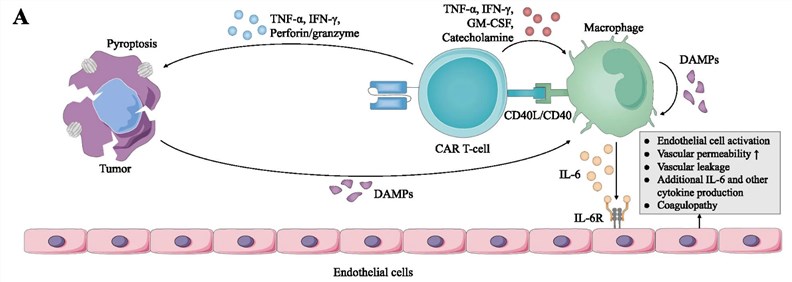 Fig.1 The Underlying Mechanisms Involved in Cytokine Release Syndrome.1
Creative Biolabs offers a comprehensive solution for sponsors developing CAR-T, TCR-T, or multispecific antibodies who must quantify inflammatory potential before human injection. Our service provides a head-to-head comparison of your lead candidates against negative controls and reference compounds known to induce varying levels of cytokine release. We don't just provide raw data; we provide a biological context that identifies potential vicious cycles of macrophage activation and systemic inflammation.
Our key project support includes quantitative cytokine response analysis, which measures multiple cytokine secretions after antigen stimulation to assess immune activation and engineered cell function. It enables comparative evaluation of CAR constructs and costimulatory domains, supports preclinical safety assessment by profiling inflammatory cytokines, and provides multiparametric immune profiling to reveal immune signaling dynamics for cell therapy development.
Discover How We Can Help - Request a Consultation.
Creative Biolabs integrates multiple analytical technologies to support comprehensive cytokine profiling and comparative immune response analysis.
| Multiplex Cytokine Detection Platforms | Immune Cell Functional Co-Culture Systems |
| Multiplex Cytokine Detection Platforms enable high-throughput, simultaneous quantification of multiple cytokines in one sample, sensitively detecting inflammatory and regulatory immune mediators. | Immune Cell Functional Co‑culture Systems assess engineered immune cell cytokine responses against antigen‑positive target cells under standardized, reproducible conditions. |
| Quantitative Immunoassay Technologies | High-Content Data Analysis |
| Quantitative Immunoassay Technologies enable accurate, wide‑range cytokine measurement to detect early and robust immune activation. | High‑Content Data Analysis uses bioinformatics to visualize and compare immune activation profiles across constructs, donors, and experimental groups. |
To initiate the service, clients typically provide required starting materials, including purified antibodies, viral vectors, or engineered T‑cells, reference benchmarks for comparison, and target specifications such as specific cell lines or donor requirements.
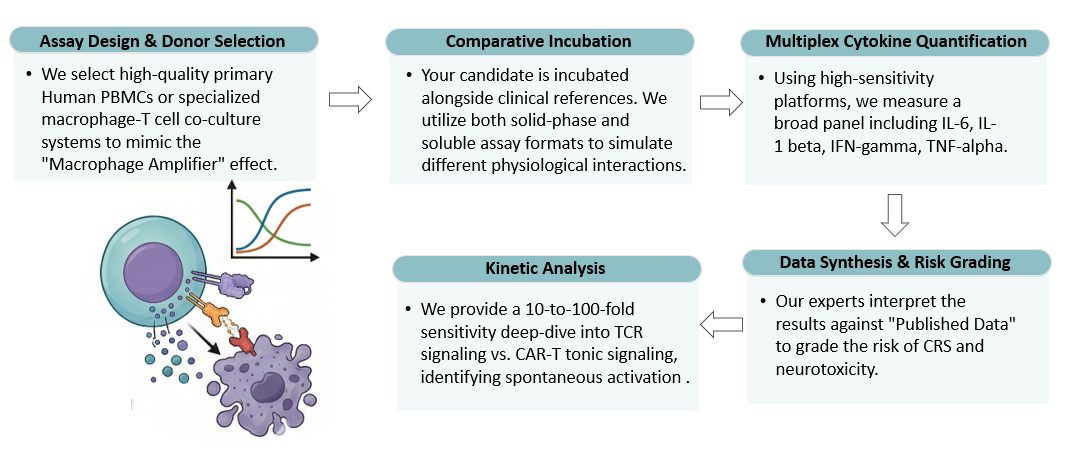
Final deliverables include a comprehensive safety report, comparative benchmark analysis against approved references, and statistical validation data with P-values and EC50 / IC50 curves.
Q: How does this service differentiate between normal T-cell activation and CRS-inducing events?
A: We monitor the decoupling of lytic factors (perforin/granzyme) from inflammatory cytokines. This allows us to identify candidates that maintain high cytotoxicity while minimizing the systemic "vicious cycle" that leads to CRS.
Q: Can you perform comparative profiling for solid tumor targets?
A: Yes. We have optimized co-culture systems for solid tumor markers, ensuring that the profiling accounts for the unique immunosuppressive environments of solid malignancies.
Q: What is the benefit of using TRuC-T cells as a benchmark in my study?
A: TRuC-T cells engage the entire TCR complex, providing a more physiological response with lower cytokine release compared to second-generation CARs. Using them as a benchmark helps you set a "gold standard" for safety in your pipeline.
Q: Do you offer specific markers for neurotoxicity (ICANS) prediction?
A: Beyond systemic cytokines, we can measure markers associated with BBB disruption and vascular endothelium activation to provide a more comprehensive ICANS risk profile.
Creative Biolabs provides a high-resolution window into the safety profile of your therapeutic candidates. By leveraging our Comparative Cytokine Release Profiling Service, you can ensure that your immunotherapy project is built on a foundation of rigorous, benchmarked safety data, effectively mitigating the risks of CRS and ICANS before they reach the clinic. Ready to discuss your project? Our team of immunology specialists is standing by to help you design the perfect safety assessment strategy. Contact Our Team for More Information and to Discuss Your Project.
Reference
For any technical issues or product/service related questions, please leave your information below. Our team will contact you soon.
All products and services are For Research Use Only and CANNOT be used in the treatment or diagnosis of disease.
 NEWSLETTER
The latest newsletter to introduce the latest breaking information, our site updates, field and other scientific news, important events, and insights from industry leaders
LEARN MORE NEWSLETTER NEW SOLUTION
CellRapeutics™ In Vivo Cell Engineering: One-stop in vivo T/B/NK cell and macrophage engineering services covering vectors construction to function verification.
LEARN MORE SOLUTION NOVEL TECHNOLOGY
Silence™ CAR-T Cell: A novel platform to enhance CAR-T cell immunotherapy by combining RNAi technology to suppress genes that may impede CAR functionality.
LEARN MORE NOVEL TECHNOLOGY NEW SOLUTION
Canine CAR-T Therapy Development: From early target discovery, CAR design and construction, cell culture, and transfection, to in vitro and in vivo function validation.
LEARN MORE SOLUTION