Creative Biolabs has a tradition of commitment. To achieve efficient execution and regulatory approval, we offer careful considerations of your program for the development of a cellular or gene therapy product – now and in the future.
EXPLORE MORE HighlightsWe focus on unmet needs and develop novel cellular and gene drugs and solutions that offer significant benefits over existing options.
EXPLORE MORE HighlightsThe advent of Chimeric Antigen Receptor T-cell (CAR-T) therapies has revolutionized the field of oncology, providing new avenues for treating various forms of cancer. Our 20 years of experience in the biotechnology sector have equipped us with the expertise and technological capabilities to support the entire lifecycle of CAR-T products, from early development to commercialization.
EXPLORE MORETo accelerate advanced breakthroughs of your projects, we offer broad range of platforms which enable our clients be free to tackle problems with cutting-edge technologies from different angles and in different methods.
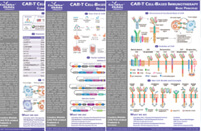
EXPLORE MORE HighlightsUse the resources in our library to help you understand your options and make critical decisions for your study. We offer oncolytic virus, CAR-T, and dendritic cell related documents, as well as newsletter. If you don't find the answers you're looking for, contact us for additional assistance.
EXPLORE MORE HighlightsGet a real taste and understanding of the business and culture of one of the world's great research-based cellular and gene therapy discovery and development companies.
EXPLORE MORE
Creative Biolabs provides HLA-Independence & Potency Functional Analysis Services to address challenges in T-cell therapy development, including tumor antigen escape, limited T-cell persistence, and the MHC-restriction constraints associated with conventional TCR-T approaches. These services support the development of universal, off-the-shelf T-cell therapeutics through optimized T cell receptor fusion construct (TRuC) engineering and comprehensive cytokine profiling. By delivering robust functional validation and potency characterization, Creative Biolabs enables reliable candidate evaluation and supports the confident transition of next-generation immunotherapy programs from laboratory discovery to clinical development.
Current immunotherapy is often limited by MHC restriction and the phenomenon of antigen escape. Recent literature indicates that TRuCs effectively reprogram the intact TCR complex to recognize tumor surface antigens in an HLA-independent manner. Unlike traditional CARs, TRuCs become functional components of the TCR, utilizing physiological signaling to achieve potent anti-tumor activity with significantly lower cytokine release. Published research demonstrates that optimizing subunit pairings and co-expressing cytokines like IL-7 and CCL21 robustly controls tumor recurrence.
Creative Biolabs provides a robust analytical suite designed to validate that your engineered T cells function independently of Human Leukocyte Antigen (HLA) restriction while maintaining superior lytic potency. Our service ensures that your TRuC-T or CAR-T candidates can recognize tumor surface antigens directly, bypassing the complexities of MHC presentation that often lead to immune evasion.
Our HLA Independence Verification Platforms include antigen-specific cytotoxicity assays, gene-edited tumor cell models, and co-culture systems. Our Functional Potency Evaluation Platforms support real-time killing assays, multiplex cytokine profiling, and flow cytometry analysis. Immune Cell Functional Characterization assesses proliferation, signaling, and phenotype. These complementary approaches enable multidimensional evaluation of immune therapeutic candidates.
Discover How We Can Help - Request a Consultation.
Creative Biolabs integrates multiple experimental platforms designed to characterize immune recognition mechanisms and functional efficacy while maintaining flexibility for diverse therapeutic modalities.
| HLA Independence Verification Platforms | Functional Potency Evaluation Platforms |
|
|
| Immune Cell Functional Characterization | |
|
|
Required Starting Materials:
Final Deliverables:
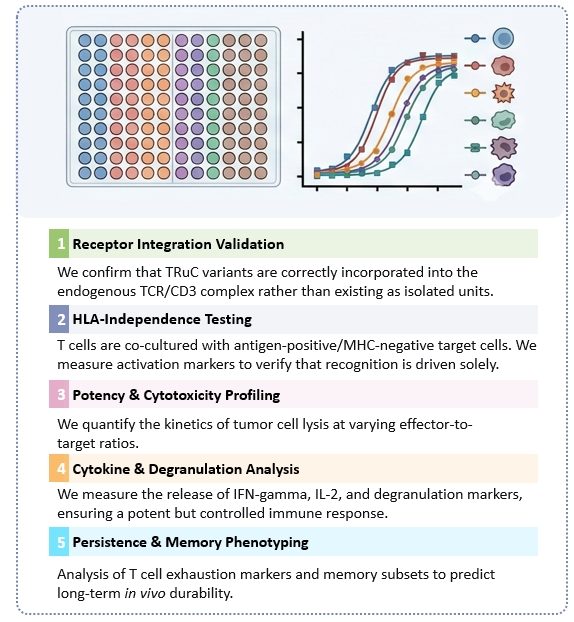
A comprehensive Technical Validation Report including real-time kill-curve data and receptor stoichiometry analysis.
Raw data files from flow cytometry.
High-resolution imaging of T cell-tumor synapses and migration assays.
We verify non-MHC-restricted tumor lysis using diverse cancer cell lines. This service quantifies the direct cytotoxic efficiency of TRuC-T cells, ensuring potent anti-tumor responses regardless of the patient's HLA haplotype.
Our multiplex assays provide detailed mapping of Th1/Th2 cytokine signatures. We compare TRuC-T profiles against standard CAR-T benchmarks to evaluate safety, activation kinetics, and the risk of cytokine release syndrome (CRS).
Q1: How do you confirm that the TRuC has actually integrated into the endogenous TCR?
A1: We visualize the native TCR complex. A successfully integrated TRuC will show a distinct shift in molecular weight (approximately 450 kDa), confirming it has become a structural part of the receptor.
Q2: Can your potency assays distinguish between different costimulatory domains?
A2: Yes. Our platform compares TRuC-mediated signaling against second-generation CARs. We provide detailed phosphorylation data for CD3 epsilon and LAT to map the exact signaling quality of your construct.
Q3: What measures are taken to ensure the HLA-independence of the receptor?
A3: We utilize MHC-deficient cell lines that still express the target antigen. If your T cells successfully lyse these targets, it provides definitive proof of HLA-independent recognition.
Q4: How do you evaluate the risk of CRS?
A4: While we do not perform clinical diagnosis, our assays measure a broad panel of pro-inflammatory cytokines. TRuC-T cells typically show a "gentler" signaling profile and lower cytokine release than CAR-T cells, which is a key safety indicator.
Creative Biolabs offers world-class HLA-Independence & Potency Functional Analysis Services, providing the scientific rigor needed to validate next-generation T cell therapies. From receptor stoichiometry to real-time cytotoxicity, we ensure your immunotherapy platform is both universal and high-performing. We offer unparalleled expertise in optimizing subunit pairings to maximize receptor stability and anti-tumor persistence. For detailed project discussions and technical inquiries, please contact us.
For any technical issues or product/service related questions, please leave your information below. Our team will contact you soon.
All products and services are For Research Use Only and CANNOT be used in the treatment or diagnosis of disease.
 NEWSLETTER
The latest newsletter to introduce the latest breaking information, our site updates, field and other scientific news, important events, and insights from industry leaders
LEARN MORE NEWSLETTER NEW SOLUTION
CellRapeutics™ In Vivo Cell Engineering: One-stop in vivo T/B/NK cell and macrophage engineering services covering vectors construction to function verification.
LEARN MORE SOLUTION NOVEL TECHNOLOGY
Silence™ CAR-T Cell: A novel platform to enhance CAR-T cell immunotherapy by combining RNAi technology to suppress genes that may impede CAR functionality.
LEARN MORE NOVEL TECHNOLOGY NEW SOLUTION
Canine CAR-T Therapy Development: From early target discovery, CAR design and construction, cell culture, and transfection, to in vitro and in vivo function validation.
LEARN MORE SOLUTION