Creative Biolabs has a tradition of commitment. To achieve efficient execution and regulatory approval, we offer careful considerations of your program for the development of a cellular or gene therapy product – now and in the future.
EXPLORE MORE HighlightsWe focus on unmet needs and develop novel cellular and gene drugs and solutions that offer significant benefits over existing options.
EXPLORE MORE HighlightsThe advent of Chimeric Antigen Receptor T-cell (CAR-T) therapies has revolutionized the field of oncology, providing new avenues for treating various forms of cancer. Our 20 years of experience in the biotechnology sector have equipped us with the expertise and technological capabilities to support the entire lifecycle of CAR-T products, from early development to commercialization.
EXPLORE MORETo accelerate advanced breakthroughs of your projects, we offer broad range of platforms which enable our clients be free to tackle problems with cutting-edge technologies from different angles and in different methods.
EXPLORE MORE HighlightsUse the resources in our library to help you understand your options and make critical decisions for your study. We offer oncolytic virus, CAR-T, and dendritic cell related documents, as well as newsletter. If you don't find the answers you're looking for, contact us for additional assistance.
EXPLORE MORE HighlightsGet a real taste and understanding of the business and culture of one of the world's great research-based cellular and gene therapy discovery and development companies.
EXPLORE MORE
Current challenges in cell therapy development include inconsistent integration efficiency, uncontrolled transgene expression, and genotoxicity risks across diverse delivery systems for CAR-T applications. Our Cross-Platform Delivery System Integration Benchmarking Services provide standardized, head‑to‑head comparisons of integration frequency across lentivirus, retrovirus, AAV, and non‑viral transposon systems. Our service delivers quantitative benchmarks and risk profiles tailored to early‑stage vector screening. By enabling rational backbone design and mitigating clonal expansion hazards, it accelerates identification of safe, high‑performance delivery platforms for CAR-T therapy.
Multiple delivery vectors including lentivirus, retrovirus, AAV, and non‑viral transposon systems are commonly used to stably integrate CAR transgenes into T cells for in vivo therapy. However, each platform presents distinct integration profiles and safety risks, such as insertional mutagenesis, clonal dominance, and genotoxicity, which must be carefully evaluated during early‑stage candidate screening.
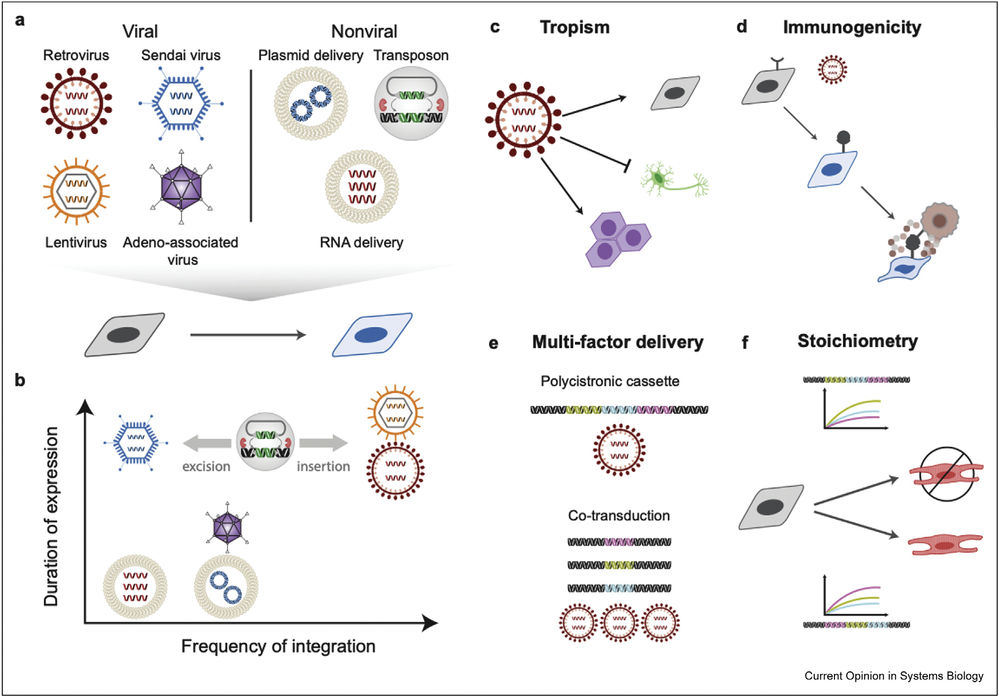 Fig.1 Gene delivery vehicles and transgene transcription.1
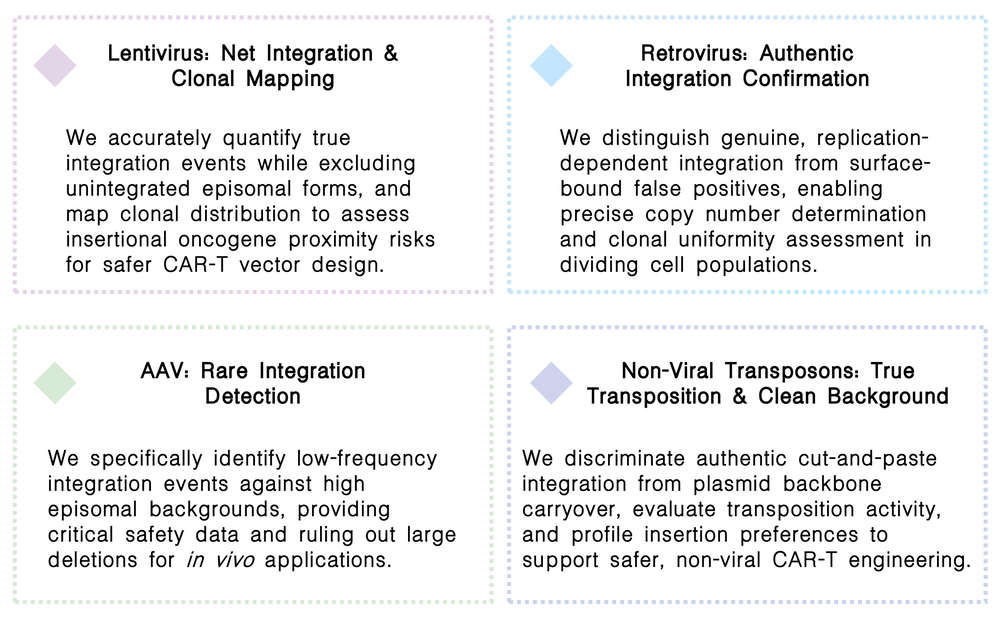
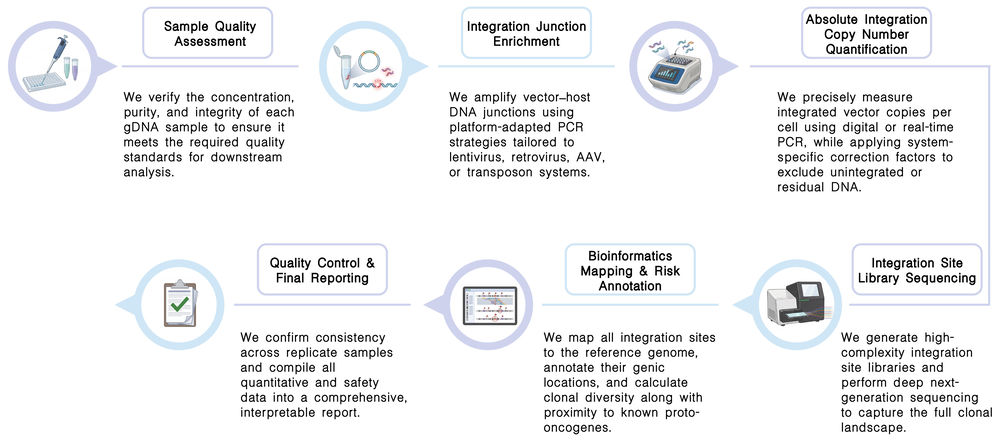
Our Cross-Platform Delivery System Integration Benchmarking Services provide standardized quantification of integration frequency, clonal distribution, and genotoxicity risk across lentivirus, retrovirus, AAV, and non‑viral transposons. This enables data‑driven vector selection for in vivo CAR‑T therapy, accelerating safe and potent candidate screening while mitigating insertional oncogenesis.
Our services deliver cross‑platform integration benchmarking, clonality, and safety risks, enabling data‑driven vector selection in CAR‑T therapy.
Q1: Which delivery systems are covered by this service?
A1: We support benchmarking for lentivirus, retrovirus, AAV, and Sleeping Beauty transposon systems. In addition, we can accommodate custom or emerging vector platforms upon request.
Q2: How do you ensure comparable results across different platforms?
A2: To enable fair cross‑platform comparisons, we apply a consistent reference gene, a shared reporter expression cassette, and standardized correction factors. This setup removes methodological biases that would otherwise compromise data alignment.
Q3: Is this service suitable for CAR‑T candidate screening?
A3: Absolutely. Our benchmarking data directly supports early‑stage candidate selection by comparing integration efficiency, clonal safety, and expression stability across delivery platforms. This enables researchers to identify the most appropriate vector for subsequent in vivo applications.
We deliver the only standardized, cross‑platform integration benchmarking for different delivery systems in in vivo CAR‑T development. Our head‑to‑head comparisons, rigorous safety profiling, and actionable vector design guidance empower you to select the safest, most efficient delivery platform with confidence.
"We relied on this benchmarking service to evaluate AAV integration frequency for our tissue-specific CAR delivery. The rare-event detection and proto-oncogene proximity mapping gave us the confidence to advance a candidate that was both efficient and clean. I highly recommend their cross-platform approach to any cell therapy group." Dr. M* C*.
"Our team was stuck between retrovirus and non-viral integrating vector for an allogeneic CAR-T project. The integration clonal mapping and Shannon diversity index provided by this service clearly showed which platform minimized insertional risk. Thanks to their actionable recommendations, we moved into in vivo proof-of-concept three months faster than planned." Dr. S* K.
"What stood out most was the unbiased head-to-head comparison across four delivery systems. The final report not only gave us copy numbers per cell but also vector design suggestions that we immediately implemented. This service turned a complex technical decision into a straightforward data-driven choice." Dr. J*.
Interested in comparing your delivery platforms for safer in vivo CAR‑T candidate selection? Contact our technical team to review your project needs, obtain a tailored quote, or arrange a one‑on‑one consultation. We're eager to help move your screening efforts forward.
Reference
For any technical issues or product/service related questions, please leave your information below. Our team will contact you soon.
All products and services are For Research Use Only and CANNOT be used in the treatment or diagnosis of disease.
 NEWSLETTER
The latest newsletter to introduce the latest breaking information, our site updates, field and other scientific news, important events, and insights from industry leaders
LEARN MORE NEWSLETTER NEW SOLUTION
CellRapeutics™ In Vivo Cell Engineering: One-stop in vivo T/B/NK cell and macrophage engineering services covering vectors construction to function verification.
LEARN MORE SOLUTION NOVEL TECHNOLOGY
Silence™ CAR-T Cell: A novel platform to enhance CAR-T cell immunotherapy by combining RNAi technology to suppress genes that may impede CAR functionality.
LEARN MORE NOVEL TECHNOLOGY NEW SOLUTION
Canine CAR-T Therapy Development: From early target discovery, CAR design and construction, cell culture, and transfection, to in vitro and in vivo function validation.
LEARN MORE SOLUTION









