Creative Biolabs has a tradition of commitment. To achieve efficient execution and regulatory approval, we offer careful considerations of your program for the development of a cellular or gene therapy product – now and in the future.
EXPLORE MORE HighlightsWe focus on unmet needs and develop novel cellular and gene drugs and solutions that offer significant benefits over existing options.
EXPLORE MORE HighlightsThe advent of Chimeric Antigen Receptor T-cell (CAR-T) therapies has revolutionized the field of oncology, providing new avenues for treating various forms of cancer. Our 20 years of experience in the biotechnology sector have equipped us with the expertise and technological capabilities to support the entire lifecycle of CAR-T products, from early development to commercialization.
EXPLORE MORETo accelerate advanced breakthroughs of your projects, we offer broad range of platforms which enable our clients be free to tackle problems with cutting-edge technologies from different angles and in different methods.
EXPLORE MORE HighlightsUse the resources in our library to help you understand your options and make critical decisions for your study. We offer oncolytic virus, CAR-T, and dendritic cell related documents, as well as newsletter. If you don't find the answers you're looking for, contact us for additional assistance.
EXPLORE MORE HighlightsGet a real taste and understanding of the business and culture of one of the world's great research-based cellular and gene therapy discovery and development companies.
EXPLORE MORE
The clinical adoption of in vivo CAR-T platforms is increasingly constrained by the latent oncogenic risk posed by integrating viral vectors, particularly the uncertain proximity of vector integration sites to known cancer-driver loci and the lack of standardized, risk-adapted thresholds for vector copy number (VCN). To address this critical safety gap, we offer a comprehensive Oncogene Proximity Profiling & VCN-Triggered Risk Escalation Service, specifically designed for in vivo CAR programs. Our service employs advanced NGS-based insertion-site mapping to precisely determine whether vector integrations cluster near high-risk genomic regions while concurrently establishing VCN-based risk escalation algorithms that correlate integration burden with clonal expansion potential. Our integrated approach empowers you to objectively stratify vector safety profiles, establish evidence-based VCN release limits, and generate robust genotoxicity data that directly support regulatory interactions.
Integrative viral vectors used in in vivo CAR therapy pose a tangible risk of insertional mutagenesis, potentially disrupting tumor suppressor genes or aberrantly activating proximal oncogenes. Vector copy number (VCN) serves as a quantitative surrogate for both transduction efficiency and integration burden, yet it remains an incomplete predictor of clonal proliferation without spatial genomic context. Therefore, simultaneous profiling of VCN and its neighboring oncogenic transcriptional landscape is imperative for early detection of transformation-prone clones, enabling proactive risk stratification and ensuring the long-term safety of autologous CAR products.
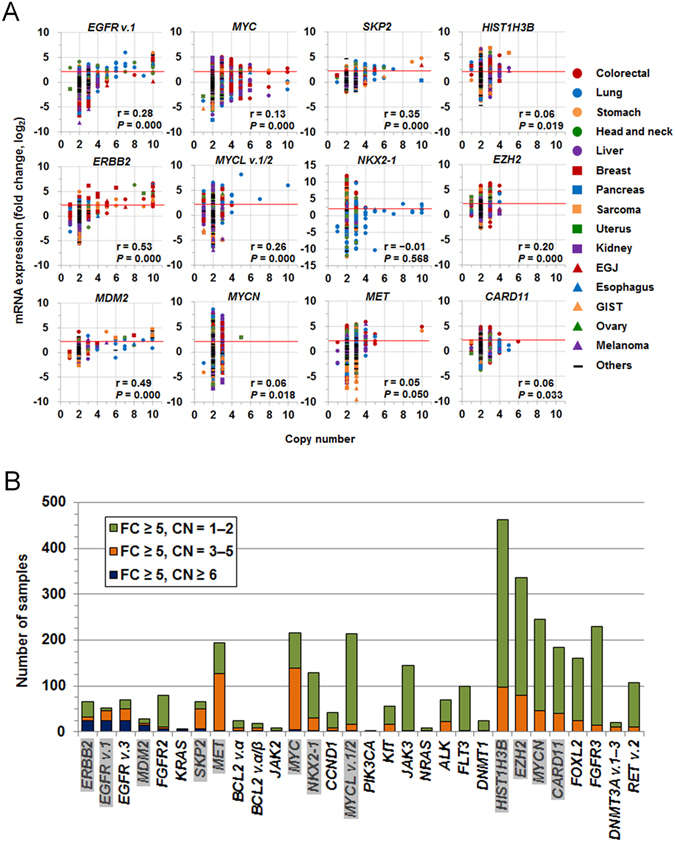 Fig.1 Expression profiles and copy-number variations of 64 oncogenes.1
Our Oncogene Proximity Profiling & VCN-Triggered Risk Escalation Service delivers dual-layer safety surveillance for in vivo CAR products. By mapping genomic insertion sites and dynamically correlating vector copy number with oncogenic pathway activation, we provide early risk stratification, enabling data-driven dose de-escalation and regulatory-grade biosafety documentation for your clinical candidates.
Our high-resolution mapping platform identifies the precise genomic integration sites of in vivo CAR vectors relative to critical oncogenes and tumor suppressor loci. By employing advanced NGS-based insertion-site analysis, we assess whether vector integrations occur within regulatory or coding regions of high-risk genes such as LMO2, MDS1/EVI1, PLAG1, or TET2, and further evaluate potential transcriptional interference caused by nearby viral enhancers or promoters. This service is essential for genotoxicity risk stratification, enabling clients to select vector candidates with favorable integration profiles and generate robust safety data that directly support regulatory filings and IND submissions.
Learn More →Our comparative benchmarking platform is designed to evaluate and rank the integration safety profiles of different in vivo delivery systems, including various lentiviral pseudotypes, non-integrating vectors, and LNP formulations, side-by-side under standardized conditions. We systematically assess each platform's integration site distribution, clonal diversity, and VCN correlation with proximity to oncogenic hotspots, providing a direct head-to-head comparison of genotoxic risk. This service is invaluable for platform selection during early development, enabling clients to make data-driven decisions on which delivery system offers the optimal balance between transduction efficiency and genomic safety prior to committing to production and preclinical toxicology studies.
Learn More →Q1: What is the significance of VCN as a safety metric, and what limits are recommended?
A1: VCN measures the average number of integrated vector copies per transduced cell and serves as an indirect proxy for insertional mutagenesis risk. Sponsors should set limits based on their specific manufacturing experience, preclinical data, and process development optimization, aiming to keep VCN as low as possible for safety while ensuring adequate transduction efficiency.
Q2: Can you perform benchmarking comparisons across different delivery platforms?
A2: Yes. Our Cross-Platform Delivery System Integration Benchmarking Service enables head-to-head safety profiling of multiple delivery systems, including various lentiviral pseudotypes, non-integrating vectors, and LNP-based formulations, under standardized conditions. We systematically compare each platform's integration site distribution, VCN correlation with oncogene proximity, and clonal diversity, allowing you to make data-driven decisions on vector platform selection.
We deliver regulatory-grade NGS integration-site profiling paired with clinically validated VCN risk algorithms, all in a unified, IND-ready platform. Our expertise spans lentiviral, transposon, and LNP delivery systems, enabling data-driven vector selection. We provide actionable safety tiers, clear regulatory justification, and accelerated timelines, helping you confidently advance safer in vivo CAR candidates.
Ready to de-risk your in vivo CAR program? Our team of cell immunology specialists is standing by to discuss your specific VCN thresholds and target antigen profiles. Let's map your oncogene proximity landscape together. Reach out today—we respond to all scientific inquiries.
Reference
For any technical issues or product/service related questions, please leave your information below. Our team will contact you soon.
All products and services are For Research Use Only and CANNOT be used in the treatment or diagnosis of disease.
 NEWSLETTER
The latest newsletter to introduce the latest breaking information, our site updates, field and other scientific news, important events, and insights from industry leaders
LEARN MORE NEWSLETTER NEW SOLUTION
CellRapeutics™ In Vivo Cell Engineering: One-stop in vivo T/B/NK cell and macrophage engineering services covering vectors construction to function verification.
LEARN MORE SOLUTION NOVEL TECHNOLOGY
Silence™ CAR-T Cell: A novel platform to enhance CAR-T cell immunotherapy by combining RNAi technology to suppress genes that may impede CAR functionality.
LEARN MORE NOVEL TECHNOLOGY NEW SOLUTION
Canine CAR-T Therapy Development: From early target discovery, CAR design and construction, cell culture, and transfection, to in vitro and in vivo function validation.
LEARN MORE SOLUTION









