Creative Biolabs has a tradition of commitment. To achieve efficient execution and regulatory approval, we offer careful considerations of your program for the development of a cellular or gene therapy product – now and in the future.
EXPLORE MORE HighlightsWe focus on unmet needs and develop novel cellular and gene drugs and solutions that offer significant benefits over existing options.
EXPLORE MORE HighlightsThe advent of Chimeric Antigen Receptor T-cell (CAR-T) therapies has revolutionized the field of oncology, providing new avenues for treating various forms of cancer. Our 20 years of experience in the biotechnology sector have equipped us with the expertise and technological capabilities to support the entire lifecycle of CAR-T products, from early development to commercialization.
EXPLORE MORETo accelerate advanced breakthroughs of your projects, we offer broad range of platforms which enable our clients be free to tackle problems with cutting-edge technologies from different angles and in different methods.
EXPLORE MORE HighlightsUse the resources in our library to help you understand your options and make critical decisions for your study. We offer oncolytic virus, CAR-T, and dendritic cell related documents, as well as newsletter. If you don't find the answers you're looking for, contact us for additional assistance.
EXPLORE MORE HighlightsGet a real taste and understanding of the business and culture of one of the world's great research-based cellular and gene therapy discovery and development companies.
EXPLORE MORE
The therapeutic efficacy of in vivo-transduced CAR-T cells is profoundly constrained by their rapid functional exhaustion and unpredictable differentiation into short-lived effector phenotypes, yet conventional analytical platforms fail to capture the dynamic fate decisions occurring within the native tissue microenvironment. Our In vivo Transduced CAR+ T-Cell Phenotypic & Differentiation Analysis is specifically designed to decode these complex biological processes. We offer a multi-parametric service that integrates high-dimensional flow cytometry, transcriptomics, and spatial tissue profiling to quantitatively map CAR+ T-cell maturation trajectories, exhaustion states, and metabolic switching directly from in vivo samples. This integrated approach empowers you with actionable, high-resolution insights into T cell persistence and lineage commitment, thereby enabling the rational design of next-generation CAR constructs and delivery strategies that favor long-lived memory differentiation over terminal effector dysfunction.
The advent of in vivo CAR-T cell therapy represents a paradigm shift from traditional ex vivo manufacturing, aiming to circumvent complex logistical hurdles by directly programming endogenous T cells within the patient's own immune ecosystem. The phenotypic quality of the resulting CAR-expressing cells is a critical determinant of therapeutic efficacy, as it profoundly influences proliferative capacity, cytotoxic function, and persistence within the tumor microenvironment. Ultimately, the differentiation state of these CAR-engineered lymphocytes, ranging from naïve/stem-cell memory phenotypes to more terminally differentiated effector subsets, governs the balance between rapid antitumor activity and long-term immunological memory, thereby shaping both immediate responses and durable remission.
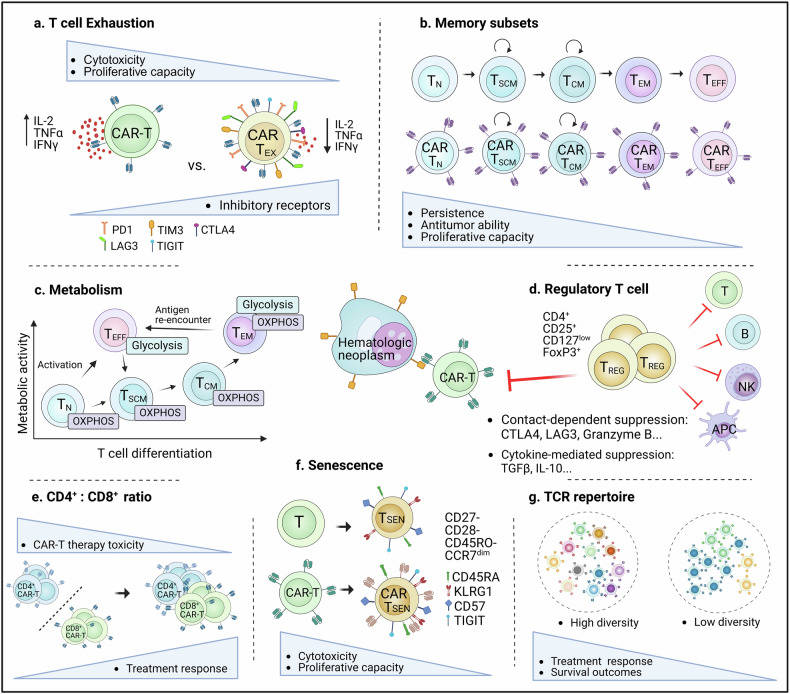 Fig.1 T cell signatures relevant to the performance of CAR-T cell treatment. 1
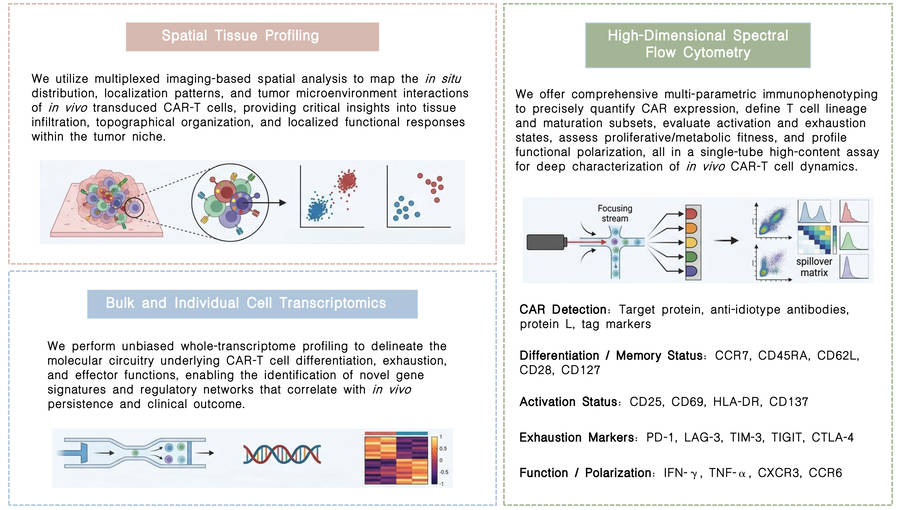
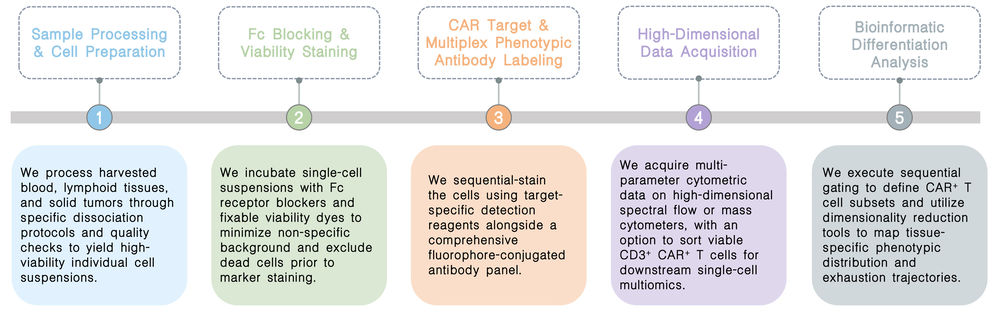
Our service offers an integrated, multi-dimensional characterization of CAR-T cell behavior following in vivo transduction, capturing phenotypic evolution and lineage commitment directly in the physiological tissue context. By synergizing high-parameter cytometry, transcriptional profiling, and spatially resolved tissue analysis, we delineate differentiation routes, exhaustion indices, and bioenergetic adaptations at exceptional granularity.
Our platform integrates high-dimensional flow cytometry, unbiased transcriptomics, and spatial tissue profiling to deliver a multi-layered characterization of in vivo transduced CAR+ T cells, spanning phenotypic identity, functional fitness, molecular circuitry, and tissue-localized behavior, to inform product potency and clinical predictability.
Q1: What differentiation states can in vivo-transduced CAR-T cells exhibit?
A1: CAR-T cells span a continuum from naive/memory phenotypes (superior persistence and self-renewal) to terminally differentiated effectors (potent cytotoxicity but short-lived), and this differentiation state critically impacts long-term therapeutic efficacy even after infusion.
Q2: How does asymmetric division influence CAR-T differentiation fate?
A2: Upon target encounter, asymmetric division generates two distinct daughters: the proximal cell inherits the synapse and most CAR molecules, showing rapid proliferation but short persistence; the distal cell enriches endogenous TCR/CD8, displaying a memory-precursor phenotype with superior long-term persistence and self-renewal despite early cytotoxicity.
Accelerate your in vivo CAR-T research with our industry-leading phenotypic and differentiation analysis. We deliver high-dimensional, individual cell precision, spanning naive, memory, and effector subsets, to rigorously evaluate cell persistence, exhaustion, and lineage fate. Partner with us for reliable, expert-driven insights that empower your next-generation immunotherapies.
"We partnered with Creative Biolabs' In vivo Transduced CAR+ T-Cell Phenotypic & Differentiation Analysis service. Utilizing customized spectral flow cytometry, they successfully resolved sparse CAR+ T-cell populations across peripheral blood and spleen tissues. Their longitudinal tracking demonstrated a sustained stem cell-like memory T cell phenotype in our in vivo generated CAR-Ts, proving superior persistence over ex vivo controls." Dr. A* KI*.
"We commissioned Creative Biolabs' service to evaluate viral vector transductions across murine spleen and tumor-infiltrating lymphocytes (TILs) at multiple post-injection timepoints. Their integrated pipeline provided unprecedented resolution. We were able to precisely map the transition of CAR+ CD8+ T cells from naïve to effector and central memory states, while simultaneously profiling exhaustion markers like PD-1, LAG-3, and TIM-3." Dr. El* Ro*.
Unlock the full potential of your CAR-T efficacy data. For expert-driven phenotypic analysis of in vivo transduced cells, reach out now. Let's discuss your specific markers and study goals. We offer rapid quotations and expert project design. Don't hesitate—contact us to move forward.
Reference
For any technical issues or product/service related questions, please leave your information below. Our team will contact you soon.
All products and services are For Research Use Only and CANNOT be used in the treatment or diagnosis of disease.
 NEWSLETTER
The latest newsletter to introduce the latest breaking information, our site updates, field and other scientific news, important events, and insights from industry leaders
LEARN MORE NEWSLETTER NEW SOLUTION
CellRapeutics™ In Vivo Cell Engineering: One-stop in vivo T/B/NK cell and macrophage engineering services covering vectors construction to function verification.
LEARN MORE SOLUTION NOVEL TECHNOLOGY
Silence™ CAR-T Cell: A novel platform to enhance CAR-T cell immunotherapy by combining RNAi technology to suppress genes that may impede CAR functionality.
LEARN MORE NOVEL TECHNOLOGY NEW SOLUTION
Canine CAR-T Therapy Development: From early target discovery, CAR design and construction, cell culture, and transfection, to in vitro and in vivo function validation.
LEARN MORE SOLUTION









