Creative Biolabs has a tradition of commitment. To achieve efficient execution and regulatory approval, we offer careful considerations of your program for the development of a cellular or gene therapy product – now and in the future.
EXPLORE MORE HighlightsWe focus on unmet needs and develop novel cellular and gene drugs and solutions that offer significant benefits over existing options.
EXPLORE MORE HighlightsThe advent of Chimeric Antigen Receptor T-cell (CAR-T) therapies has revolutionized the field of oncology, providing new avenues for treating various forms of cancer. Our 20 years of experience in the biotechnology sector have equipped us with the expertise and technological capabilities to support the entire lifecycle of CAR-T products, from early development to commercialization.
EXPLORE MORETo accelerate advanced breakthroughs of your projects, we offer broad range of platforms which enable our clients be free to tackle problems with cutting-edge technologies from different angles and in different methods.
EXPLORE MORE HighlightsUse the resources in our library to help you understand your options and make critical decisions for your study. We offer oncolytic virus, CAR-T, and dendritic cell related documents, as well as newsletter. If you don't find the answers you're looking for, contact us for additional assistance.
EXPLORE MORE HighlightsGet a real taste and understanding of the business and culture of one of the world's great research-based cellular and gene therapy discovery and development companies.
EXPLORE MORE
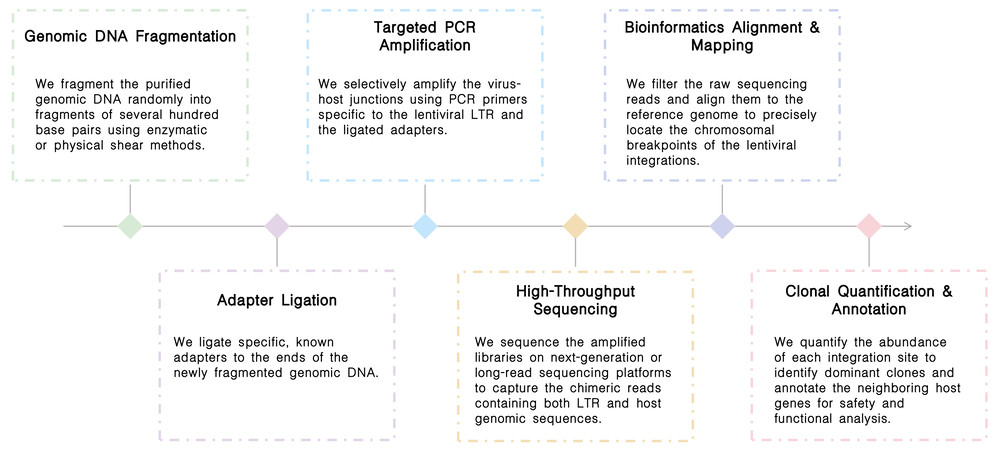
While lentiviral vectors are indispensable in gene and cell therapy, their semi-random genomic integration poses significant risks of insertional mutagenesis and oncogenic transformation. To address these critical safety concerns, we provide a comprehensive Lentiviral Integration Site Analysis (ISA) & Insertion Mutagenesis Safety Evaluation. Utilizing advanced high-throughput sequencing and specialized bioinformatics, this service precisely maps integration sites and monitors clonal dynamics with exceptional resolution. By delivering highly sensitive, regulatory-compliant data, we empower you to confidently assess therapeutic safety and accelerate their clinical translation.
Lentiviral integration site profiling constitutes a critical quality attribute in CAR-T cell therapy, as the precise genomic location of vector insertion directly governs transgene expression stability and clonal dynamics within engineered T-cell products. Insertion mutagenesis, the potential dysregulation of host genes adjacent to or downstream of the integration locus, poses a well-documented risk of aberrant clonal expansion and leukemogenesis, necessitating rigorous safety surveillance.
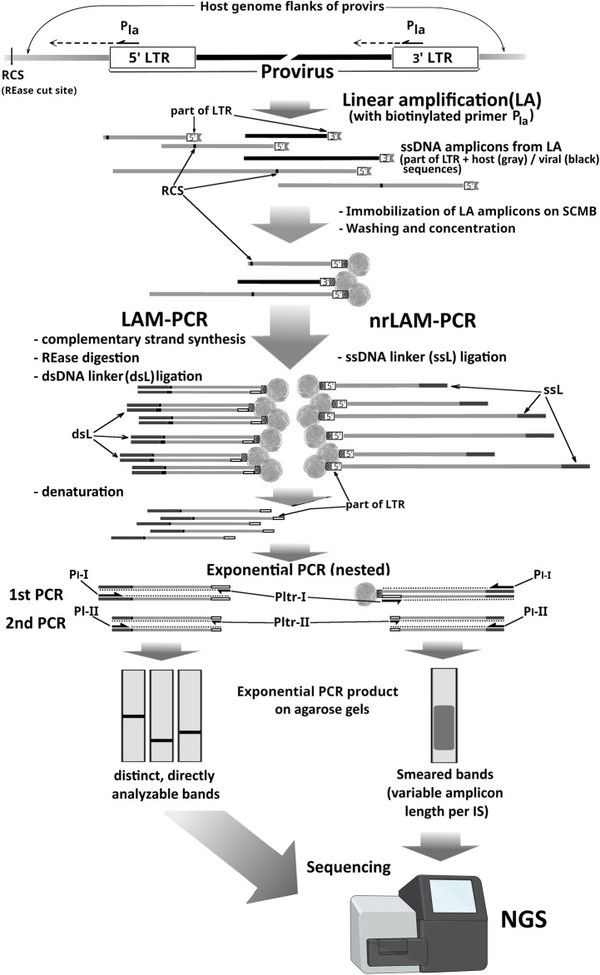 Fig.1 The methodological landscape for identifying integration sites of retroviruses and retroviral vectors. 1
Our service delivers high-resolution genomic mapping of vector integration profiles. By precisely quantifying clonal dynamics and identifying insertional genotoxicity near critical oncogenes, we mitigate insertional mutagenesis risks. We provide robust, regulatory-ready safety datasets and expert bioinformatics to confidently accelerate your cell therapy toward successful IND filing.
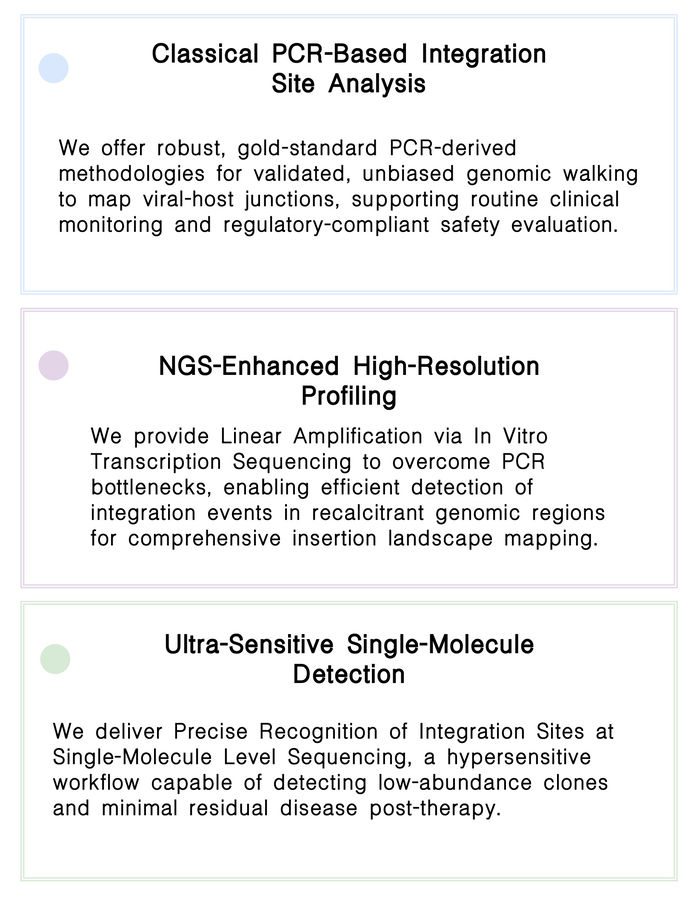
We provide a comprehensive, tiered lentiviral integration site analysis portfolio, spanning validated PCR-based genotyping, NGS-enhanced full-genome coverage, and single-molecule ultra-sensitive detection, to deliver precise insertion mutagenesis safety evaluation across all stages of translational gene therapy development.
Q1: Does your safety evaluation cross-reference known oncogenes?
A1: Yes. Our automated annotation pipeline cross-references all identified integration sites with updated cancer gene databases. We specifically risk-score any insertions occurring of known proto-oncogenes, tumor suppressor genes, or microRNAs involved in hematopoiesis and oncogenesis.
Q2: Can this service be used for longitudinal patient monitoring during clinical trials?
A2: Yes. We offer specialized longitudinal tracking services tailored for Phase I/II/III clinical trials. By analyzing peripheral blood or bone marrow samples collected from patients at multiple post-infusion time points, we can monitor the clonal evolution and ensure early detection of any aberrant clonal expansion.
We deliver industry-leading, high-resolution ISA services powered by advanced LAM-PCR and NGS technologies. By providing precise single-base mapping, rigorous clonal dominance tracking, and comprehensive oncogene risk annotation, we ensure your gene and cell therapy products meet the most stringent global regulatory standards for clinical safety and efficacy.
"In hematopoietic stem cell (HSC) gene therapy, insertion mutagenesis is a critical safety bottleneck. We used this service to analyze the clonal diversity of our lentivirus-transduced HSCs before and after transplantation in animal models. Their high-throughput sequencing approach combined with bioinformatics pipelines delivered highly accurate indices and coefficients. This allowed us to rigorously prove that our vector modifications successfully prevented clonal dominance and insertional oncogenesis." Dr. K* T*.
"During our CAR-T clinical trials, monitoring the clonal expansion and safety of the infused cells was our top priority. This Lentiviral Integration Site Analysis (ISA) service provided us with longitudinal mapping of integration sites with incredible genomic resolution. They were able to detect and quantify dominant clones and evaluate if any insertions occurred near known oncogenes." Dr. C* S*.
As leaders in lentiviral ISA and insertion mutagenesis safety, we provide expert end-to-end support from advanced sequencing to precise risk classification. Our team offers rapid turnaround and clear regulatory guidance. Let's discuss your project needs and timeline. Reach out today for a consultation and detailed quote—we're ready to move your program forward.
Reference
For any technical issues or product/service related questions, please leave your information below. Our team will contact you soon.
All products and services are For Research Use Only and CANNOT be used in the treatment or diagnosis of disease.
 NEWSLETTER
The latest newsletter to introduce the latest breaking information, our site updates, field and other scientific news, important events, and insights from industry leaders
LEARN MORE NEWSLETTER NEW SOLUTION
CellRapeutics™ In Vivo Cell Engineering: One-stop in vivo T/B/NK cell and macrophage engineering services covering vectors construction to function verification.
LEARN MORE SOLUTION NOVEL TECHNOLOGY
Silence™ CAR-T Cell: A novel platform to enhance CAR-T cell immunotherapy by combining RNAi technology to suppress genes that may impede CAR functionality.
LEARN MORE NOVEL TECHNOLOGY NEW SOLUTION
Canine CAR-T Therapy Development: From early target discovery, CAR design and construction, cell culture, and transfection, to in vitro and in vivo function validation.
LEARN MORE SOLUTION









