Creative Biolabs has a tradition of commitment. To achieve efficient execution and regulatory approval, we offer careful considerations of your program for the development of a cellular or gene therapy product – now and in the future.
EXPLORE MORE HighlightsWe focus on unmet needs and develop novel cellular and gene drugs and solutions that offer significant benefits over existing options.
EXPLORE MORE HighlightsThe advent of Chimeric Antigen Receptor T-cell (CAR-T) therapies has revolutionized the field of oncology, providing new avenues for treating various forms of cancer. Our 20 years of experience in the biotechnology sector have equipped us with the expertise and technological capabilities to support the entire lifecycle of CAR-T products, from early development to commercialization.
EXPLORE MORETo accelerate advanced breakthroughs of your projects, we offer broad range of platforms which enable our clients be free to tackle problems with cutting-edge technologies from different angles and in different methods.
EXPLORE MORE HighlightsUse the resources in our library to help you understand your options and make critical decisions for your study. We offer oncolytic virus, CAR-T, and dendritic cell related documents, as well as newsletter. If you don't find the answers you're looking for, contact us for additional assistance.
EXPLORE MORE HighlightsGet a real taste and understanding of the business and culture of one of the world's great research-based cellular and gene therapy discovery and development companies.
EXPLORE MORE
The clinical translation of CAR-T cell therapies remains constrained by critical safety liabilities, including cytokine release syndrome (CRS), replication-competent lentivirus (RCL) contamination, and insertional mutagenesis, each demanding rigorous, continuous surveillance throughout the product lifecycle. Our CAR Therapy Clinical Safety Endpoint Monitoring Services provide a comprehensive, regulatory-aligned solution that simultaneously addresses these three core safety domains. Built upon multiplex high-throughput immunoassays, validated RCL detection systems, and high-resolution integration site analysis coupled with proprietary bioinformatics, our platform delivers ultrasensitive, real-time safety data from infusion through long-term follow-up. By consolidating acute toxicity, vector safety, and genotoxicity monitoring into one seamless framework, we empower you with early warning signals, standardised regulatory dossiers, and data continuity that accelerates clinical development and strengthens product lifecycle management.
Chimeric antigen receptor (CAR) T-cell therapy represents a transformative paradigm in oncology, reprogramming autologous or allogeneic lymphocytes to recognise and eliminate tumour-associated antigens with remarkable specificity. However, this potent biological modality carries inherent safety concerns, including cytokine release syndrome, off-tumour toxicity, and vector-related genotoxicity, that demand rigorous, life-cycle-long surveillance to ensure patient welfare and regulatory compliance.
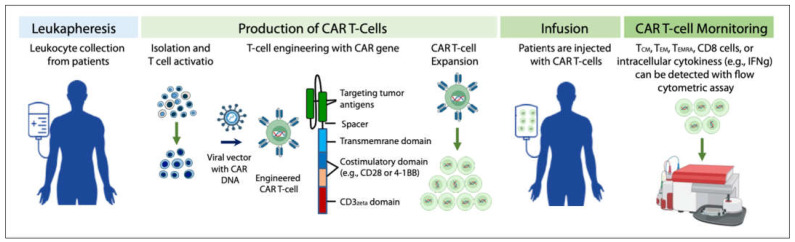 Fig.1 Preparation, therapeutic application, and performance assessment of CAR-T cells. 1
Our unified safety surveillance framework tackles the three principal risk domains in CAR-T cell therapy, cytokine release syndrome, replication-competent lentiviral contamination, and insertional oncogenic potential. Leveraging high-plex cytokine profiling, regulatory-qualified RCL screening, and high-definition integration site mapping driven by in-house bioinformatics pipelines, we generate submission-ready, longitudinal safety intelligence spanning initial infusion to extended post-treatment surveillance.
This service provides robust, parallel quantification of key pro-inflammatory and anti-inflammatory cytokines (e.g., IL-6, IFN-γ, TNF-α) using automated multiplex platforms, enabling real-time, high-frequency monitoring of CRS onset and severity in CAR-T recipients. It supports early risk stratification, guides timely immunomodulatory interventions, and generates quantitative data streams.
Learn More →This assay suite delivers validated, regulatory-grade detection of replication-competent lentivirus, including VSV-G pseudotyped and wild-type recombinants, using sensitive amplification and readout systems. It ensures batch-release testing, vector lot qualification, and long-term patient monitoring meet strict safety thresholds, thereby mitigating the risk of insertional reactivation or secondary transmission.
Learn More →This service combines high-throughput sequencing-based integration site profiling with bioinformatic clonal tracking to map vector-genome junctions across transduced cell populations. It assesses potential oncogene proximity, epigenomic hot spots, and clonal dominance over time, providing a quantitative risk assessment for insertional mutagenesis.
Learn More →Q1: What safety endpoints does this service cover?
A1: We cover three critical safety domains: acute toxicity via CRS biomarker profiling, vector safety via RCL detection, and long-term genotoxicity via lentiviral integration site analysis (ISA) with insertional mutagenesis risk assessment.
Q2: At what time points should samples be collected for CRS monitoring?
A2: We recommend a pre-infusion baseline, followed by daily sampling during the peak risk window, with extended monitoring through day 28 or until clinical resolution, depending on your trial protocol and cytokine dynamics.
We offer the only integrated platform that simultaneously monitors CRS dynamics, RCL regulatory compliance, and insertional mutagenesis risk, all under one validated framework. Our ultrasensitive assays and regulatory-grade bioinformatics deliver early warning signals, standardised safety dossiers, and seamless IND-to-post-marketing continuity, empowering decisive clinical action with uncompromised quality.
Our scientific and regulatory experts are ready to tailor a safety monitoring strategy for your CAR-T program. Reach out to discuss assay design, timeline optimization, or submission planning. We respond with preliminary feasibility and a customized proposal aligned with your development milestones.
Reference
For any technical issues or product/service related questions, please leave your information below. Our team will contact you soon.
All products and services are For Research Use Only and CANNOT be used in the treatment or diagnosis of disease.
 NEWSLETTER
The latest newsletter to introduce the latest breaking information, our site updates, field and other scientific news, important events, and insights from industry leaders
LEARN MORE NEWSLETTER NEW SOLUTION
CellRapeutics™ In Vivo Cell Engineering: One-stop in vivo T/B/NK cell and macrophage engineering services covering vectors construction to function verification.
LEARN MORE SOLUTION NOVEL TECHNOLOGY
Silence™ CAR-T Cell: A novel platform to enhance CAR-T cell immunotherapy by combining RNAi technology to suppress genes that may impede CAR functionality.
LEARN MORE NOVEL TECHNOLOGY NEW SOLUTION
Canine CAR-T Therapy Development: From early target discovery, CAR design and construction, cell culture, and transfection, to in vitro and in vivo function validation.
LEARN MORE SOLUTION









