Creative Biolabs has a tradition of commitment. To achieve efficient execution and regulatory approval, we offer careful considerations of your program for the development of a cellular or gene therapy product – now and in the future.
EXPLORE MORE HighlightsWe focus on unmet needs and develop novel cellular and gene drugs and solutions that offer significant benefits over existing options.
EXPLORE MORE HighlightsThe advent of Chimeric Antigen Receptor T-cell (CAR-T) therapies has revolutionized the field of oncology, providing new avenues for treating various forms of cancer. Our 20 years of experience in the biotechnology sector have equipped us with the expertise and technological capabilities to support the entire lifecycle of CAR-T products, from early development to commercialization.
EXPLORE MORETo accelerate advanced breakthroughs of your projects, we offer broad range of platforms which enable our clients be free to tackle problems with cutting-edge technologies from different angles and in different methods.
EXPLORE MORE HighlightsUse the resources in our library to help you understand your options and make critical decisions for your study. We offer oncolytic virus, CAR-T, and dendritic cell related documents, as well as newsletter. If you don't find the answers you're looking for, contact us for additional assistance.
EXPLORE MORE HighlightsGet a real taste and understanding of the business and culture of one of the world's great research-based cellular and gene therapy discovery and development companies.
EXPLORE MORE
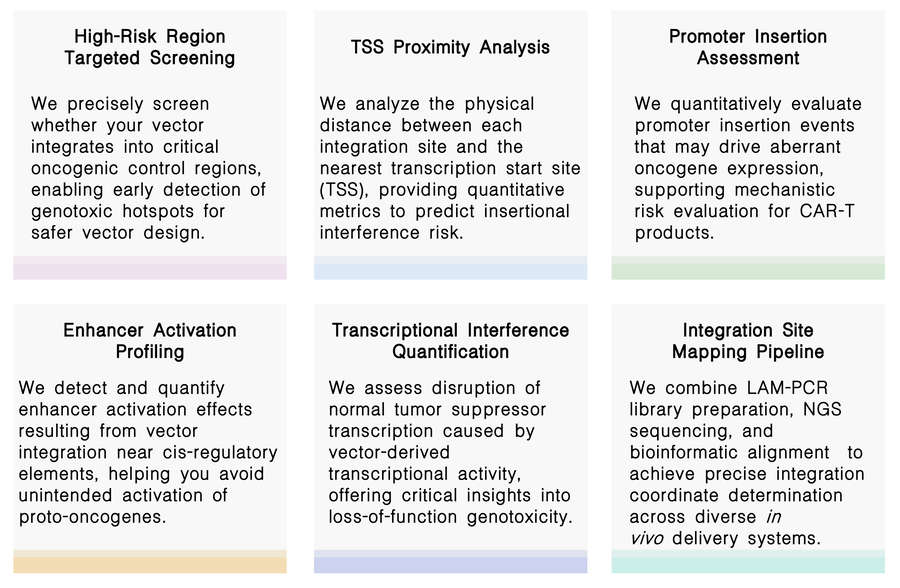
Despite the clinical promise of gene therapies, accurately assessing the risk of insertional oncogenesis, particularly proximity to critical oncogenic control regions and physical distance to nearest transcription start sites, remains a major challenge. We introduce the Oncogene/Tumor Suppressor Proximity Profiling & Transcription Interference Assessment Services, a dedicated analytical platform that maps vector integration sites and quantifies promoter insertion or enhancer activation effects. Our service leverages high-resolution benchmarking of insertional risk profiles across diverse in vivo CAR-T delivery systems, including lentivirus, retrovirus, AAV, and LNP/mRNA mediated transposon platforms. By precisely determining whether a vector integrates into high-risk genomic regions and assessing transcriptional interference, we empower you with critical safety and efficacy data to guide safer vector design and regulatory decision-making.
Oncogenes and tumor suppressors drive cancer hallmarks by regulating EV formation, cargo sorting, and release dynamics across disease progression, thus remodeling the surrounding stroma and immune landscape. Incorporating their activity states into CAR T cell engineering presents dual challenges, including possible EV shuttling of growth signals into modified T cells or dampening of cytotoxic responses, alongside potential gains in T cell homing, longevity, and defense against suppressive tumor cues.
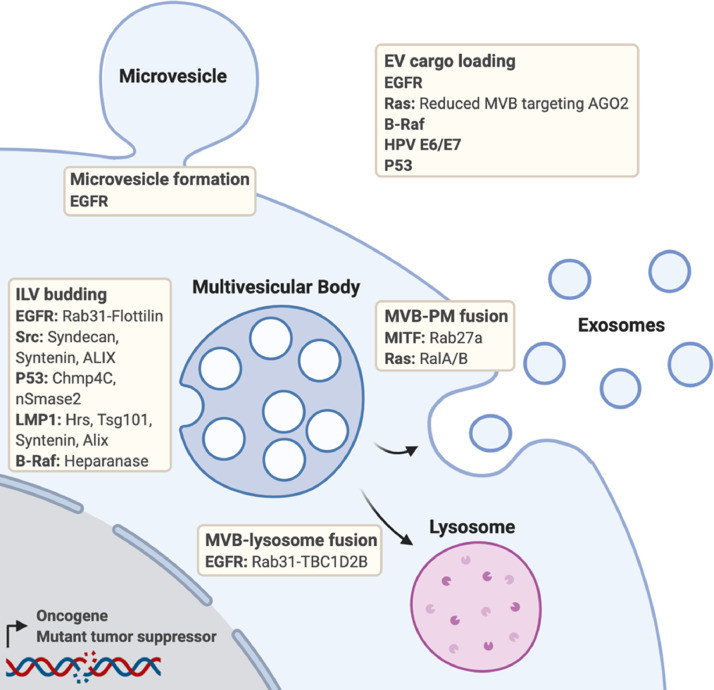 Fig.1 The functions of oncogenes and tumor suppressors during distinct phases of extracellular vesicle release and cargo packaging in cancer.1
Our Oncogene/Tumor Suppressor Proximity Profiling & Transcription Interference Assessment Services directly map physical interactions and transcriptional conflicts between oncogenes and tumor suppressors at endogenous chromatin loci. By integrating high-resolution proximity-dependent crosslinking with real-time elongation assays, we reveal how oncogenic signaling silences suppressor genes or disrupts their feedback loops. This empowers precise mechanism-driven immunotherapy and combination target discovery.
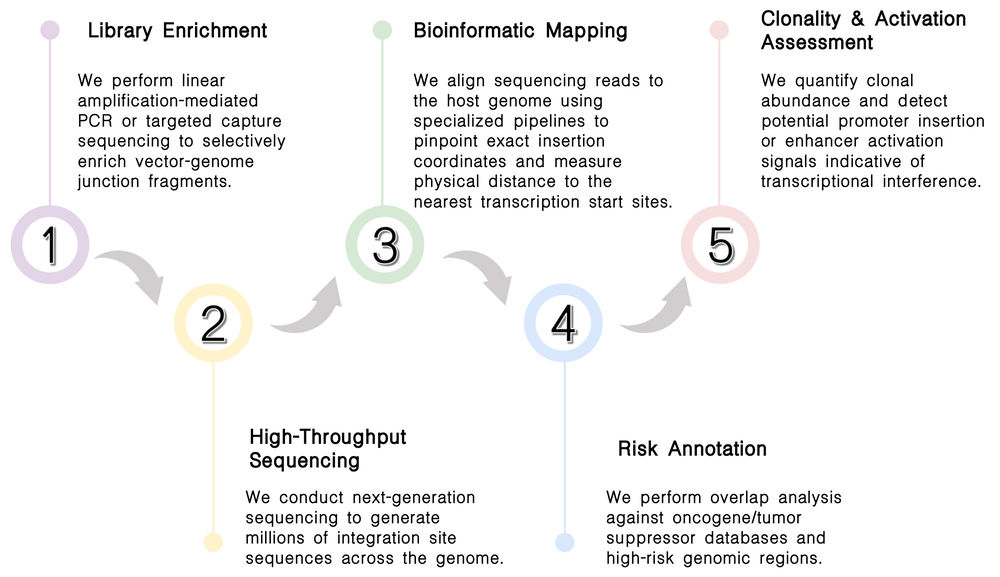
We offer comprehensive oncogenomic safety assessment for your gene therapy vectors, precisely mapping integration sites, quantifying proximity to high-risk oncogenic regions and TSS, and evaluating promoter insertion, enhancer activation, and transcriptional interference risks.
Q1: Can your service be applied to non-viral delivery systems (e.g., LNP mRNA transposons)?
A1: Yes, our platform agnostic pipeline supports lentivirus, retrovirus, AAV, Sleeping Beauty transposons, and LNP/mRNA-based systems, enabling direct safety benchmarking across modalities.
Q2: Can you detect integration events that occur in quiescent or non-dividing cells (e.g., HSCs or neurons)?
A2: Yes, our ligation mediated PCR and targeted capture protocols are independent of cell proliferation, allowing detection of stable insertions in both dividing and non-dividing primary human cells, including CD34+ HSPCs and post mitotic neurons.
Our integrated platform uniquely combines proximity profiling with transcription interference assessment to directly map oncogene and tumor suppressor crosstalk at chromatin level. We resolve physical interactions and functional transcriptional conflicts in native cellular contexts, offering mechanistic clarity essential for targeted cancer immunotherapy and checkpoint regulation studies. Fast, reproducible, and tailored to your immune-oncology models.
"Using Creative Biolabs' Oncogene/Tumor Suppressor Proximity Profiling & Transcription Interference Assessment Services, we were able to map the MYC p53 interaction landscape at sub-nanometer resolution. The proximity profiling service revealed unexpected spatial clustering of MYC near p53 responsive promoters, while the transcription interference assessment clearly quantified how MYC overexpression blocks p53's recruitment of RNA Pol II." Dr. El*a.
"Our team applied Creative Biolabs' services to study KRAS-driven transcriptional conflict with FOXO3. The proximity profiling identified physical tethering of mutant KRAS to FOXO3 binding sites, and the transcription interference service directly measured decreased FOXO3 target gene elongation." Dr. S* O*.
"The Oncogene/Tumor Suppressor Proximity Profiling & Transcription Interference Assessment Services were transformative for our study on mutant p53 gain-of-function. Proximity profiling revealed that mutant p53 physically associates with the BRD4 controlled super-enhancer of MYC, and the transcription interference service directly measured how this interaction interferes with MYC's own negative feedback loop." Dr. H*P* R*.
Ready to resolve oncogene and tumor suppressor crosstalk in your immunotherapy models? Reach out to our scientific team directly through the inquiry form on this page. We provide rapid feasibility assessments, detailed service proposals, and expert consultation to tailor each assay to your specific cancer targets and transcriptional questions.
Reference
For any technical issues or product/service related questions, please leave your information below. Our team will contact you soon.
All products and services are For Research Use Only and CANNOT be used in the treatment or diagnosis of disease.
 NEWSLETTER
The latest newsletter to introduce the latest breaking information, our site updates, field and other scientific news, important events, and insights from industry leaders
LEARN MORE NEWSLETTER NEW SOLUTION
CellRapeutics™ In Vivo Cell Engineering: One-stop in vivo T/B/NK cell and macrophage engineering services covering vectors construction to function verification.
LEARN MORE SOLUTION NOVEL TECHNOLOGY
Silence™ CAR-T Cell: A novel platform to enhance CAR-T cell immunotherapy by combining RNAi technology to suppress genes that may impede CAR functionality.
LEARN MORE NOVEL TECHNOLOGY NEW SOLUTION
Canine CAR-T Therapy Development: From early target discovery, CAR design and construction, cell culture, and transfection, to in vitro and in vivo function validation.
LEARN MORE SOLUTION









