Creative Biolabs has a tradition of commitment. To achieve efficient execution and regulatory approval, we offer careful considerations of your program for the development of a cellular or gene therapy product – now and in the future.
EXPLORE MORE HighlightsWe focus on unmet needs and develop novel cellular and gene drugs and solutions that offer significant benefits over existing options.
EXPLORE MORE HighlightsThe advent of Chimeric Antigen Receptor T-cell (CAR-T) therapies has revolutionized the field of oncology, providing new avenues for treating various forms of cancer. Our 20 years of experience in the biotechnology sector have equipped us with the expertise and technological capabilities to support the entire lifecycle of CAR-T products, from early development to commercialization.
EXPLORE MORETo accelerate advanced breakthroughs of your projects, we offer broad range of platforms which enable our clients be free to tackle problems with cutting-edge technologies from different angles and in different methods.
EXPLORE MORE HighlightsUse the resources in our library to help you understand your options and make critical decisions for your study. We offer oncolytic virus, CAR-T, and dendritic cell related documents, as well as newsletter. If you don't find the answers you're looking for, contact us for additional assistance.
EXPLORE MORE HighlightsGet a real taste and understanding of the business and culture of one of the world's great research-based cellular and gene therapy discovery and development companies.
EXPLORE MORE
Despite durable remissions in some patients, CAR-T therapy faces significant hurdles, including antigen escape, relapse, and incomplete reconstitution of humoral and cellular immunity. To address these post-therapeutic complexities, we offer Post-CAR Therapy BCR/TCR Immune Repertoire Clonality & Diversity Analysis (BCR/TCR-Seq). Our service provides high-resolution profiling of B cell receptor and T cell receptor repertoires from peripheral blood or tumor samples, capturing clonal expansion, diversity indices, and lineage tracking. Leveraging advanced bioinformatics and proprietary algorithms, our analysis delivers actionable insights into immune recovery, minimal residual disease monitoring, and relapse prediction, empowering you to optimize patient-specific follow-up strategies.
The T cell receptor (TCR) is a highly polymorphic heterodimeric complex expressed on the surface of T lymphocytes, enabling the specific recognition of peptide antigens presented in the context of major histocompatibility complex (MHC) molecules, thereby serving as the cornerstone of cellular adaptive immunity. In parallel, the B cell receptor (BCR), which is essentially a membrane-bound form of immunoglobulin, mediates direct antigen recognition through its variable regions, initiating humoral immune responses and subsequently undergoing affinity maturation and class switching upon antigen encounter. The high-throughput sequencing of TCR and BCR repertoires has revolutionized immunology by providing an unprecedented, quantitative lens into the clonal dynamics, diversity, and antigen-specific selection of lymphocyte populations, offering critical insights into immune surveillance, autoimmunity, vaccine efficacy, and the tumor–immune interface.
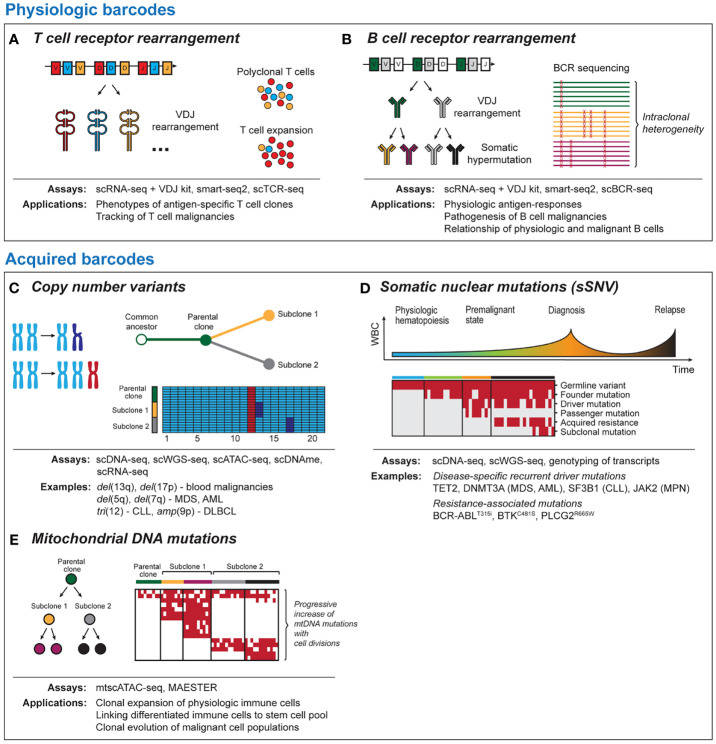 Fig.1 T cell receptor and B cell receptor sequencing. 1
As a pioneer in cellular immunotherapy analytics, our Post-CAR Therapy BCR/TCR-Seq delivers high-resolution mapping of immune repertoire clonality and diversity. Our service enables precise tracking of clonal expansion, relapse risk prediction, and functional immune reconstitution assessment. Leveraging deep sequencing and advanced bioinformatics, we provide actionable insights to optimize combination strategies and evaluate long-term treatment efficacy, empowering clinicians with definitive data for informed decision-making.
Our BCR/TCR immune repertoire analysis delivers a comprehensive post-CAR-T evaluation framework, integrating clonality quantification, longitudinal clone tracking, and BCR phylogenetic reconstruction to decode immune reconstitution dynamics, identify clinically relevant clonal signatures, and illuminate antigen-driven selective pressures governing therapeutic outcomes.
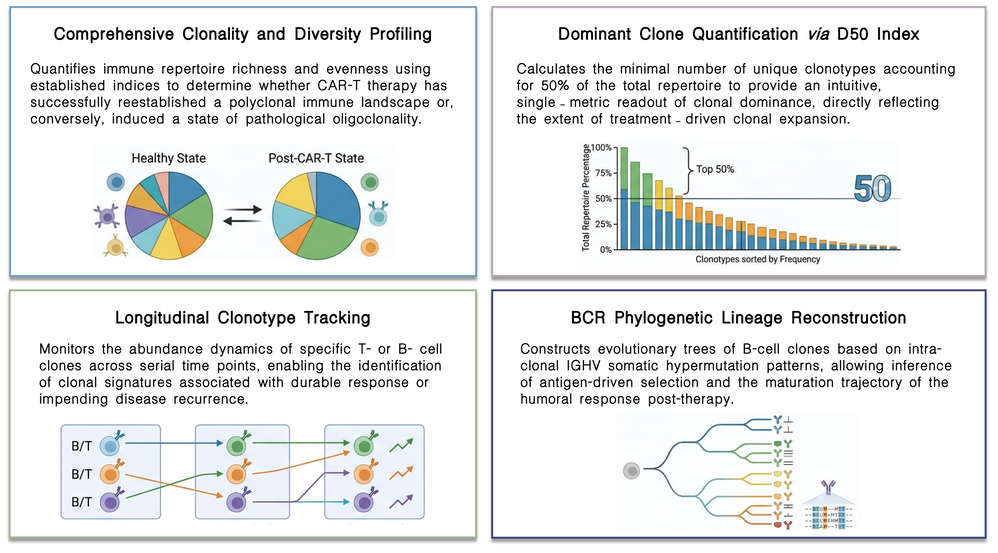
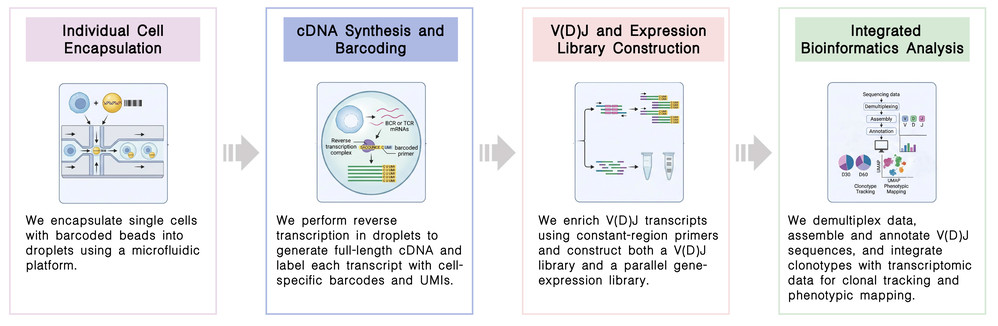
Q1: Why prioritize BCR/TCR repertoire analysis over flow cytometry post-CAR-T?
A1: BCR/TCR sequencing surpasses flow cytometry by not only quantifying B-cell abundance but also resolving their developmental maturation state. Critically, it reveals that sustained remission depends on the clonal expansion and cytotoxic polarization of endogenous T-cells, not merely CAR-T persistence, establishing repertoire analysis as a superior functional barometer of immune reconstitution.
Q2: What are the essential technical pitfalls in BCR versus TCR clonotype definition?
A2: The pivotal distinction is that TCR clonotypes are defined by exact CDR3 nucleotide matching, whereas BCRs undergo somatic hypermutation, necessitating nucleotide-distance-based clustering to group related lineages; applying exact matching to BCRs would falsely fragment clones. Additionally, individual cell data must be rigorously filtered to exclude doublets presenting dual chains.
Our post‑CAR BCR/TCR‑seq delivers ultra‑deep clonotype tracking, quantitative diversity metrics, and longitudinal convergence analysis. We distinguish treatment‐specific repertoire shifts from background noise, enabling precise relapse prediction and immune recovery monitoring.
"Employing Creative Biolabs' TCRB sequencing platform, we profiled the clonal architecture of infused products and post-infusion peripheral blood in B cell malignancy patients receiving CD19-directed CAR-T therapy. Our data revealed that clonal diversity peaked within the infusion product and progressively contracted following adoptive transfer, providing critical insights into the transcriptional programs governing the long-term persistence and functional trajectory of engrafted CAR-T clones." Dr. J* A. F*.
"In a separate cohort of patients with relapsed/refractory B cell non-Hodgkin lymphoma, we applied Creative Biolabs's TCR sequencing service to map repertoire dynamics across multiple longitudinal time points. Comparative analysis between complete responders and non-responders demonstrated that patients achieving durable remission exhibited markedly enhanced clonal expansion of tumor-recirculating CD8⁺ effector memory T cells and activated peripheral memory CD8⁺ T cells at the one-month landmark, distinguishing favorable outcomes from relapsed or refractory disease." Dr. Y* L*.
Ready to decode your CAR therapy's true efficacy? Maximize your clinical insights with our precision Post-CAR Therapy BCR/TCR-Seq services. Our immunity experts provide tailored immune repertoire clonality and diversity analysis to track expansion and persistence. Contact us today to request a custom quote and accelerate your breakthroughs.
Reference
For any technical issues or product/service related questions, please leave your information below. Our team will contact you soon.
All products and services are For Research Use Only and CANNOT be used in the treatment or diagnosis of disease.
 NEWSLETTER
The latest newsletter to introduce the latest breaking information, our site updates, field and other scientific news, important events, and insights from industry leaders
LEARN MORE NEWSLETTER NEW SOLUTION
CellRapeutics™ In Vivo Cell Engineering: One-stop in vivo T/B/NK cell and macrophage engineering services covering vectors construction to function verification.
LEARN MORE SOLUTION NOVEL TECHNOLOGY
Silence™ CAR-T Cell: A novel platform to enhance CAR-T cell immunotherapy by combining RNAi technology to suppress genes that may impede CAR functionality.
LEARN MORE NOVEL TECHNOLOGY NEW SOLUTION
Canine CAR-T Therapy Development: From early target discovery, CAR design and construction, cell culture, and transfection, to in vitro and in vivo function validation.
LEARN MORE SOLUTION









