Creative Biolabs has a tradition of commitment. To achieve efficient execution and regulatory approval, we offer careful considerations of your program for the development of a cellular or gene therapy product – now and in the future.
EXPLORE MORE HighlightsWe focus on unmet needs and develop novel cellular and gene drugs and solutions that offer significant benefits over existing options.
EXPLORE MORE HighlightsThe advent of Chimeric Antigen Receptor T-cell (CAR-T) therapies has revolutionized the field of oncology, providing new avenues for treating various forms of cancer. Our 20 years of experience in the biotechnology sector have equipped us with the expertise and technological capabilities to support the entire lifecycle of CAR-T products, from early development to commercialization.
EXPLORE MORETo accelerate advanced breakthroughs of your projects, we offer broad range of platforms which enable our clients be free to tackle problems with cutting-edge technologies from different angles and in different methods.
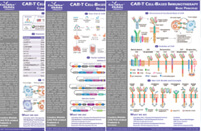
EXPLORE MORE HighlightsUse the resources in our library to help you understand your options and make critical decisions for your study. We offer oncolytic virus, CAR-T, and dendritic cell related documents, as well as newsletter. If you don't find the answers you're looking for, contact us for additional assistance.
EXPLORE MORE HighlightsGet a real taste and understanding of the business and culture of one of the world's great research-based cellular and gene therapy discovery and development companies.
EXPLORE MORE
Poor T-cell infiltration, dense stromal barriers, and highly immunosuppressive tumor microenvironments remain major obstacles in pancreatic ductal adenocarcinoma research. Our Preclinical Trial-on-Chip Pancreatic "Cold Tumor" Model Customization Service addresses these challenges by enabling accurate validation of CAR-T efficacy and optimization of infiltration strategies using advanced microfluidic platforms and patient-derived 3D co-culture systems. This human-relevant, physiologically faithful model bridges the gap between static 2D assays and costly animal studies, providing actionable insights that reduce clinical failure risk and accelerate the development of next-generation cell therapies.
Pancreatic ductal adenocarcinoma is characterized by dense desmoplastic stroma, abnormal vasculature, and strong immunosuppression, leading to poor CAR-T penetration and activity. Recent literature highlights microphysiological tumor-on-chip systems as reliable tools to model these barriers and capture dynamic immune-tumor interactions. Integrating such models into CAR-T development enables more predictive preclinical evaluation and supports rational therapeutic optimization.
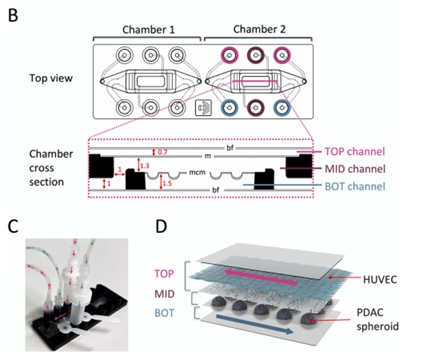 Fig.1 Design of a biochip.1
Our service provides a high-fidelity, biomimetic platform designed to replicate the "fortress" architecture of pancreatic cold tumors. It directly addresses the central challenge of solid tumor CAR-T therapy, physical and biochemical exclusion within the tumor microenvironment. By engineering a customizable microfluidic chip incorporating dense extracellular matrix and immunosuppressive cellular components, the platform enables physiologically relevant modeling of stromal barriers. Real-time visualization and quantitative analysis allow you to assess CAR-T trafficking, stromal penetration, target recognition, and functional cytotoxicity, generating actionable insights for candidate optimization and translational decision making.
Discover How We Can Help - Request a Consultation to design a chip model.
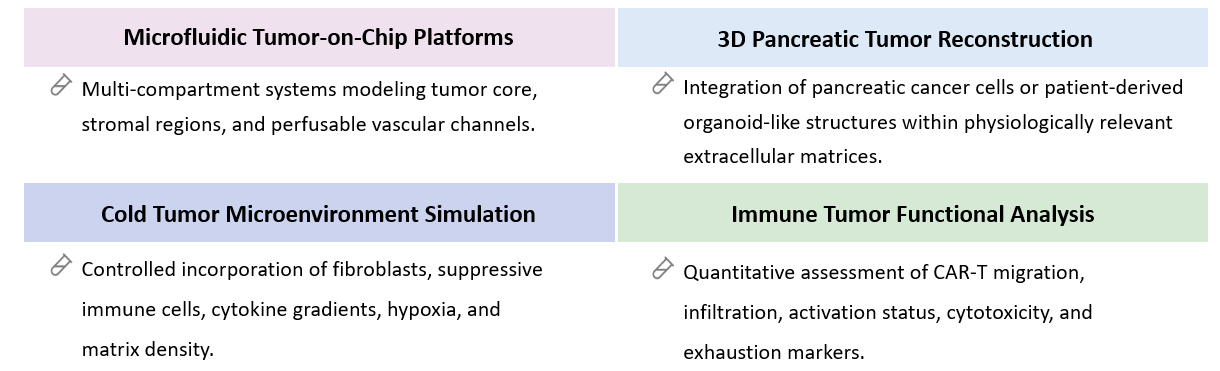
Creative Biolabs provides a flexible and non-infringing technology framework, including:
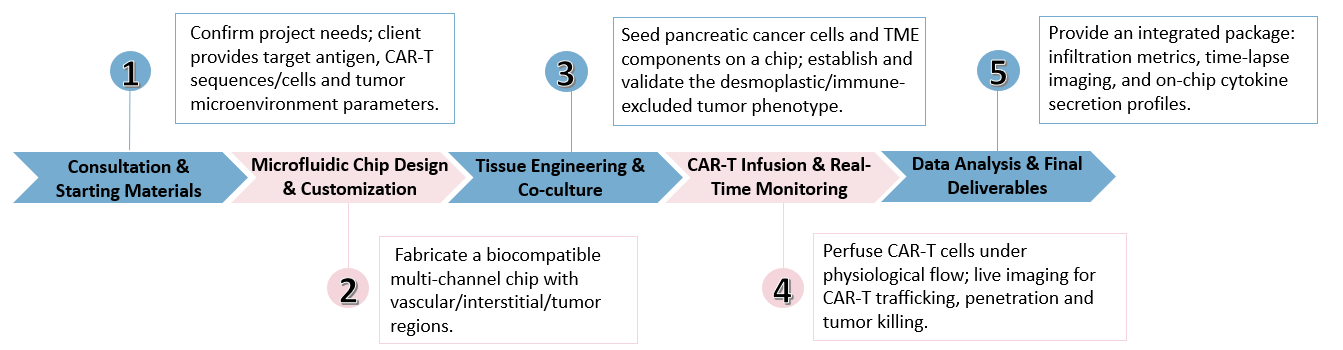
To ensure your model is tailored to your specific therapeutic target, we follow a rigorous, high-throughput manufacturing and testing protocol:
Q1: Can I use my own patient-derived organoids in the customized chip?
A1: Absolutely. Our platform is designed for modularity. You can ship your PDOs to us, and we will integrate them with our standardized or customized TME components to create a personalized testing environment.
Q2: What imaging capabilities are provided with the service?
Q2: We provide high-resolution confocal and fluorescence imaging. We can provide time-lapse videos of T-cell migration and quantify parameters like "Distance to Tumor Core" and "Infiltration Velocity" using our AI-driven image analysis software.
Q3: How does the "Trial-on-Chip" compare to traditional animal models?
A3: While animal models provide systemic data, they are often poor predictors of human T-cell behavior due to species-specific immune differences. Our chips use 100% human cells and allow for real-time observation of the "human" immune synapse, often providing more actionable data in a fraction of the time.
We offer tailored bone marrow-on-chip models that recreate the hematopoietic and stromal niche specifically for CAR-T research. By mimicking the marrow's unique architecture, this platform provides a high-fidelity environment to evaluate CAR-T expansion, long-term persistence, and safety before moving to clinical trials.
Learn More →To tackle the complexities of Glioblastoma, our GBM-specific chips integrate blood-brain barrier (BBB) features, hypoxia, and immunosuppressive niches. This specialized setup allows researchers to realistically track CAR-T cell penetration, survival, and antitumor potency within the challenging brain microenvironment.
Learn More →Our HCC and metastasis platforms accurately replicate the liver's microenvironment and metastatic sites. These chips enable real-time monitoring of CAR-T infiltration, activation, and cytotoxicity, offering the physiological insights needed to predict how therapies will overcome dense tumor barriers and prevent spread.
Learn More →Creative Biolabs provides a revolutionary approach to overcoming the "Cold Tumor" barrier in pancreatic cancer. By combining microfluidic precision with deep biological expertise, our Preclinical Trial-on-Chip Customization Service ensures that your CAR-T candidates are tested against the most realistic human barriers available today. Don't let your research be limited by outdated models. Please contact our team to discuss your project and for further information.
Reference
For any technical issues or product/service related questions, please leave your information below. Our team will contact you soon.
All products and services are For Research Use Only and CANNOT be used in the treatment or diagnosis of disease.
 NEWSLETTER
The latest newsletter to introduce the latest breaking information, our site updates, field and other scientific news, important events, and insights from industry leaders
LEARN MORE NEWSLETTER NEW SOLUTION
CellRapeutics™ In Vivo Cell Engineering: One-stop in vivo T/B/NK cell and macrophage engineering services covering vectors construction to function verification.
LEARN MORE SOLUTION NOVEL TECHNOLOGY
Silence™ CAR-T Cell: A novel platform to enhance CAR-T cell immunotherapy by combining RNAi technology to suppress genes that may impede CAR functionality.
LEARN MORE NOVEL TECHNOLOGY NEW SOLUTION
Canine CAR-T Therapy Development: From early target discovery, CAR design and construction, cell culture, and transfection, to in vitro and in vivo function validation.
LEARN MORE SOLUTION