Creative Biolabs has a tradition of commitment. To achieve efficient execution and regulatory approval, we offer careful considerations of your program for the development of a cellular or gene therapy product – now and in the future.
EXPLORE MORE HighlightsWe focus on unmet needs and develop novel cellular and gene drugs and solutions that offer significant benefits over existing options.
EXPLORE MORE HighlightsThe advent of Chimeric Antigen Receptor T-cell (CAR-T) therapies has revolutionized the field of oncology, providing new avenues for treating various forms of cancer. Our 20 years of experience in the biotechnology sector have equipped us with the expertise and technological capabilities to support the entire lifecycle of CAR-T products, from early development to commercialization.
EXPLORE MORETo accelerate advanced breakthroughs of your projects, we offer broad range of platforms which enable our clients be free to tackle problems with cutting-edge technologies from different angles and in different methods.
EXPLORE MORE HighlightsUse the resources in our library to help you understand your options and make critical decisions for your study. We offer oncolytic virus, CAR-T, and dendritic cell related documents, as well as newsletter. If you don't find the answers you're looking for, contact us for additional assistance.
EXPLORE MORE HighlightsGet a real taste and understanding of the business and culture of one of the world's great research-based cellular and gene therapy discovery and development companies.
EXPLORE MORE
The development of cell and gene therapies using lentiviral vectors is hindered by stringent regulatory demands for demonstrating the absence of replication-competent lentivirus (RCL), particularly given the inherent risks of insertional mutagenesis and viral spread, alongside the complex matrix effects that can compromise assay sensitivity. Our Replication-Competent Lentivirus (RCL) Regulatory Compliance Assay (VSV-G / Wild-Type) addresses this critical need with a validated, high-sensitivity co-culture system designed to detect both VSV-G-pseudotyped and wild-type RCL. Our service provides end-to-end testing, including sample preparation, amplification, and quantitative endpoint analysis. With broad dynamic range, built-in controls, and rapid turnaround, it offers you robust, audit-ready data to ensure patient safety.
Replication-competent lentivirus (RCL) is any lentiviral particle capable of completing a full replication cycle within host cells, arising primarily from homologous recombination between overlapping viral sequences used in vector production systems. The vesicular stomatitis virus G glycoprotein (VSV-G) is the most commonly employed envelope protein for pseudotyping clinical-grade lentiviral vectors, while wild-type envelope variants may occasionally emerge through recombination events or cross-contamination, both of which pose potential safety risks due to their broad tropism and pathogenic capacity.
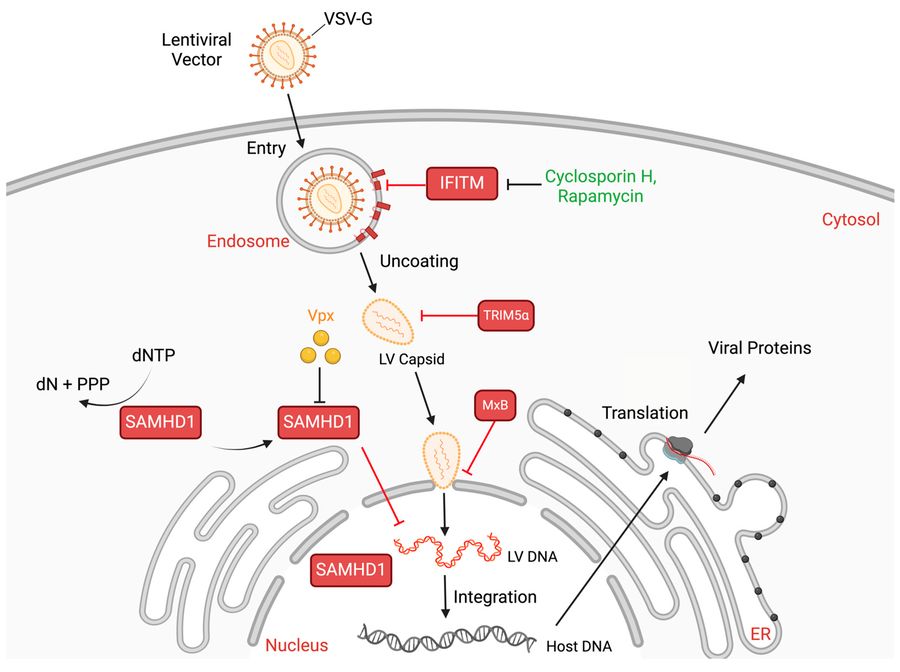 Fig.1 Host cellular factors impose barriers to lentiviral vectors at stages. 1
Our RCL assay delivers validated detection of VSV-G and wild-type replication-competent lentivirus, specifically designed for gene therapy product release and regulatory filings. This highly sensitive, quantitative test minimizes false positives while ensuring batch-to-batch consistency. We provide full documentation support, reducing development risks with unparalleled analytical rigor.
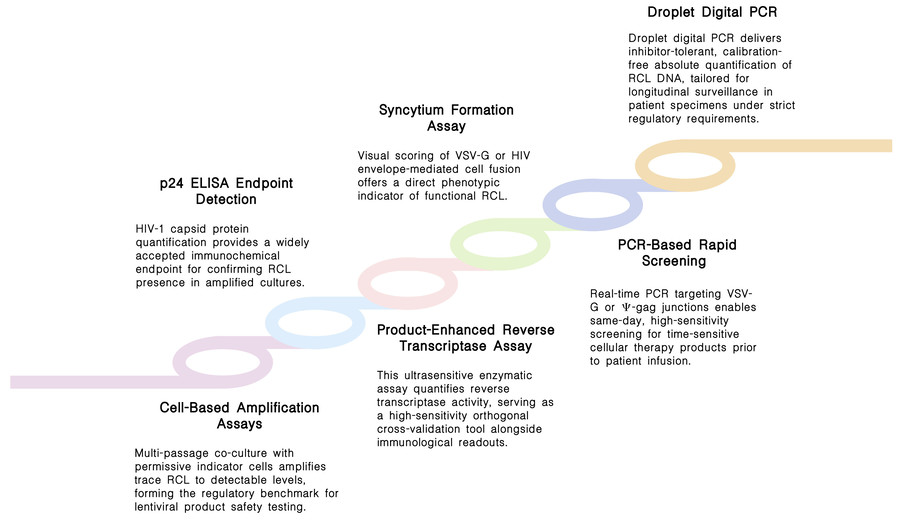
We offer a comprehensive, regulatory-compliant suite of RCL testing services, combining gold-standard cell-based amplification with advanced molecular platforms to deliver high-sensitivity screening, orthogonal validation, and longitudinal patient monitoring for clinical-grade lentiviral vectors and cell therapies.
Q1: Why is a 21-day cell amplification assay required instead of direct qPCR for RCL detection?
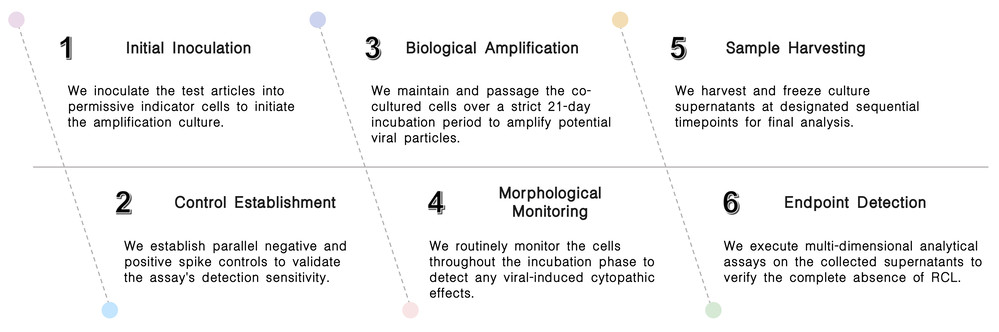
A1: Direct molecular quantification cannot differentiate infectious viral particles from inert genomic fragments, residual plasmid DNA, or replication-defective vector debris, which frequently leads to false-positive outcomes that compromise product release. To mitigate this risk, global regulatory bodies mandate a three-week co-cultivation phase with highly permissive indicator cells, allowing any scarce, replication-competent contaminants to propagate exponentially and reach detectable thresholds before enzymatic or genetic endpoint analysis.
Q2: What corrective actions should be implemented in the event of a positive RCL result?
A2: A confirmed positive signal necessitates the immediate initiation of a comprehensive deviation investigation, beginning with a thorough laboratory audit to rule out potential cross-contamination from positive control materials, followed by re-testing archival retention aliquots.
With cutting-edge qPCR and cell-culture co-cultivation platforms, we deliver highly sensitive, robust RCL assays compliant with global regulatory standards. Our deep expertise in VSV-G and wild-type lentivirus detection ensures rigorous biosafety validation, accelerating your gene therapy pipelines from discovery to clinical release with unparalleled precision and reliability.
"Developing novel lentiviral vectors means we must rigorously exclude any possibility of generating replication-competent recombinants. This service's assay design for detecting wild-type lentivirus and pseudotyped VSV-G remnants is incredibly robust. Their inclusion of stringent positive and negative controls gave our research team complete peace of mind." Prof. J* M*.
"This high-throughput RCL assay service has seamlessly integrated into our workflow. The combination of cell-culture amplification with qPCR readout for VSV-G sequences offered both the cell-based biological relevance and the molecular precision we needed. It significantly reduced our batch testing bottlenecks." E* R*.
As your partner in RCL safety, we offer expert guidance to streamline your regulatory strategy. Contact our team for a confidential consultation on assay design and validation to accelerate your timeline. We are ready to discuss your specific program needs and provide a customized compliance proposal. Reach out to us today.
Reference
For any technical issues or product/service related questions, please leave your information below. Our team will contact you soon.
All products and services are For Research Use Only and CANNOT be used in the treatment or diagnosis of disease.
 NEWSLETTER
The latest newsletter to introduce the latest breaking information, our site updates, field and other scientific news, important events, and insights from industry leaders
LEARN MORE NEWSLETTER NEW SOLUTION
CellRapeutics™ In Vivo Cell Engineering: One-stop in vivo T/B/NK cell and macrophage engineering services covering vectors construction to function verification.
LEARN MORE SOLUTION NOVEL TECHNOLOGY
Silence™ CAR-T Cell: A novel platform to enhance CAR-T cell immunotherapy by combining RNAi technology to suppress genes that may impede CAR functionality.
LEARN MORE NOVEL TECHNOLOGY NEW SOLUTION
Canine CAR-T Therapy Development: From early target discovery, CAR design and construction, cell culture, and transfection, to in vitro and in vivo function validation.
LEARN MORE SOLUTION









