Creative Biolabs has a tradition of commitment. To achieve efficient execution and regulatory approval, we offer careful considerations of your program for the development of a cellular or gene therapy product – now and in the future.
EXPLORE MORE HighlightsWe focus on unmet needs and develop novel cellular and gene drugs and solutions that offer significant benefits over existing options.
EXPLORE MORE HighlightsThe advent of Chimeric Antigen Receptor T-cell (CAR-T) therapies has revolutionized the field of oncology, providing new avenues for treating various forms of cancer. Our 20 years of experience in the biotechnology sector have equipped us with the expertise and technological capabilities to support the entire lifecycle of CAR-T products, from early development to commercialization.
EXPLORE MORETo accelerate advanced breakthroughs of your projects, we offer broad range of platforms which enable our clients be free to tackle problems with cutting-edge technologies from different angles and in different methods.
EXPLORE MORE HighlightsUse the resources in our library to help you understand your options and make critical decisions for your study. We offer oncolytic virus, CAR-T, and dendritic cell related documents, as well as newsletter. If you don't find the answers you're looking for, contact us for additional assistance.
EXPLORE MORE HighlightsGet a real taste and understanding of the business and culture of one of the world's great research-based cellular and gene therapy discovery and development companies.
EXPLORE MORE
The clinical translation of in vivo CAR programs is frequently hindered by critical CMC bottlenecks, including persistent host-cell impurities that provoke off-target toxicity and the lack of standardized, early-phase genotoxicity readouts to de-risk vector-associated DNA damage. To address these challenges, we offer a fully integrated CMC Impurity Clearance & Acute Genotoxicity Screening Service specifically tailored for in vivo CAR-T platforms. Our service combines orthogonal residual impurity quantification (HCD/HCP) with a panel of rapid in vivo biomarkers to simultaneously monitor transient systemic cytotoxicity and vector-targeting consistency across all manufacturing batches. This dual-threaded approach enables clients to streamline regulatory filings, accelerate lead selection, and confidently ensure lot-to-lot functional uniformity, reducing late-stage attrition and shortening the path to first-in-human trials.
In vivo CAR-T therapy represents a paradigm shift in adoptive immunotherapy, enabling direct genetic reprogramming of a patient's endogenous T cells through systemic administration of targeted viral or non-viral vectors, thereby bypassing the complex and costly ex vivo manufacturing process. However, this in situ engineering approach introduces critical safety and quality concerns that necessitate rigorous CMC oversight: delivery vectors such as lentiviral systems carry risks of insertional mutagenesis and off-target transduction, while vector-associated impurities, including residual host-cell proteins and DNA from production cell lines, can provoke immunotoxicity and compromise product consistency.
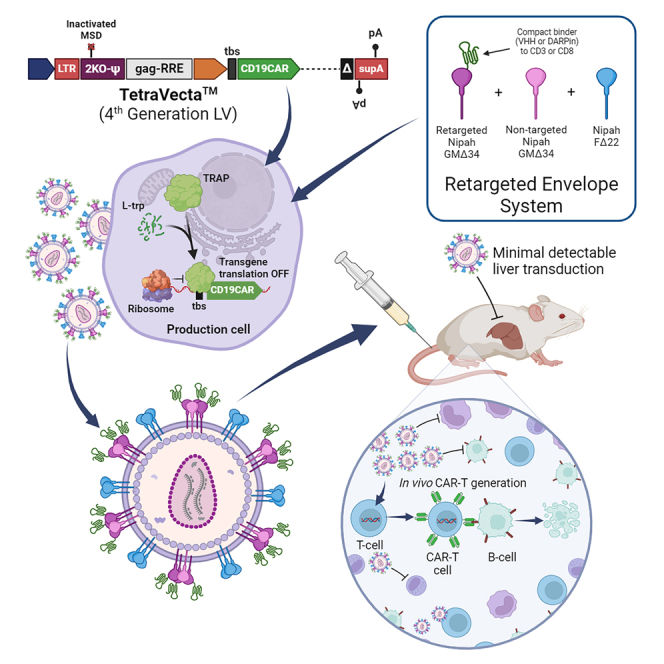 Fig.1 Efficient in vivo CAR T-cell generation is accomplished through a retargeted fourth-generation lentiviral system.1
Our CMC Impurity Clearance & Acute Genotoxicity Screening Service for in vivo CAR integrates orthogonal host-cell impurity quantification with real-time in vivo toxicity biomarkers in a unified platform. It enables early de-risking of vector-associated DNA damage, ensures batch-to-batch targeting consistency, and streamlines regulatory submissions, delivering high-quality, decision-grade data that accelerates IND-enabling programs while reducing preclinical costs and timelines.
Our platform precisely quantifies host-cell DNA and protein contaminants that persist in in vivo CAR vector preparations. By establishing stringent CMC release criteria, this service directly supports the assessment of short-term non-target tissue tolerance during the early transduction phase, while simultaneously verifying the structural integrity of viral envelopes or lipid nanoparticles. It is an essential tool for process development and lot-release testing, ensuring that residual impurity levels remain within safe, regulatory-compliant thresholds before systemic administration.
Learn More →Our service focuses on the early, reversible toxicological events that may arise in off-target organs during the initial hours to days following vector infusion. Using a panel of sensitive in vivo biomarkers, we monitor acute inflammatory responses, DNA damage, and cellular integrity loss across major organ systems. This offering is critical for lead candidate selection and dose-range finding, providing an early warning system to de-risk programs by distinguishing transient, acceptable vector-associated effects from more severe, dose-limiting toxicities.
Learn More →Dedicated to CMC quality assurance, our analytical solutions verify the functional fidelity of engineered surface ligands, such as anti-CD3 or anti-CD5 binding moieties, on viral coats and LNP carriers. Through high-throughput binding-efficiency assays and conformational stability profiling, we ensure that every manufacturing batch maintains uniform target-recognition capacity. Our service is indispensable for bridging preclinical and clinical development, guaranteeing that product performance remains reproducible and reliable across the entire production lifecycle.
Learn More →Q1: What are the main CMC impurity challenges for in vivo CAR vectors, and how does your service address them?
A1: The primary impurities are HCD and HCP from production cell lines, which can provoke off-target immune responses and toxicity. Purification of labile viral vectors or lipid nanoparticles is particularly difficult because standard methods often compromise vector infectivity or consistency. Our service provides orthogonal quantification of these impurities alongside functional integrity testing to ensure each batch meets rigorous safety and quality thresholds before systemic administration.
Q2: What acute genotoxicity and cytotoxicity risks are screened for in vivo CAR products?
A2: Key risks include insertional mutagenesis from integrating vectors, transient systemic inflammation, and off-target cellular damage in non-target organs during the initial transduction window. For vectors with integrating potential, there is a theoretical risk of insertional oncogenesis. Our platform utilizes a panel of rapid in vivo biomarkers to monitor these acute events, including cytokine release and cellular integrity loss, providing an early de-risking tool to distinguish transient, acceptable effects from dose-limiting toxicities.
We combine orthogonal impurity quantification with multiplexed in vivo genotoxicity biomarkers in a single, streamlined platform, eliminating the need for fragmented vendor coordination. Our tailored CMC workflows accelerate regulatory de-risking, ensure batch-to-batch functional consistency, and deliver actionable data that directly supports IND-enabling studies, saving both time and critical preclinical resources.
Our scientific team is ready to design a tailored CMC screening strategy that fits your specific in vivo CAR vector and development timeline. Reach out today to discuss your program's unique challenges—whether at lead selection, IND-enabling, or batch-release stage. Let us help you accelerate the path to clinic with confidence and regulatory clarity.
Reference
For any technical issues or product/service related questions, please leave your information below. Our team will contact you soon.
All products and services are For Research Use Only and CANNOT be used in the treatment or diagnosis of disease.
 NEWSLETTER
The latest newsletter to introduce the latest breaking information, our site updates, field and other scientific news, important events, and insights from industry leaders
LEARN MORE NEWSLETTER NEW SOLUTION
CellRapeutics™ In Vivo Cell Engineering: One-stop in vivo T/B/NK cell and macrophage engineering services covering vectors construction to function verification.
LEARN MORE SOLUTION NOVEL TECHNOLOGY
Silence™ CAR-T Cell: A novel platform to enhance CAR-T cell immunotherapy by combining RNAi technology to suppress genes that may impede CAR functionality.
LEARN MORE NOVEL TECHNOLOGY NEW SOLUTION
Canine CAR-T Therapy Development: From early target discovery, CAR design and construction, cell culture, and transfection, to in vitro and in vivo function validation.
LEARN MORE SOLUTION









