Creative Biolabs has a tradition of commitment. To achieve efficient execution and regulatory approval, we offer careful considerations of your program for the development of a cellular or gene therapy product – now and in the future.
EXPLORE MORE HighlightsWe focus on unmet needs and develop novel cellular and gene drugs and solutions that offer significant benefits over existing options.
EXPLORE MORE HighlightsThe advent of Chimeric Antigen Receptor T-cell (CAR-T) therapies has revolutionized the field of oncology, providing new avenues for treating various forms of cancer. Our 20 years of experience in the biotechnology sector have equipped us with the expertise and technological capabilities to support the entire lifecycle of CAR-T products, from early development to commercialization.
EXPLORE MORETo accelerate advanced breakthroughs of your projects, we offer broad range of platforms which enable our clients be free to tackle problems with cutting-edge technologies from different angles and in different methods.
EXPLORE MORE HighlightsUse the resources in our library to help you understand your options and make critical decisions for your study. We offer oncolytic virus, CAR-T, and dendritic cell related documents, as well as newsletter. If you don't find the answers you're looking for, contact us for additional assistance.
EXPLORE MORE HighlightsGet a real taste and understanding of the business and culture of one of the world's great research-based cellular and gene therapy discovery and development companies.
EXPLORE MORE
The clinical translation of in vivo CAR therapies is increasingly hindered by the dual challenges of ensuring vector replication incompetence and meeting stringent CMC quality control compliance across heterogeneous regulatory landscapes. Our Replication Competence & CMC Quality Control Compliance Validation Services for In vivo CAR provide a unified, risk-based analytical framework tailored specifically for integrase-competent lentiviral and retrovector systems. We offer end-to-end validation protocols, from replication-competent lentivirus (RCL) detection to lot-release potency and purity assays, all aligned with guidelines. By integrating cutting-edge nucleic acid testing with regulatory intelligence, we de-risk your development pipeline and deliver robust, audit-ready data packages that ensure patient safety and regulatory confidence from bench to bedside.
In vivo CAR therapy represents a paradigm shift from conventional ex vivo manufacturing, enabling direct programming of a patient's own T cells within the body using nanoparticle delivery systems, thereby circumventing the logistical burdens of leukapheresis, ex vivo culture, and reinfusion. However, the safety and regulatory success of this approach hinge critically on rigorous replication competence assessment, as any residual or emergent replication-competent vectors, whether from lentiviral or retroviral backbones, pose tangible risks of insertional mutagenesis, uncontrolled T cell proliferation, and oncogenesis, underscoring the non-negotiable need for validated RCL/RCR detection and comprehensive CMC quality control throughout the in-situ engineering cascade.
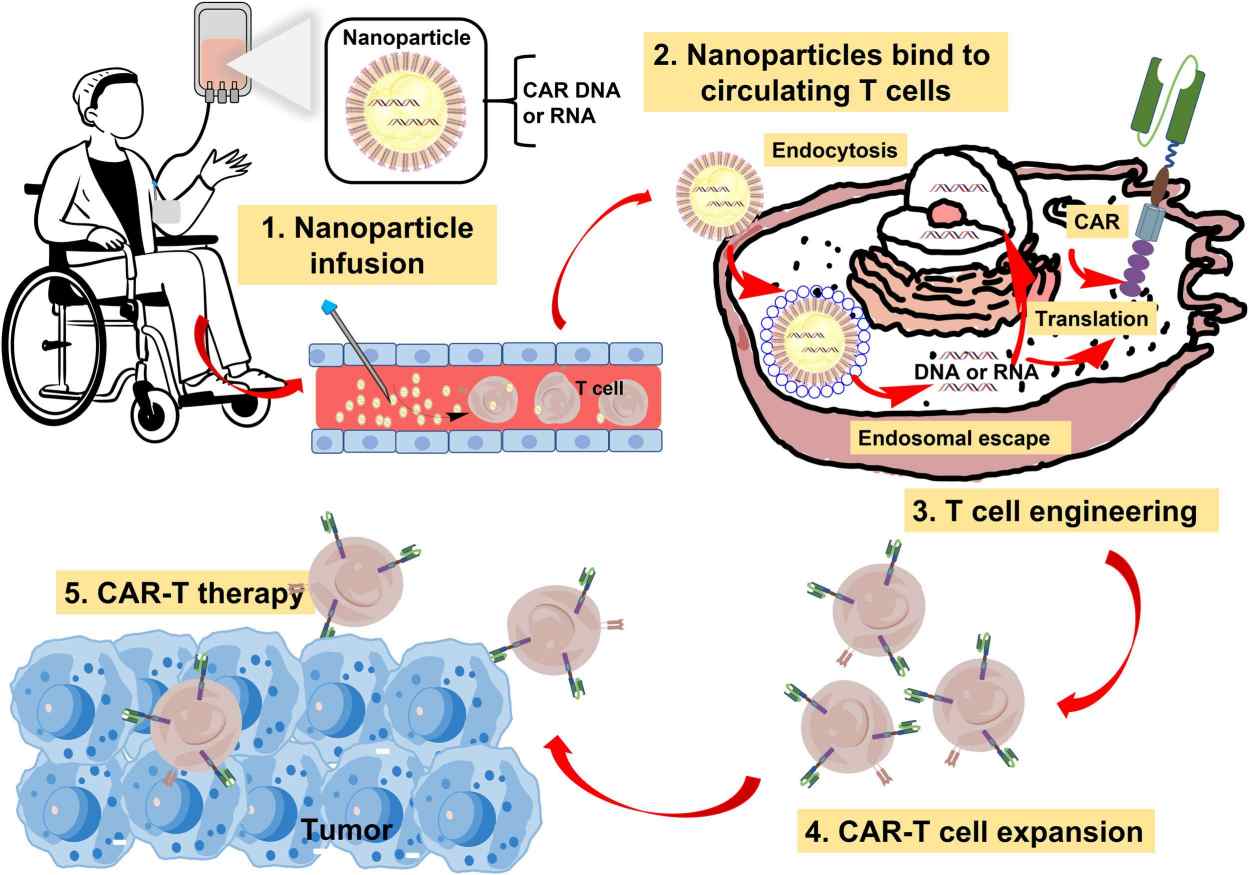 Fig.1 The in vivo procedure of nanoparticle-mediated in-situ CAR-T cell generation.1
Our Replication Competence & CMC Quality Control Compliance Validation Services for In vivo CAR provide a fully integrated, regulatory-aligned framework to ensure vector safety and product consistency. We offer end-to-end validation, from RCL/RCR detection to potency and purity assays, delivering audit-ready data packages that de-risk development, accelerate IND approval, and safeguard clinical translation from bench to bedside.
This service portfolio is dedicated to the regulatory-mandated qualification of lentiviral or retroviral vectors used in in vivo CAR programs, ensuring they are strictly replication-incompetent prior to systemic administration. Through a tiered strategy combining sensitive in vitro indicator cell assays and in vivo immunocompetent animal models, we provide definitive evidence for the absence of replication-competent recombinants.
Learn More →This analytical platform addresses the unique safety challenges of directly injected in vivo CAR vectors by thoroughly characterizing and quantifying process- and product-related impurities that could trigger innate immune responses or oncogenic transformation. We employ orthogonal physicochemical methods alongside sensitive in vitro genotoxicity batteries to evaluate residual host-cell DNA, plasmid backbones, endotoxins, and aggregation species.
Learn More →Q1: What samples must be tested for RCL during lentiviral vector production?
A1: Both the unprocessed viral vector supernatant and the end-of-production cells should be tested for each batch. RCL may arise from recombination events during packaging, and its presence is not always consistent between these two sample types. Therefore, testing only one is insufficient to fully ensure safety.
Q2: Are RCL and RCR testing both required?
A2: For lentiviral vectors, RCL (Replication-Competent Lentivirus) testing applies. For gamma-retroviral vectors, the analogous requirement is RCR (Replication-Competent Retrovirus) testing. Both are critical safety pass/fail criteria—products must be free of replication-competent virus.
We combine deep regulatory intelligence with hands-on analytical expertise to deliver fully validated, audit-ready RCL/CMC data packages tailored for in vivo CAR programs. Our integrated approach from vector design to lot release de-risks your pipeline, accelerates IND filing, and ensures patient safety with scientific rigor and regulatory precision. Choose us for clarity, compliance, and speed.
Ready to de-risk your in vivo CAR program with regulatory-grade RCL and CMC validation? Our expert team is available for confidential consultations, whether you need a full validation strategy, gap analysis, or expedited project support. Reach out today, and let's turn regulatory complexity into your competitive advantage.
Reference
For any technical issues or product/service related questions, please leave your information below. Our team will contact you soon.
All products and services are For Research Use Only and CANNOT be used in the treatment or diagnosis of disease.
 NEWSLETTER
The latest newsletter to introduce the latest breaking information, our site updates, field and other scientific news, important events, and insights from industry leaders
LEARN MORE NEWSLETTER NEW SOLUTION
CellRapeutics™ In Vivo Cell Engineering: One-stop in vivo T/B/NK cell and macrophage engineering services covering vectors construction to function verification.
LEARN MORE SOLUTION NOVEL TECHNOLOGY
Silence™ CAR-T Cell: A novel platform to enhance CAR-T cell immunotherapy by combining RNAi technology to suppress genes that may impede CAR functionality.
LEARN MORE NOVEL TECHNOLOGY NEW SOLUTION
Canine CAR-T Therapy Development: From early target discovery, CAR design and construction, cell culture, and transfection, to in vitro and in vivo function validation.
LEARN MORE SOLUTION









