Creative Biolabs has a tradition of commitment. To achieve efficient execution and regulatory approval, we offer careful considerations of your program for the development of a cellular or gene therapy product – now and in the future.
EXPLORE MORE HighlightsWe focus on unmet needs and develop novel cellular and gene drugs and solutions that offer significant benefits over existing options.
EXPLORE MORE HighlightsThe advent of Chimeric Antigen Receptor T-cell (CAR-T) therapies has revolutionized the field of oncology, providing new avenues for treating various forms of cancer. Our 20 years of experience in the biotechnology sector have equipped us with the expertise and technological capabilities to support the entire lifecycle of CAR-T products, from early development to commercialization.
EXPLORE MORETo accelerate advanced breakthroughs of your projects, we offer broad range of platforms which enable our clients be free to tackle problems with cutting-edge technologies from different angles and in different methods.
EXPLORE MORE HighlightsUse the resources in our library to help you understand your options and make critical decisions for your study. We offer oncolytic virus, CAR-T, and dendritic cell related documents, as well as newsletter. If you don't find the answers you're looking for, contact us for additional assistance.
EXPLORE MORE HighlightsGet a real taste and understanding of the business and culture of one of the world's great research-based cellular and gene therapy discovery and development companies.
EXPLORE MORE
Creative Biolabs provides a Germline Transmission & Sensitive Tissue Testing (DRG) Service for In Vivo CAR to support evaluation of reproductive safety in gene-modified and in vivo CAR programs. This service addresses key uncertainties such as gonadal biodistribution, germline exposure risk assessment, and regulatory requirements for long-term genetic stability. It enables characterization of vector and construct distribution in sensitive reproductive tissues and evaluates potential germline involvement using validated molecular detection methods and tissue-level analytical platforms.
As an essential safety testing module for gene-modified therapeutics, germline transmission analysis combined with high-sensitivity DRG tissue detection holds great significance, most notably for in vivo CAR systems relying on nucleic acid and vector-mediated delivery approaches. Preclinical gene therapy studies have proven that vector DNA may temporarily localize in gonadal tissue, though such distribution rarely leads to germline integration or heritable gene transfer.
Creative Biolabs provides a structured safety evaluation framework designed to support in vivo CAR programs from early preclinical development to regulatory submission. Our service focuses on detecting vector distribution in reproductive organs, assessing potential germline exposure, and confirming absence of heritable genetic transfer. Our core technical outputs encompass quantitative biodistribution characterization of reproductive and somatic tissues, high-precision screening for germline vector exposure in reproductive cells and biological fluids, ultrasensitive long-term detection of vector retention in tissues, and regulatory-aligned risk evaluation that fully complies with reproductive safety guidelines.
Discover How We Can Help - Request a Consultation.
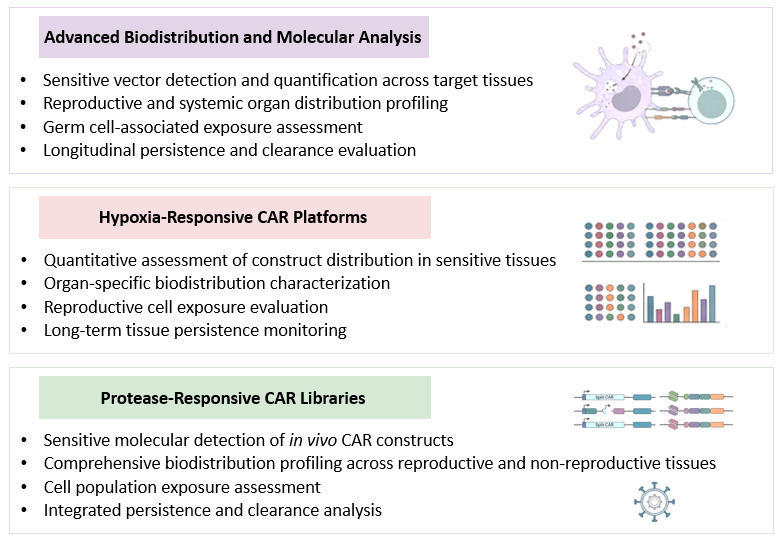
Creative Biolabs offers integrated analytical and in vivo platforms for CAR construct reproductive safety testing, featuring high-sensitivity PCR quantification, reproductive tissue biodistribution and germ cell fraction analysis, gonadal and germline exposure screening, multi-organ off-target monitoring, plus regulatory-compliant risk assessment reports with cross-tissue correlation analysis.
To launch the reproductive safety study, clients need to provide CAR construct specifications, a preclinical study design covering animal species, dosage, and sampling timeline, and a list of target tissues to be collected and analyzed.
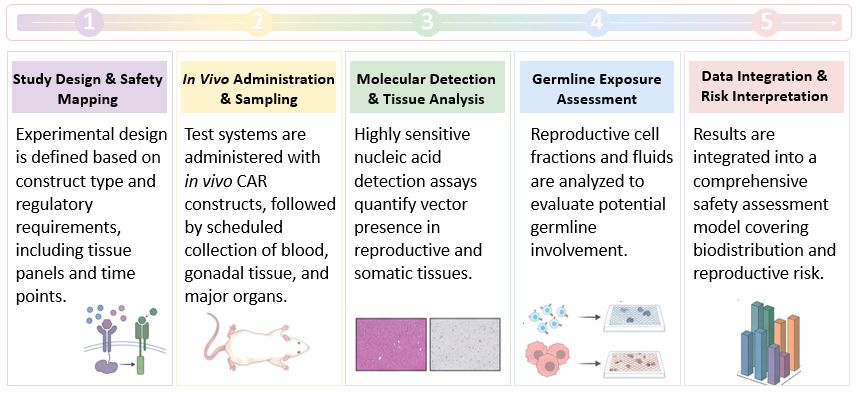
Clients will receive a complete biodistribution and reproductive tissue exposure report, quantitative vector distribution data, germline exposure risk summaries, and safety interpretation documents prepared for regulatory submission.
Evaluation of potential germline transmission risk and reproductive genetic toxicity through sensitive detection of vector distribution, genomic integration, and genotoxic effects in reproductive tissues, ensuring safety assessment for gene and cell therapy candidates.
Learn More →Detailed assessment of neurotoxicity in peripheral nervous system tissues, with emphasis on dorsal root ganglia, analyzing structural integrity, neuronal function, and molecular injury markers to identify potential off-target neurotoxic effects of therapeutic candidates.
Learn More →Q1: Why is germline transmission testing important for in vivo CAR systems?
A1: It ensures that systemic gene delivery vectors do not introduce heritable genetic changes into patient DNA, which is essential for establishing, long-term reproductive safety profiles.
Q2: Does detection in gonadal tissue indicate germline integration?
A2: Not necessarily. Positive signals frequently reflect transient vascular biodistribution or accumulation in localized somatic support cells rather than permanent genomic integration into actual reproductive germ cells.
Q3: What tissues are included in sensitive tissue testing?
A3: Testing commonly evaluates the testis, ovary, liver, spleen, brain, and bone marrow to provide a highly sensitive, overview of systemic vector exposure and long-term tissue persistence.
Q4: Can this testing support regulatory submissions?
A4: Yes. The generated data is structurally organized to align perfectly with preclinical reproductive safety expectations and guidelines mandated by global regulatory agencies for gene therapy evaluation packages.
Q5: How does this service support in vivo CAR development?
A5: It identifies potential reproductive liabilities early, allowing development teams to make data-driven optimizations regarding delivery vehicle engineering, targeting mechanisms, and safe preclinical dosing strategies.
Creative Biolabs provides Germline Transmission & Sensitive Tissue Testing (DRG) services tailored for in vivo CAR development, enabling accurate assessment of reproductive safety, tissue exposure, and germline risk characterization. These studies support the development of robust IND-enabling packages and strengthen translational confidence in advanced gene-modified therapies. Driven by our state-of-the-art molecular biology platforms and a dedicated team of regulatory compliance experts, we ensure that your advanced therapeutics seamlessly meet global preclinical safety benchmarks. For detailed project consultation, study design customization, or regulatory support, please feel free to reach out to our expert team.
For any technical issues or product/service related questions, please leave your information below. Our team will contact you soon.
All products and services are For Research Use Only and CANNOT be used in the treatment or diagnosis of disease.
 NEWSLETTER
The latest newsletter to introduce the latest breaking information, our site updates, field and other scientific news, important events, and insights from industry leaders
LEARN MORE NEWSLETTER NEW SOLUTION
CellRapeutics™ In Vivo Cell Engineering: One-stop in vivo T/B/NK cell and macrophage engineering services covering vectors construction to function verification.
LEARN MORE SOLUTION NOVEL TECHNOLOGY
Silence™ CAR-T Cell: A novel platform to enhance CAR-T cell immunotherapy by combining RNAi technology to suppress genes that may impede CAR functionality.
LEARN MORE NOVEL TECHNOLOGY NEW SOLUTION
Canine CAR-T Therapy Development: From early target discovery, CAR design and construction, cell culture, and transfection, to in vitro and in vivo function validation.
LEARN MORE SOLUTION









