Creative Biolabs has a tradition of commitment. To achieve efficient execution and regulatory approval, we offer careful considerations of your program for the development of a cellular or gene therapy product – now and in the future.
EXPLORE MORE HighlightsWe focus on unmet needs and develop novel cellular and gene drugs and solutions that offer significant benefits over existing options.
EXPLORE MORE HighlightsThe advent of Chimeric Antigen Receptor T-cell (CAR-T) therapies has revolutionized the field of oncology, providing new avenues for treating various forms of cancer. Our 20 years of experience in the biotechnology sector have equipped us with the expertise and technological capabilities to support the entire lifecycle of CAR-T products, from early development to commercialization.
EXPLORE MORETo accelerate advanced breakthroughs of your projects, we offer broad range of platforms which enable our clients be free to tackle problems with cutting-edge technologies from different angles and in different methods.
EXPLORE MORE HighlightsUse the resources in our library to help you understand your options and make critical decisions for your study. We offer oncolytic virus, CAR-T, and dendritic cell related documents, as well as newsletter. If you don't find the answers you're looking for, contact us for additional assistance.
EXPLORE MORE HighlightsGet a real taste and understanding of the business and culture of one of the world's great research-based cellular and gene therapy discovery and development companies.
EXPLORE MORE
Creative Biolabs provides In-Depth Evaluation Services of Targeted Neurotoxicity within Sensitive Peripheral Nervous Tissues (Dorsal Root Ganglia Focus) to support neuro-safety assessment of gene therapies, viral vectors, and other advanced therapeutics. This service addresses concerns related to DRG exposure, peripheral neurotoxicity, tissue-specific biodistribution, and regulatory requirements for sensitive nervous tissue evaluation. Through integrated histopathological examination, molecular characterization, biomarker analysis, and functional assessments, Creative Biolabs helps identify potential neurotoxic liabilities, characterize tissue-specific safety profiles, and generate robust preclinical data to support translational development and regulatory submissions.
Growing evidence from nonclinical neurotoxicity studies has highlighted the dorsal root ganglia as one of the most sensitive peripheral nervous system structures susceptible to therapy-related injury. Published investigations have reported neuronal degeneration, axonal alterations, inflammatory cell infiltration, and sensory nerve abnormalities following exposure to certain neurotropic therapeutic platforms. These findings have increased regulatory attention toward dedicated DRG evaluation during preclinical safety assessment.
Sensitive peripheral nervous tissues, particularly dorsal root ganglia (DRG), have become critical evaluation targets in the safety assessment of gene-modified therapeutics, engineered immune cell products, viral vector-based therapies, and other advanced medicinal products. Findings related to DRG injury, neuronal degeneration, inflammatory infiltration, or unintended tissue exposure can significantly influence regulatory review and clinical development strategies.
Creative Biolabs provides dedicated neurotoxicity evaluation services focused on vulnerable peripheral nervous system compartments. Our integrated approach supports the identification of treatment-related neurotoxic effects, characterization of tissue distribution patterns, and generation of safety datasets suitable for preclinical decision-making. Our core project support capabilities cover DRG tissue collection and pathology, peripheral nervous system biodistribution, neuroinflammation and immune infiltration detection, neuronal damage characterization, molecular testing of therapeutics in neural tissues, and functional neurotoxicity correlation analysis.
Discover How We Can Help - Request a Consultation.
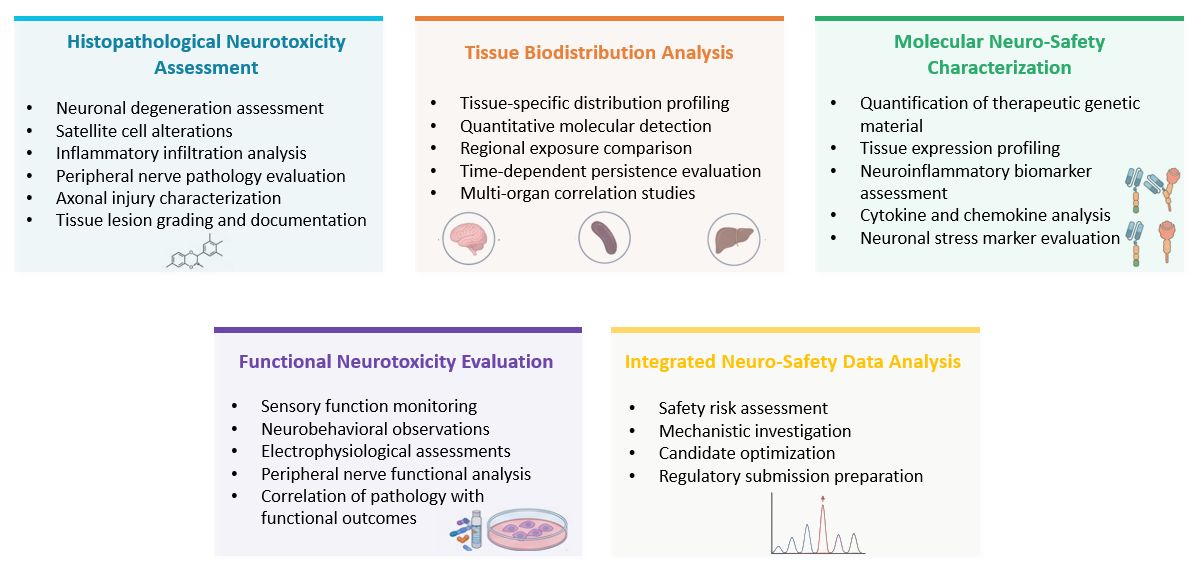
We deliver histopathological evaluation of neural tissues, nervous system biodistribution testing, molecular neuro-safety profiling and functional neurotoxicity monitoring, integrating all datasets to conduct risk evaluation, mechanistic research, candidate optimization and regulatory dossier preparation.
To start the neurotoxicity evaluation project, clients shall provide therapeutic product profiles, existing biodistribution/toxicology data if accessible, as well as study goals, target tissues, animal species and relevant regulatory demands.
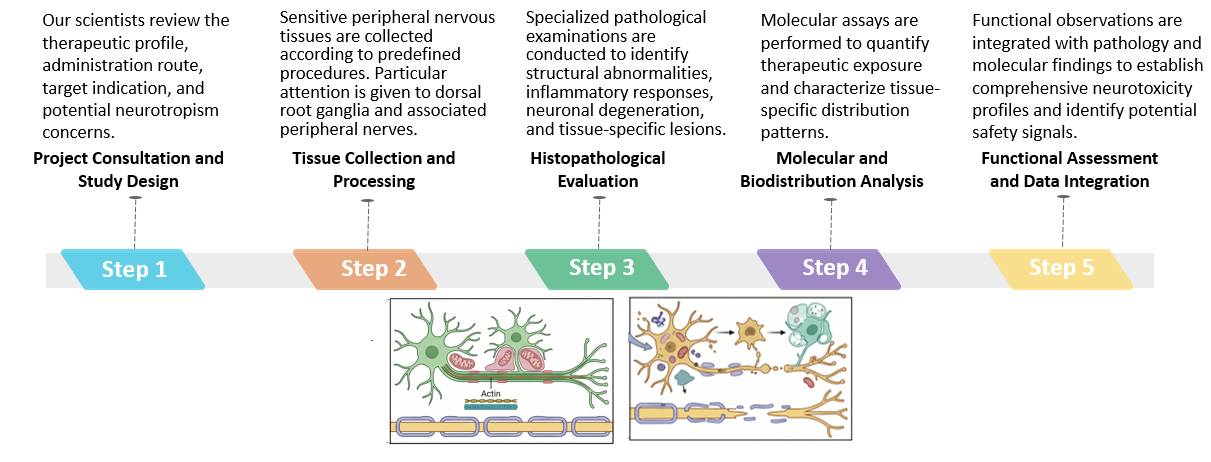
Clients will receive complete project documents containing graded histopathology reports, biodistribution and molecular analysis reports, as well as an integrated neurotoxicity assessment summary with supporting datasets.
Q: Why is dorsal root ganglia evaluation important during preclinical development?
A: The DRG is highly sensitive to certain therapeutic exposures and may reveal early indicators of peripheral neurotoxicity that are not readily detected in other tissues. Dedicated assessment helps generate a more complete safety profile.
Q: Which therapeutic modalities may benefit from DRG-focused neurotoxicity studies?
A: DRG evaluation is frequently considered for gene-modified therapies, viral vector-based therapeutics, engineered immune cell products, nucleic acid therapeutics, and other modalities with potential nervous system exposure.
Q: Can neurotoxicity findings be correlated with biodistribution data?
A: Yes. Combining pathology findings with biodistribution analysis helps determine whether tissue exposure patterns are associated with observed neurotoxic effects and supports mechanistic interpretation.
Q: What types of endpoints are included in a neurotoxicity assessment?
A: A complete assessment may include histopathology, molecular characterization, tissue distribution analysis, inflammatory marker evaluation, and functional neurological endpoints.
Q: Can the study design be customized for specific regulatory objectives?
A: Absolutely. Creative Biolabs develops tailored study strategies aligned with project goals, therapeutic characteristics, and anticipated regulatory expectations to maximize the value of generated data.
Creative Biolabs provides In-Depth Evaluation Services of Targeted Neurotoxicity within Sensitive Peripheral Nervous Tissues, with specialized focus on dorsal root ganglia assessment. Our integrated capabilities combine tissue harvesting, pathology evaluation, biodistribution analysis, molecular characterization, and functional assessment to support informed safety decisions throughout therapeutic development. Whether you are evaluating a novel therapeutic candidate, investigating potential neurotoxicity risks, or preparing for regulatory interactions, Creative Biolabs can support your project with customized neuro-safety solutions. Connect with our team for extra information and a conversation about your project.
For any technical issues or product/service related questions, please leave your information below. Our team will contact you soon.
All products and services are For Research Use Only and CANNOT be used in the treatment or diagnosis of disease.
 NEWSLETTER
The latest newsletter to introduce the latest breaking information, our site updates, field and other scientific news, important events, and insights from industry leaders
LEARN MORE NEWSLETTER NEW SOLUTION
CellRapeutics™ In Vivo Cell Engineering: One-stop in vivo T/B/NK cell and macrophage engineering services covering vectors construction to function verification.
LEARN MORE SOLUTION NOVEL TECHNOLOGY
Silence™ CAR-T Cell: A novel platform to enhance CAR-T cell immunotherapy by combining RNAi technology to suppress genes that may impede CAR functionality.
LEARN MORE NOVEL TECHNOLOGY NEW SOLUTION
Canine CAR-T Therapy Development: From early target discovery, CAR design and construction, cell culture, and transfection, to in vitro and in vivo function validation.
LEARN MORE SOLUTION









