Creative Biolabs has a tradition of commitment. To achieve efficient execution and regulatory approval, we offer careful considerations of your program for the development of a cellular or gene therapy product – now and in the future.
EXPLORE MORE HighlightsWe focus on unmet needs and develop novel cellular and gene drugs and solutions that offer significant benefits over existing options.
EXPLORE MORE HighlightsThe advent of Chimeric Antigen Receptor T-cell (CAR-T) therapies has revolutionized the field of oncology, providing new avenues for treating various forms of cancer. Our 20 years of experience in the biotechnology sector have equipped us with the expertise and technological capabilities to support the entire lifecycle of CAR-T products, from early development to commercialization.
EXPLORE MORETo accelerate advanced breakthroughs of your projects, we offer broad range of platforms which enable our clients be free to tackle problems with cutting-edge technologies from different angles and in different methods.
EXPLORE MORE HighlightsUse the resources in our library to help you understand your options and make critical decisions for your study. We offer oncolytic virus, CAR-T, and dendritic cell related documents, as well as newsletter. If you don't find the answers you're looking for, contact us for additional assistance.
EXPLORE MORE HighlightsGet a real taste and understanding of the business and culture of one of the world's great research-based cellular and gene therapy discovery and development companies.
EXPLORE MORE
Current challenges in vector design include the inability to reliably predict homologous recombination (HR) events that may lead to replication-competent viruses, compromising safety and efficacy. Our Homologous Recombination Sequence Modeling & Evolution Prediction Services addresses this gap by integrating bioinformatic and molecular assessments of vector sequences to minimize HR risks. We provide in silico modeling of recombination hotspots, evolutionary trajectory simulations, and empirical validation of vector candidates. By predicting recombination-prone regions pre-synthesis, our service enables safer vector design, accelerates regulatory approval, and reduces costly wet-lab failures, offering confidence for gene therapy and vaccine development.
Replication-competent vector homologous recombination denotes the restoration of viral self-replication capacity through genetic exchange between vector constructs and homologous templates, including helper plasmids, host chromosomal regions, or concurrent vector systems. Such events represent a principal safety concern in therapeutic gene delivery and vaccine platforms, given that rare recombinational rescue can yield propagating viruses capable of triggering genotoxicity, systemic dissemination, or immune dysregulation, hazards that conventional sequence comparison methods frequently fail to foresee.
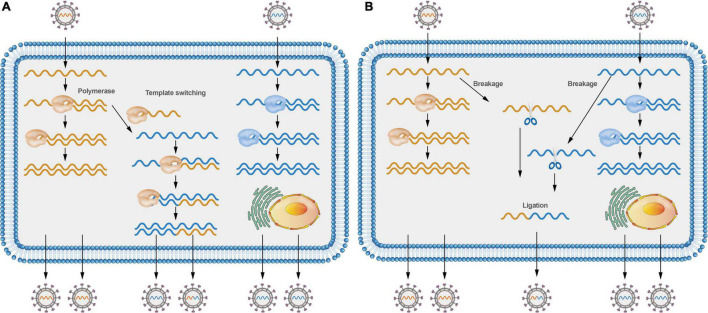 Fig.1 Recombination in positive-sense RNA viruses.1
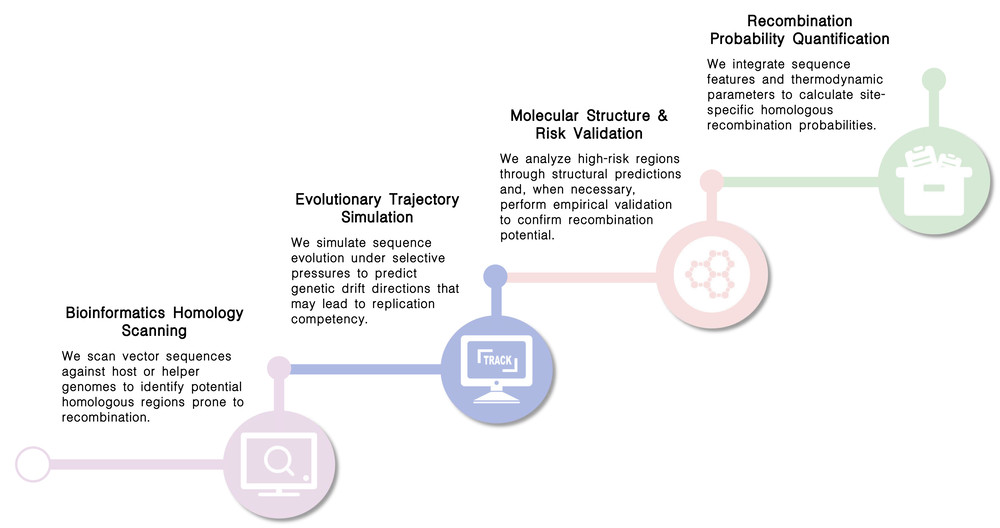
Our Homologous Recombination Sequence Modeling & Evolution Prediction Services integrate bioinformatic homology scanning, structural modeling, and evolutionary simulations to systematically identify and mitigate recombination risks in viral vectors. By predicting replication-competent variants pre-synthesis, we enable safer vector design, accelerate regulatory approval, and reduce costly failures, delivering confidence for gene therapy and vaccine development.
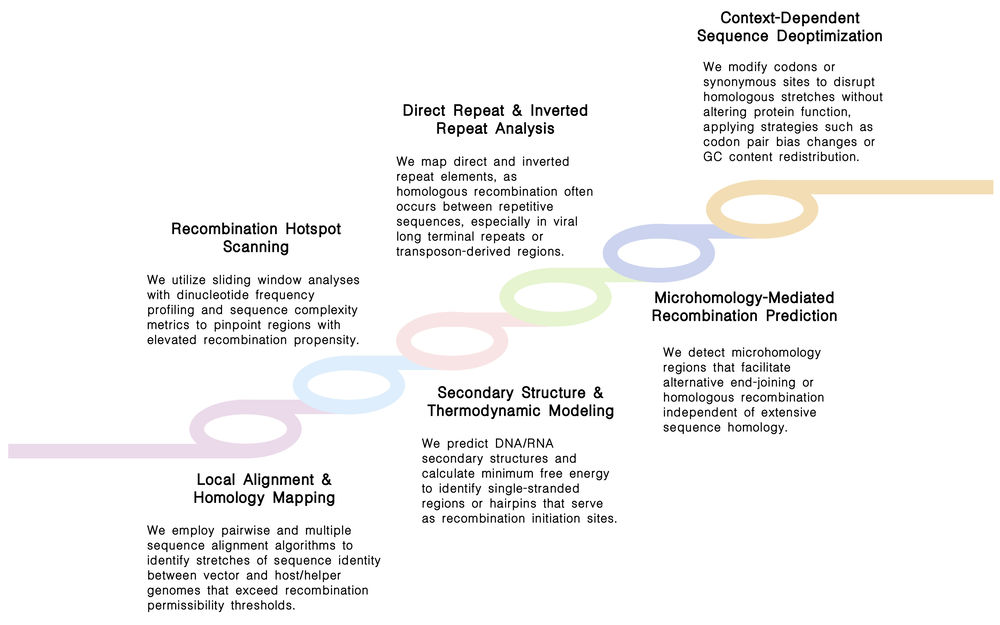
We offer a comprehensive suite of computational strategies to model homologous recombination risks, including homology mapping, hotspot scanning, structural and thermodynamic analysis, repeat characterization, microhomology prediction, and sequence deoptimization for safer vector design.
Q1: What types of vectors can this service evaluate?
A1: We evaluate lentiviral, AAV, gamma-retroviral, non-viral plasmids, and RNA-based vector systems, including those with split packaging or self-inactivating designs.
Q2: What is the turnaround time for a standard project?
A2: Typical turnaround ranges from 2 to 4 weeks, depending on vector complexity and whether optional wet-lab validation is requested.
Q3: What formats do you accept for starting materials?
A3: We accept FASTA, GenBank, or plain-text sequence files, along with host genome references or helper plasmid sequences when available.
Choose us for unparalleled expertise in predicting and mitigating homologous recombination risks. We combine advanced bioinformatic modeling, evolutionary simulations, and optional wet-lab validation to deliver safer vector designs. Our proactive approach accelerates regulatory approval, reduces costly failures, and provides documented confidence for gene therapy and vaccine development.
"Our gamma-retroviral vector carried extensive repetitive elements that raised safety concerns. The homology scanning and microhomology prediction modules pinpointed exactly which regions were prone to recombination. We modified the vector accordingly, and subsequent empirical testing confirmed zero recombination events even under selective pressure." Dr. P* S*.
"We used the evolution prediction arm to simulate how our split-vector system might recombine with endogenous retroviral sequences in target cells. The service not only identified the recombination-prone regions but also provided an optimized sequence with redesigned codon usage. The final vector showed unprecedented stability in our in vivo models." Dr. A* W*.
We invite you to discuss your vector safety challenges with our expert team. Contact us to request a customized project plan, receive a confidential quote, or schedule a technical consultation. Let us help you minimize recombination risks and accelerate your gene therapy or vaccine development program with confidence.
Reference
For any technical issues or product/service related questions, please leave your information below. Our team will contact you soon.
All products and services are For Research Use Only and CANNOT be used in the treatment or diagnosis of disease.
 NEWSLETTER
The latest newsletter to introduce the latest breaking information, our site updates, field and other scientific news, important events, and insights from industry leaders
LEARN MORE NEWSLETTER NEW SOLUTION
CellRapeutics™ In Vivo Cell Engineering: One-stop in vivo T/B/NK cell and macrophage engineering services covering vectors construction to function verification.
LEARN MORE SOLUTION NOVEL TECHNOLOGY
Silence™ CAR-T Cell: A novel platform to enhance CAR-T cell immunotherapy by combining RNAi technology to suppress genes that may impede CAR functionality.
LEARN MORE NOVEL TECHNOLOGY NEW SOLUTION
Canine CAR-T Therapy Development: From early target discovery, CAR design and construction, cell culture, and transfection, to in vitro and in vivo function validation.
LEARN MORE SOLUTION









