Creative Biolabs has a tradition of commitment. To achieve efficient execution and regulatory approval, we offer careful considerations of your program for the development of a cellular or gene therapy product – now and in the future.
EXPLORE MORE HighlightsWe focus on unmet needs and develop novel cellular and gene drugs and solutions that offer significant benefits over existing options.
EXPLORE MORE HighlightsThe advent of Chimeric Antigen Receptor T-cell (CAR-T) therapies has revolutionized the field of oncology, providing new avenues for treating various forms of cancer. Our 20 years of experience in the biotechnology sector have equipped us with the expertise and technological capabilities to support the entire lifecycle of CAR-T products, from early development to commercialization.
EXPLORE MORETo accelerate advanced breakthroughs of your projects, we offer broad range of platforms which enable our clients be free to tackle problems with cutting-edge technologies from different angles and in different methods.
EXPLORE MORE HighlightsUse the resources in our library to help you understand your options and make critical decisions for your study. We offer oncolytic virus, CAR-T, and dendritic cell related documents, as well as newsletter. If you don't find the answers you're looking for, contact us for additional assistance.
EXPLORE MORE HighlightsGet a real taste and understanding of the business and culture of one of the world's great research-based cellular and gene therapy discovery and development companies.
EXPLORE MORE
The development of in vivo CAR therapies faces significant regulatory and safety challenges, particularly the risk of replication-competent vector (RCV) emergence that could lead to oncogenesis or insertional mutagenesis. We offer comprehensive Statutory Replication-Competent Vector (RCV) Safety Clearance Services specifically tailored for in vivo CAR applications. Our services include validated co-culture assays, contamination auditing, and sequence modeling to detect and mitigate RCV risks. By combining regulatory expertise with advanced predictive analytics, we provide robust safety documentation and actionable insights, enabling you to accelerate regulatory approval and ensure product safety from discovery through clinical translation.
A replication-competent vector is a modified viral or plasmid-based system capable of self-propagation within host cells, enabling sustained gene expression and amplification of genetic material without helper viruses. In CAR therapy, replication-competent vectors offer a promising platform for efficient and durable delivery of the CAR transgene into immune effector cells, potentially enhancing in vivo expansion and long-term anti-tumor activity while simplifying ex vivo manufacturing protocols through library-based optimization of vector components.
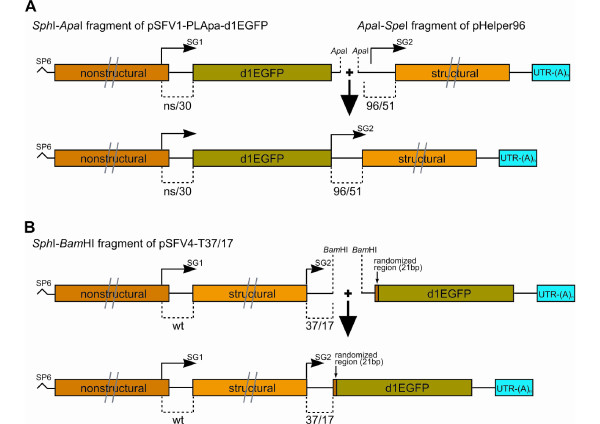 Fig.1 Approaches for building replication-competent vector genomes and corresponding libraries.1
Our Statutory RCV Safety Clearance Services for in vivo CAR therapies provide regulatory-compliant detection of replication-competent lentivirus/retrovirus and AAV contaminants. Leveraging co-culture assays, contamination auditing, and predictive sequence modeling, we mitigate oncogenic risks, ensure product safety, and accelerate regulatory approval from discovery to clinical translation.
This service provides regulatory-compliant co-culture assays to detect replication-competent lentivirus (RCL) or retrovirus (RCR) in in vivo CAR vector products. It supports product safety evaluation by enabling sensitive and validated detection of potential RCL/RCr contamination, which is essential for meeting gene therapy regulatory requirements and advancing candidate products toward clinical trials.
Learn More →This offering focuses on the detection and quantification of replication-competent AAV (RCA) impurities during in vivo CAR vector production. It helps you ensure the absence of RCA contaminants that could compromise product safety and efficacy, providing critical auditing support for quality control, regulatory submissions, and lot release of AAV-based gene therapies.
Learn More →This service employs computational modeling and predictive algorithms to assess the risk of homologous recombination events in vector genomes, as well as to forecast potential sequence evolution of replication-competent recombinants. It supports risk assessment and vector design optimization for in vivo CAR applications, enabling proactive safety evaluation and reducing the likelihood of unintended RC vector emergence during product development.
Learn More →Q1: What types of RCV risks are relevant for CAR products?
A1: For in vivo CAR products, the main safety concerns revolve around three types of replication-competent vectors: RCL from lentiviral systems, RCR from gamma-retroviral platforms, and RCA from AAV-based constructs. These unwanted variants can emerge during vector production, often triggered by homologous recombination between vector genomes and helper or packaging sequences present in producer cells. Additionally, rare manufacturing errors may lead to their accidental formation. Once present, these RCVs pose serious clinical threats, including insertional mutagenesis that disrupts tumor suppressor genes or activation of oncogenes, potentially driving secondary cancers or uncontrolled clonal expansion.
Q2: Can these services be used for early-stage vector design?
A2: Yes. Predictive modeling can guide vector engineering to minimize recombination potential, while full clearance assays are typically required for later-stage safety validation and lot release.
Q3: What sample types do you accept?
A3: We accept vector supernatants, producer cell lysates, final CAR vector products, and co-culture harvests, depending on the specific assay requirements.
We combine regulatory expertise with advanced predictive analytics to deliver statutory RCV safety clearance tailored for in vivo CAR therapies. Our validated co-culture assays, RCA auditing, and recombination modeling proactively mitigate oncogenic risks, accelerate regulatory approval, and ensure your product meets global safety standards from discovery to clinical translation.
Concerned about regulatory risks for your CAR program? A statutory RCV clearance strategy can offer a clear path forward. Contact our regulatory safety specialists now. We deliver fast, expert guidance to assess your vector platform, design a customized testing approach, and provide a cost-competitive proposal. Just fill out the short form on this page, and one of our senior scientists will follow up to review your product stage and regulatory milestones.
Reference
For any technical issues or product/service related questions, please leave your information below. Our team will contact you soon.
All products and services are For Research Use Only and CANNOT be used in the treatment or diagnosis of disease.
 NEWSLETTER
The latest newsletter to introduce the latest breaking information, our site updates, field and other scientific news, important events, and insights from industry leaders
LEARN MORE NEWSLETTER NEW SOLUTION
CellRapeutics™ In Vivo Cell Engineering: One-stop in vivo T/B/NK cell and macrophage engineering services covering vectors construction to function verification.
LEARN MORE SOLUTION NOVEL TECHNOLOGY
Silence™ CAR-T Cell: A novel platform to enhance CAR-T cell immunotherapy by combining RNAi technology to suppress genes that may impede CAR functionality.
LEARN MORE NOVEL TECHNOLOGY NEW SOLUTION
Canine CAR-T Therapy Development: From early target discovery, CAR design and construction, cell culture, and transfection, to in vitro and in vivo function validation.
LEARN MORE SOLUTION









