Creative Biolabs has a tradition of commitment. To achieve efficient execution and regulatory approval, we offer careful considerations of your program for the development of a cellular or gene therapy product – now and in the future.
EXPLORE MORE HighlightsWe focus on unmet needs and develop novel cellular and gene drugs and solutions that offer significant benefits over existing options.
EXPLORE MORE HighlightsThe advent of Chimeric Antigen Receptor T-cell (CAR-T) therapies has revolutionized the field of oncology, providing new avenues for treating various forms of cancer. Our 20 years of experience in the biotechnology sector have equipped us with the expertise and technological capabilities to support the entire lifecycle of CAR-T products, from early development to commercialization.
EXPLORE MORETo accelerate advanced breakthroughs of your projects, we offer broad range of platforms which enable our clients be free to tackle problems with cutting-edge technologies from different angles and in different methods.
EXPLORE MORE HighlightsUse the resources in our library to help you understand your options and make critical decisions for your study. We offer oncolytic virus, CAR-T, and dendritic cell related documents, as well as newsletter. If you don't find the answers you're looking for, contact us for additional assistance.
EXPLORE MORE HighlightsGet a real taste and understanding of the business and culture of one of the world's great research-based cellular and gene therapy discovery and development companies.
EXPLORE MORE
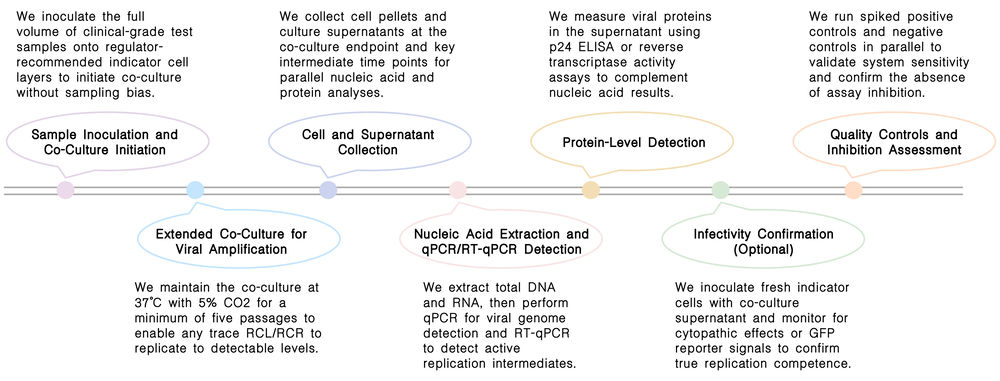
Ensuring clinical-grade vectors for gene-modified cell therapies remain entirely free of replication-competent lentivirus (RCL) and retrovirus (RCR) is a major hurdle, given the tumorigenic and biosafety threats posed by trace contaminants. To meet these statutory requirements, our RCL/RCR Co-Culture Assays employ a prolonged co-culture system using regulator-recommended indicator cell lines. Our platform combines ultrasensitive qPCR with ELISA-based readouts to rigorously confirm the absence of replication-competent viral residuals in bulk CAR-T vector intermediates and final in vivo formulations. Our approach offers full regulatory alignment, delivering you validated safety data and dependable support for advancing clinical-stage cell therapy programs.
Replication-competent lentivirus (RCL) and replication-competent retrovirus (RCR) are rare but hazardous contaminants that can arise during the production of viral vectors for gene therapy. In CAR-T therapy, the presence of even trace amounts of RCL or RCR poses serious risks, including insertional mutagenesis, uncontrolled clonal expansion, malignant transformation, and potential systemic dissemination following patient infusion.
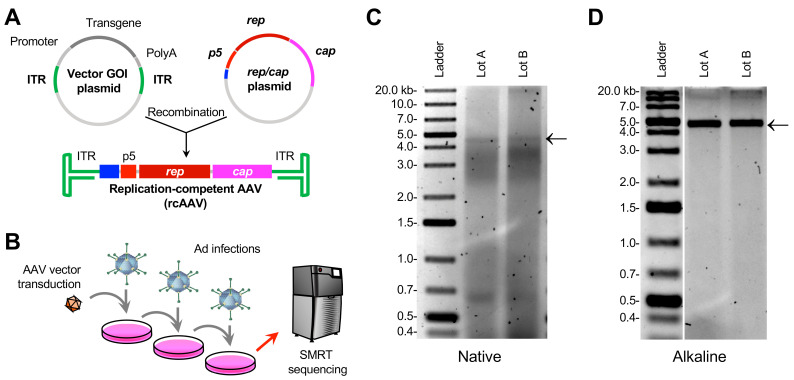 Fig.1 Amplification of replication-competent AAV.1
Our Statutory RCL/RCR Co-Culture Assays combine regulator-recommended indicator cells with extended co-culture and orthogonal qPCR/ELISA detection to ensure clinical-grade CAR-T vectors are free of replication-competent virus. We provide full volume testing, built-in controls, and complete IND-ready reports, offering clients uncompromised safety validation and regulatory confidence.
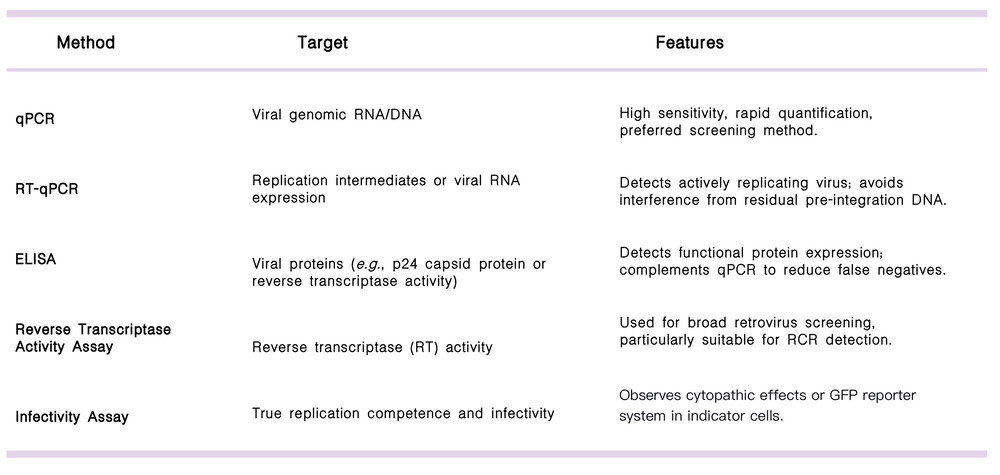
We offer a suite of orthogonal detection methods for Statutory RCL/RCR Co-Culture Assays, including qPCR, RT-qPCR, ELISA and infectivity assays, ensuring sensitive, complementary, and regulatory-compliant identification of replication-competent virus in clinical-grade CAR-T products.
Final Deliverables:
Q1: Which offers better sensitivity, qPCR or ELISA? Is it necessary to run both?
A1: qPCR delivers higher nucleic acid sensitivity but may detect non-infectious, integration-defective vector DNA. In contrast, ELISA targeting p24 or RT activity captures functional viral proteins, directly reflecting particle integrity and replicative capacity. Regulatory guidelines mandate using both in parallel: qPCR serves as a high-sensitivity screen, while ELISA confirms protein expression. Together, they significantly lower false-negative risk.
Q2: How much sample volume is required?
A2: We request the entire volume of clinical-grade vector bulk and final formulation, or a fully representative large-volume aliquot. The exact amount depends on your production process and batch size to avoid sampling bias. Please contact us in advance to determine the precise sample volume needed.
Choose us for regulatory-ready RCL/RCR testing with co-culture and orthogonal qPCR/ELISA. We deliver ultra-high sensitivity, full-volume sampling, built-in controls, and complete submission packages, including CoA and validation reports, ensuring your clinical-stage CAR-T products meet global safety standards with absolute confidence.
"After a suspected RCL contamination scare during process scale-up, we turned to this co-culture assay service. The team used full-volume testing on our bulk vector and final formulation, confirming no replication-competent virus was present. The detailed CoA and raw data allowed us to quickly resume clinical production with full safety documentation." Dr. James Liu.
"We incorporated the Statutory RCL/RCR Co-Culture Assays into our lot release testing strategy. The built-in spiked positive controls and inhibition assessment gave us real confidence in each negative result. Over six consecutive lots, we observed consistent assay performance with no false negatives. This service has become an essential part of our product safety framework." Dr. S* C*.
"We outsourced our RCL/RCR statutory testing to this service during a peak production period when our internal capacity was exhausted. Despite the high sample volume, the team delivered all reports within 5-6 weeks as promised. The communication was clear, and the data package was well-organized for direct submission. This allowed us to meet our regulatory deadline without compromising quality." Dr. Anita Verma.
For inquiries, pricing, or to initiate a Statutory RCL/RCR Co-Culture Assay for your CAR-T program, please reach out to our regulatory support team. We provide rapid technical assessments, sample volume guidance, and a detailed quote tailored to your IND timeline. Let us help secure your product's safety with confidence.
Reference
For any technical issues or product/service related questions, please leave your information below. Our team will contact you soon.
All products and services are For Research Use Only and CANNOT be used in the treatment or diagnosis of disease.
 NEWSLETTER
The latest newsletter to introduce the latest breaking information, our site updates, field and other scientific news, important events, and insights from industry leaders
LEARN MORE NEWSLETTER NEW SOLUTION
CellRapeutics™ In Vivo Cell Engineering: One-stop in vivo T/B/NK cell and macrophage engineering services covering vectors construction to function verification.
LEARN MORE SOLUTION NOVEL TECHNOLOGY
Silence™ CAR-T Cell: A novel platform to enhance CAR-T cell immunotherapy by combining RNAi technology to suppress genes that may impede CAR functionality.
LEARN MORE NOVEL TECHNOLOGY NEW SOLUTION
Canine CAR-T Therapy Development: From early target discovery, CAR design and construction, cell culture, and transfection, to in vitro and in vivo function validation.
LEARN MORE SOLUTION









