Creative Biolabs has a tradition of commitment. To achieve efficient execution and regulatory approval, we offer careful considerations of your program for the development of a cellular or gene therapy product – now and in the future.
EXPLORE MORE HighlightsWe focus on unmet needs and develop novel cellular and gene drugs and solutions that offer significant benefits over existing options.
EXPLORE MORE HighlightsThe advent of Chimeric Antigen Receptor T-cell (CAR-T) therapies has revolutionized the field of oncology, providing new avenues for treating various forms of cancer. Our 20 years of experience in the biotechnology sector have equipped us with the expertise and technological capabilities to support the entire lifecycle of CAR-T products, from early development to commercialization.
EXPLORE MORETo accelerate advanced breakthroughs of your projects, we offer broad range of platforms which enable our clients be free to tackle problems with cutting-edge technologies from different angles and in different methods.
EXPLORE MORE HighlightsUse the resources in our library to help you understand your options and make critical decisions for your study. We offer oncolytic virus, CAR-T, and dendritic cell related documents, as well as newsletter. If you don't find the answers you're looking for, contact us for additional assistance.
EXPLORE MORE HighlightsGet a real taste and understanding of the business and culture of one of the world's great research-based cellular and gene therapy discovery and development companies.
EXPLORE MORE
Despite the promise of cell and vesicle-based immunotherapies, solid tumors remain refractory due to poor CAR-T infiltration, chemokine-receptor mismatches, and the inability of conventional 2D models to predict penetration efficacy. Creative Biolabs' 3D Tumor Organoid Penetration Assays for Vesicle & CAR-T Homing combines physiologically relevant tumor microenvironments with advanced imaging platforms. We provide standardized protocols and high‑throughput spatial analysis to precisely quantify homing, extravasation, and deep‑tissue infiltration of both CAR-T cells and therapeutic vesicles.
Traditional two‑dimensional monolayer cultures, while operationally simple and cost‑effective, fail to recapitulate the complex three‑dimensional architecture, cellular heterogeneity, and dynamic microenvironment of solid tumors, often leading to poor translational outcomes in drug development. In recent years, three‑dimensional tumor models, including multicellular tumor spheroids, organoids, tumor‑on‑a‑chip platforms, and tissue slice cultures, have emerged as powerful preclinical tools that better preserve tumor architecture, stromal components, and pathophysiological gradients. These models not only bridge the gap between in vitro and in vivo systems but also offer unique advantages in high‑throughput drug screening, mechanistic studies of tumor‑stroma interactions, and personalized medicine.
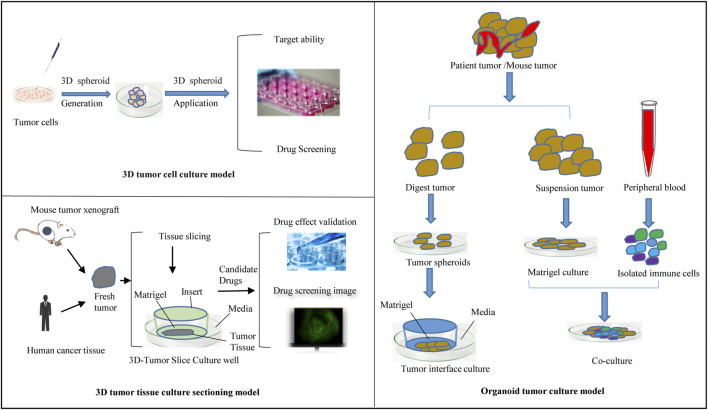 Fig.1 Diverse 3D tumor culture strategies for xenograft and human model systems.1
Our platform offers a high‑fidelity preclinical model that extends beyond conventional cytotoxicity readouts, enabling detailed assessment of the structural and biochemical obstacles limiting CAR-T cell and vesicle access to target sites. We deliver quantitative metrics on infiltration depth, homing kinetics, and crosstalk with endogenous immune components.
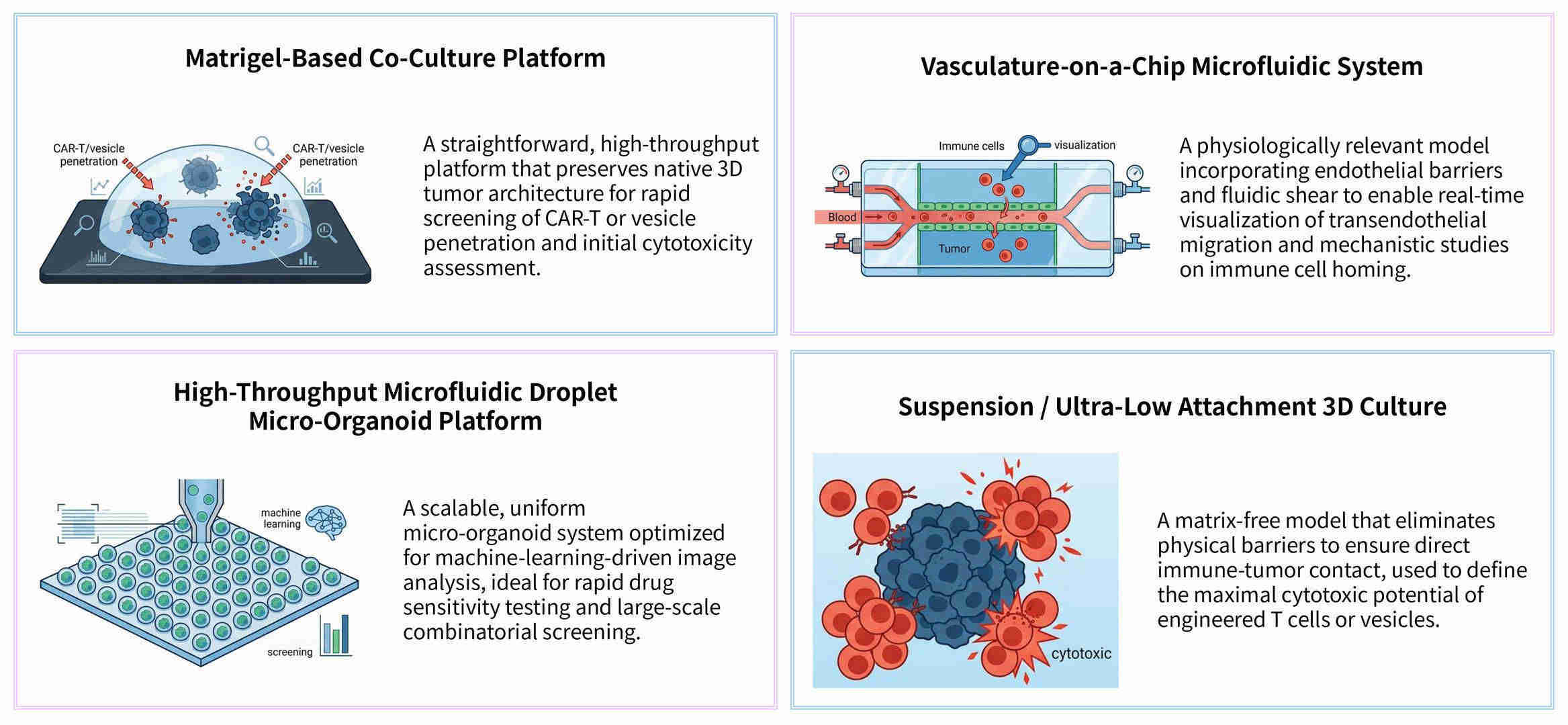
We offer a comprehensive suite of 3D tumor organoid penetration assays that span from high‑throughput screening platforms to physiologically relevant vascularized models, enabling precise evaluation of CAR-T and vesicle homing across varying levels of biological complexity.
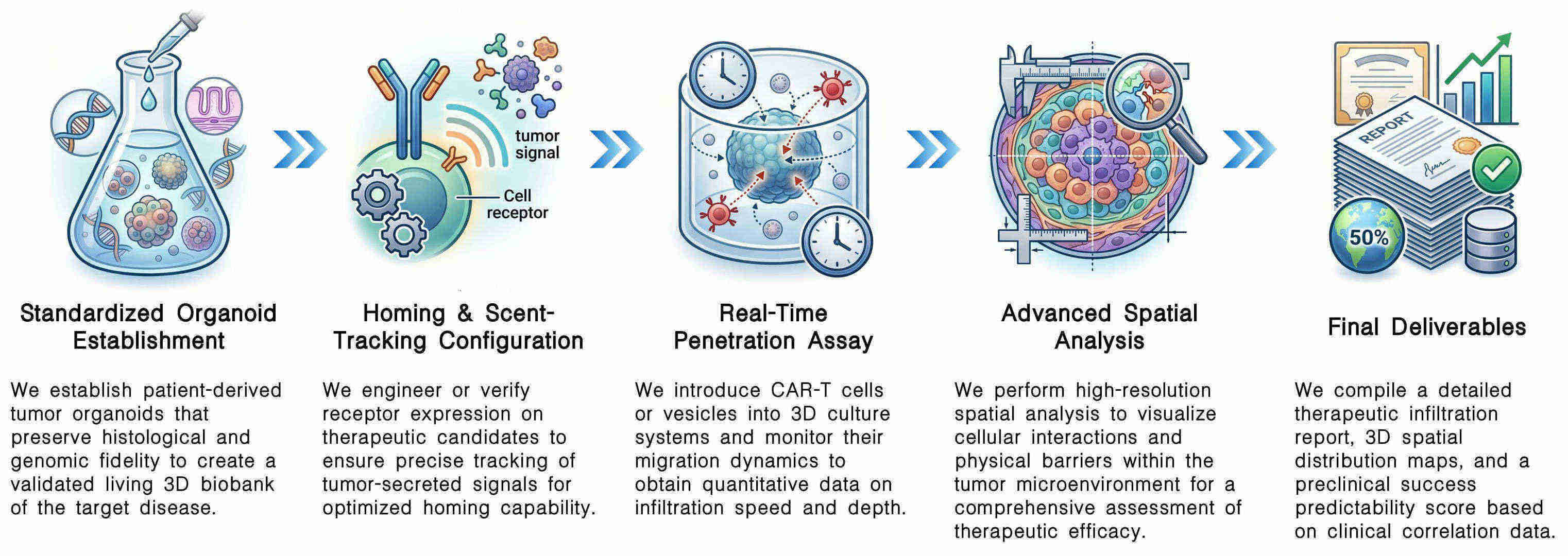
Estimated Timeframe: The typical timeframe for this service ranges from 4 to 8 weeks, depending on the complexity of the organoid establishment and the number of therapeutic variants being screened.
Q1: How do your assays compare to traditional Boyden chambers?
A1: Traditional Boyden chambers rely on 2D membrane filters that fail to capture the structural complexity of tumor tissue. Our 3D spheroid-based platform recapitulates key features of micrometastases, including the formation of invadopodia and interactions with the extracellular matrix, offering substantially higher physiological relevance for assessing invasive behavior.
Q2: What is the minimum amount of CAR-T cells required for a screen?
A2: The required cell number depends on the scale of the experimental design and the number of organoid conditions being tested. Our microfluidic platforms have been optimized to accommodate limited or low-volume samples, making them well suited for early-stage discovery efforts where cell quantities are often restrictive.
Choose our platform for its unparalleled physiological relevance, combining tumor organoids, stromal components, and microfluidic vasculature to accurately model CAR-T and vesicle homing. We deliver high-content spatial analysis that bridges the gap between in vitro screening and in vivo outcomes, accelerating your solid tumor immunotherapy pipeline.
"Using Creative Biolabs' 3D organoid platform offered essential clarity on CAR‑T trafficking in solid tumors, specifically delineating CXCR6‑dependent infiltration." Dr. Sarah L***n.
"Visualizing vesicle penetration within a standardized 3D matrix enabled us to discard three false-positive candidates that would have otherwise failed in vivo. Creative Biolabs delivers exceptional spatial analytics." Prof. Marc A***s.
"Reproducibility was a long‑standing hurdle until we integrated Creative Biolabs' organoid system. Their 3D invasion assays now serve as the cornerstone of our lead optimization pipeline." Janet R***r.
To learn more about how our 3D Tumor Organoid Penetration Assays can accelerate your immunotherapy program, please reach out to our scientific team. We are happy to discuss your specific model requirements, provide a detailed project quote, and tailor a study design to your needs. Contact us today to move your candidates confidently toward the clinic.
Reference
For any technical issues or product/service related questions, please leave your information below. Our team will contact you soon.
All products and services are For Research Use Only and CANNOT be used in the treatment or diagnosis of disease.
 NEWSLETTER
The latest newsletter to introduce the latest breaking information, our site updates, field and other scientific news, important events, and insights from industry leaders
LEARN MORE NEWSLETTER NEW SOLUTION
CellRapeutics™ In Vivo Cell Engineering: One-stop in vivo T/B/NK cell and macrophage engineering services covering vectors construction to function verification.
LEARN MORE SOLUTION NOVEL TECHNOLOGY
Silence™ CAR-T Cell: A novel platform to enhance CAR-T cell immunotherapy by combining RNAi technology to suppress genes that may impede CAR functionality.
LEARN MORE NOVEL TECHNOLOGY NEW SOLUTION
Canine CAR-T Therapy Development: From early target discovery, CAR design and construction, cell culture, and transfection, to in vitro and in vivo function validation.
LEARN MORE SOLUTION