Creative Biolabs has a tradition of commitment. To achieve efficient execution and regulatory approval, we offer careful considerations of your program for the development of a cellular or gene therapy product – now and in the future.
EXPLORE MORE HighlightsWe focus on unmet needs and develop novel cellular and gene drugs and solutions that offer significant benefits over existing options.
EXPLORE MORE HighlightsThe advent of Chimeric Antigen Receptor T-cell (CAR-T) therapies has revolutionized the field of oncology, providing new avenues for treating various forms of cancer. Our 20 years of experience in the biotechnology sector have equipped us with the expertise and technological capabilities to support the entire lifecycle of CAR-T products, from early development to commercialization.
EXPLORE MORETo accelerate advanced breakthroughs of your projects, we offer broad range of platforms which enable our clients be free to tackle problems with cutting-edge technologies from different angles and in different methods.
EXPLORE MORE HighlightsUse the resources in our library to help you understand your options and make critical decisions for your study. We offer oncolytic virus, CAR-T, and dendritic cell related documents, as well as newsletter. If you don't find the answers you're looking for, contact us for additional assistance.
EXPLORE MORE HighlightsGet a real taste and understanding of the business and culture of one of the world's great research-based cellular and gene therapy discovery and development companies.
EXPLORE MORE
The development of in vivo CAR-T therapy continues to face persistent challenges inherited from conventional ex vivo manufacturing, including complex processes, high production costs, long turnaround times, and limited efficacy against solid tumors. Creative Biolabs' In vivo CAR-T Development with FuNVs (Fusion Nanovesicle) Technology enables precise in vivo T cell engineering via a non-viral approach, delivering customized nanovesicles directly to target cells. Our platform significantly streamlines the supply chain, reduces production costs, and enhances both safety and therapeutic outcomes in solid tumors, accelerating the translation of next-generation immunotherapies from bench to bedside.
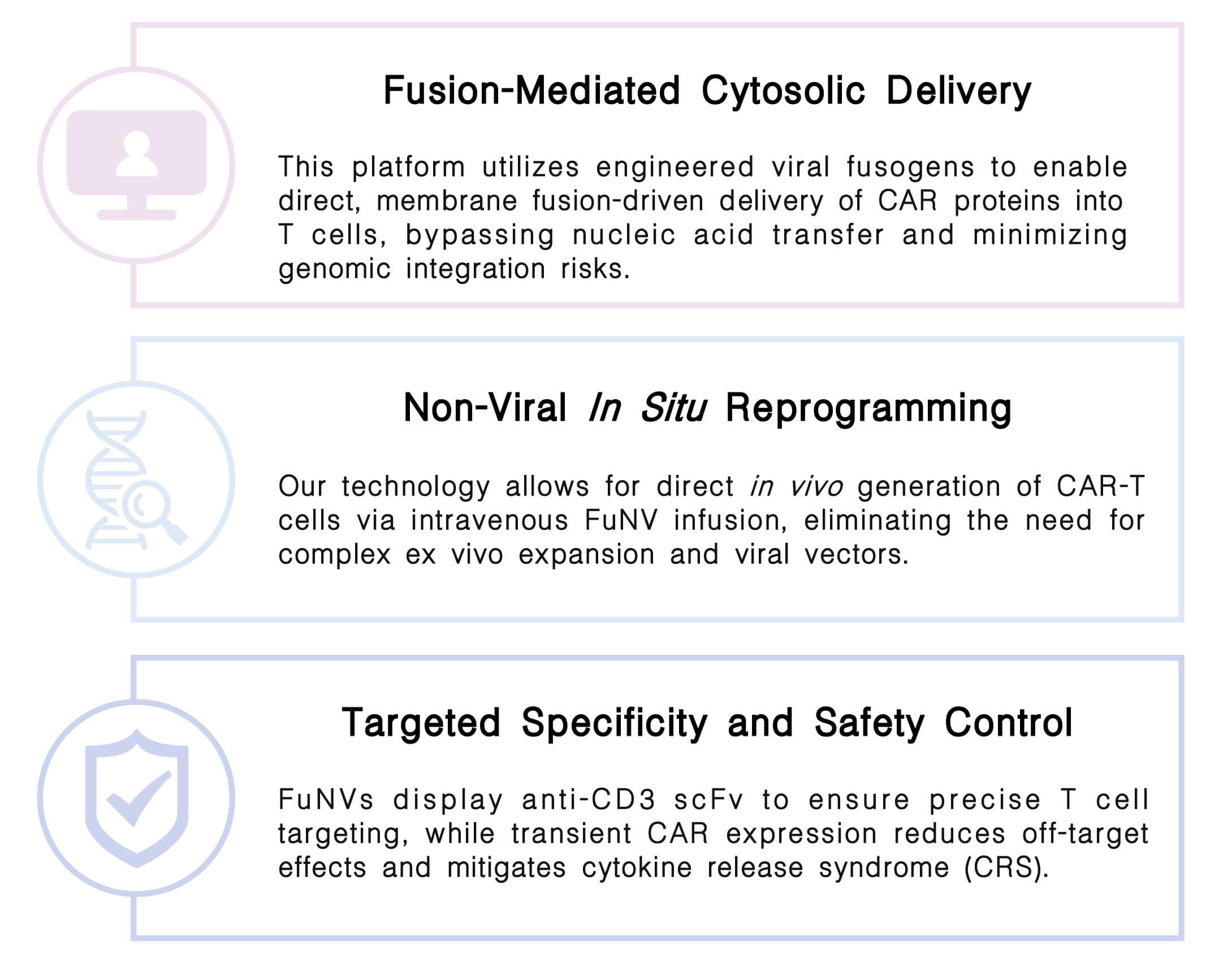
Fusion Nanovesicles (FuNVs) are a class of engineered virus-mimetic nanocarriers designed with surface-displayed fusogenic proteins that specifically target T cells, such as modified fusogens derived from measles or reovirus. These FuNVs enable direct cytosolic delivery of functional proteins into target cells via membrane fusion. The in vivo CAR-T development platform based on FuNVs utilizes intravenous administration of CAR protein-loaded FuNVs to efficiently reprogram T cells directly inside the living organism, generating functional CAR-T cells. This approach bypasses the complexity and high costs associated with conventional ex vivo expansion processes, while significantly reducing the risk of adverse effects such as cytokine release syndrome (CRS).
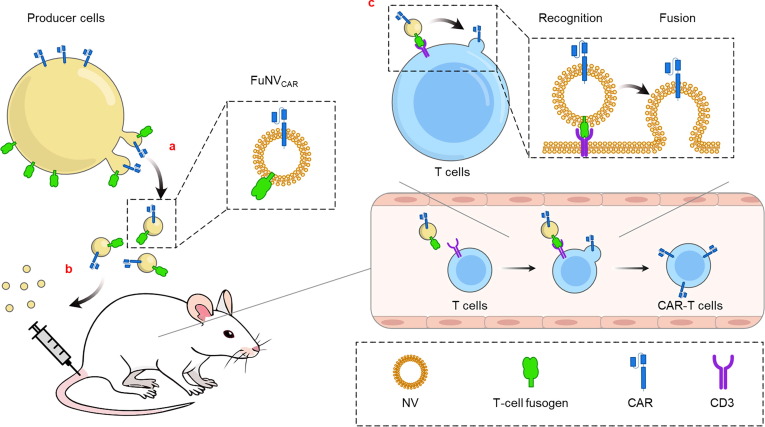 Fig.1 In vivo generation of CAR-T cells via virus-mimetic fusion nanovesicles (FuNVs).1
Creative Biolabs' In vivo CAR-T Development with FuNVs (Fusion Nanovesicle) Technology enables the direct and safe generation of CAR-T cells inside the patient's body, eliminating reliance on traditional ex vivo cell expansion processes. Our solution accelerates research progress through superior scalability, significantly reduces the risk of CRS, and achieves precise targeting efficiency.
We offer an innovative in vivo CAR-T development platform centered on FuNVs. Our system enables the direct cytosolic delivery of CAR proteins via engineered fusogens, allowing for non-viral T cell reprogramming within the patient, and ensures precise targeting with controlled, transient expression to enhance efficacy and reduce safety risks.
Required Starting Materials:
Key Steps:

Final Deliverables:
How does the FuNV platform compare to traditional viral vectors for in vivo gene delivery?
Viral vectors carry risks of immunogenicity and off-target genomic integration. Our FuNV platform is non-viral and based on a membrane fusion mechanism, which significantly mitigates these risks, offering a safer and more controllable method for delivering genetic material exclusively to the target T cell population. We encourage you to contact us for a detailed technical comparison.
Can FuNVs be used to target tumors other than B-cell malignancies (e.g., solid tumors)?
Absolutely. While in vivo CAR-T is proven for hematological cancers, our platform's engineering capabilities are designed for solid tumors. We utilize engineered nanovesicles (e.g., anti-PD-L1 NVs) to remodel the immunosuppressive tumor microenvironment and prevent CAR-T exhaustion, which is the primary challenge in solid tumor oncology.
We directly tackle key bottlenecks in cancer immunotherapy. Our engineered nanovesicles enable non-viral, in vivo generation of CAR-T cells with enhanced safety and reduced CRS risk, superior targeting precision, multi-modal payload versatility, and unprecedented scalability, offering a transformative solution for both hematological and solid tumors.
"The application of Creative Biolabs' In vivo CAR-T Development platform incorporating FuNVs Technology has markedly enhanced the safety profile of STING agonist delivery in our study. By enabling precise localization of the therapeutic payload to the tumor microenvironment, this approach effectively circumvents the severe systemic inflammatory responses previously associated with free agonist administration." Ky Ro*.
"Utilizing Creative Biolabs' In vivo CAR-T Development with FuNVs Technology has substantially improved the commercial viability of our CAR-T initiative. The platform supports scalable, high-throughput, and non-viral cell modification, thereby enabling feasible mass production—an achievement that remained elusive with conventional methodologies." Jn Sh*.
"Through Creative Biolabs' In vivo CAR-T Development enhanced by FuNVs Technology, we have achieved multi-modal targeting capability, seamlessly integrating T cell therapy with gene silencing mechanisms. This system permits the co-delivery of CAR genes and EGFR-targeting siRNA with enzyme-activated specificity, significantly augmenting therapeutic precision." Aa Wg*.
Ready to unlock the full potential of your pipeline? We are here to ensure your vision translates into viable, efficient, and impactful outcomes. Our team offers detailed exploratory discussions, all necessary technical dossiers, and a clear project roadmap tailored to your specific objectives.
Connect with our experts to take the first strategic step.
Reference
For any technical issues or product/service related questions, please leave your information below. Our team will contact you soon.
All products and services are For Research Use Only and CANNOT be used in the treatment or diagnosis of disease.
 NEWSLETTER
The latest newsletter to introduce the latest breaking information, our site updates, field and other scientific news, important events, and insights from industry leaders
LEARN MORE NEWSLETTER NEW SOLUTION
CellRapeutics™ In Vivo Cell Engineering: One-stop in vivo T/B/NK cell and macrophage engineering services covering vectors construction to function verification.
LEARN MORE SOLUTION NOVEL TECHNOLOGY
Silence™ CAR-T Cell: A novel platform to enhance CAR-T cell immunotherapy by combining RNAi technology to suppress genes that may impede CAR functionality.
LEARN MORE NOVEL TECHNOLOGY NEW SOLUTION
Canine CAR-T Therapy Development: From early target discovery, CAR design and construction, cell culture, and transfection, to in vitro and in vivo function validation.
LEARN MORE SOLUTION