Creative Biolabs has a tradition of commitment. To achieve efficient execution and regulatory approval, we offer careful considerations of your program for the development of a cellular or gene therapy product – now and in the future.
EXPLORE MORE HighlightsWe focus on unmet needs and develop novel cellular and gene drugs and solutions that offer significant benefits over existing options.
EXPLORE MORE HighlightsThe advent of Chimeric Antigen Receptor T-cell (CAR-T) therapies has revolutionized the field of oncology, providing new avenues for treating various forms of cancer. Our 20 years of experience in the biotechnology sector have equipped us with the expertise and technological capabilities to support the entire lifecycle of CAR-T products, from early development to commercialization.
EXPLORE MORETo accelerate advanced breakthroughs of your projects, we offer broad range of platforms which enable our clients be free to tackle problems with cutting-edge technologies from different angles and in different methods.
EXPLORE MORE HighlightsUse the resources in our library to help you understand your options and make critical decisions for your study. We offer oncolytic virus, CAR-T, and dendritic cell related documents, as well as newsletter. If you don't find the answers you're looking for, contact us for additional assistance.
EXPLORE MORE HighlightsGet a real taste and understanding of the business and culture of one of the world's great research-based cellular and gene therapy discovery and development companies.
EXPLORE MORE
Current in vivo CAR-T therapies face significant challenges, including manufacturing complexity, viral vector-related safety risks, and limited efficacy in solid tumors. Creative Biolabs' In vivo CAR-T Development with Synthetic Nanocarrier Technology enables direct in vivo generation of functional CAR-T cells through non-viral RNA delivery. This approach bypasses conventional ex vivo manufacturing constraints while ensuring precise T cell targeting and enhanced tumor microenvironment penetration. We provide comprehensive solutions from nanocarrier design and CAR construct optimization to function validation, accelerating your path to next-generation cell therapies.
Synthetic nanocarrier technology refers to the use of nanoscale delivery systems, such as lipid nanoparticles and polymeric micelles, engineered with targeting ligands and stimuli-responsive properties to achieve specific intracellular delivery of drugs or genetic material. In the context of in vivo CAR-T development, this platform enables efficient non-viral delivery of CAR genes, overcoming key limitations including lengthy ex vivo manufacturing, risks associated with viral vectors, and poor infiltration into solid tumors. As a result, it significantly enhances treatment controllability, safety, and targeting potential against solid malignancies.
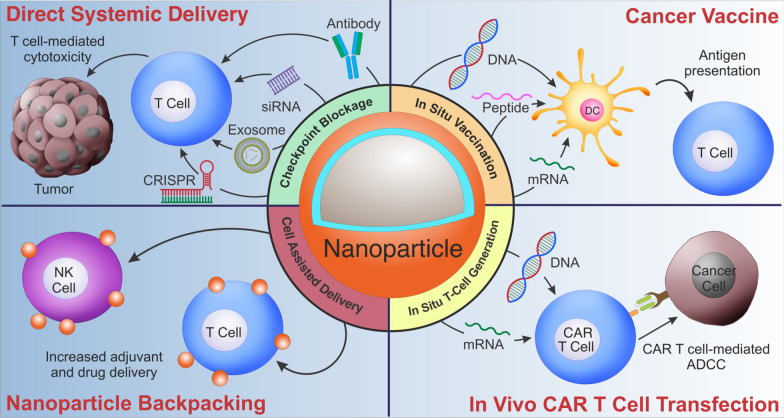 Fig.1 Precision targeting in cancer immunotherapy: advanced nano-engineered delivery systems.1
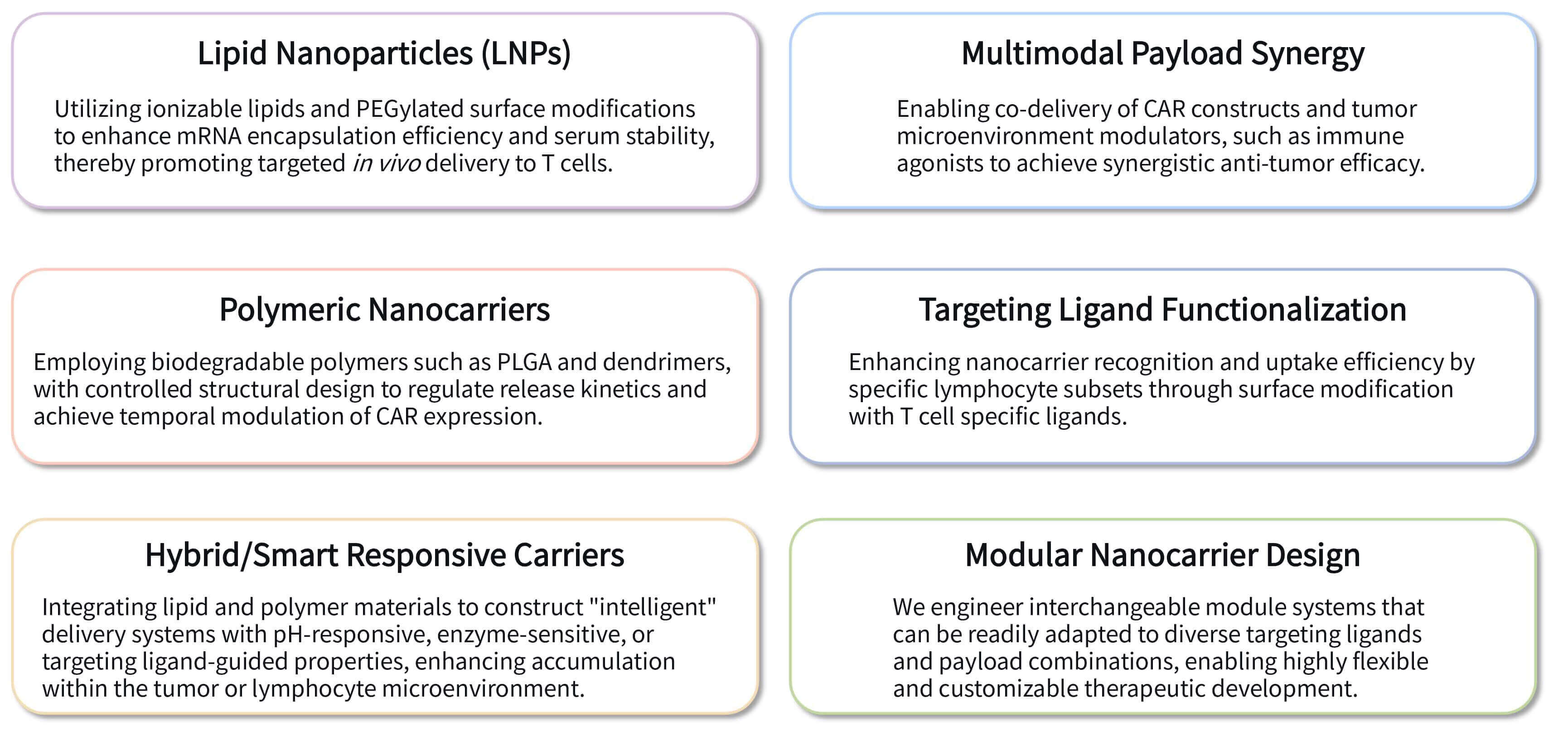
Creative Biolabs' In vivo CAR-T Development with Synthetic Nanocarrier Technology provides programmable non-viral delivery platforms to directly generate functional CAR-T cells in vivo. Our approach enables efficient T cell targeting, tumor microenvironment (TME) remodeling, and transient CAR expression, offering a safe, scalable, and cost-effective strategy for overcoming solid tumor resistance.
We offer a comprehensive in vivo CAR-T platform built on advanced synthetic nanocarrier technologies, including LNPs, polymeric, and smart hybrid systems. Our non-viral engineering, multimodal co-delivery, and precision targeting strategies enable efficient T cell programming and solid TME modulation, providing tailored solutions for next-generation cell therapies.
Required Starting Materials:
Key Steps:
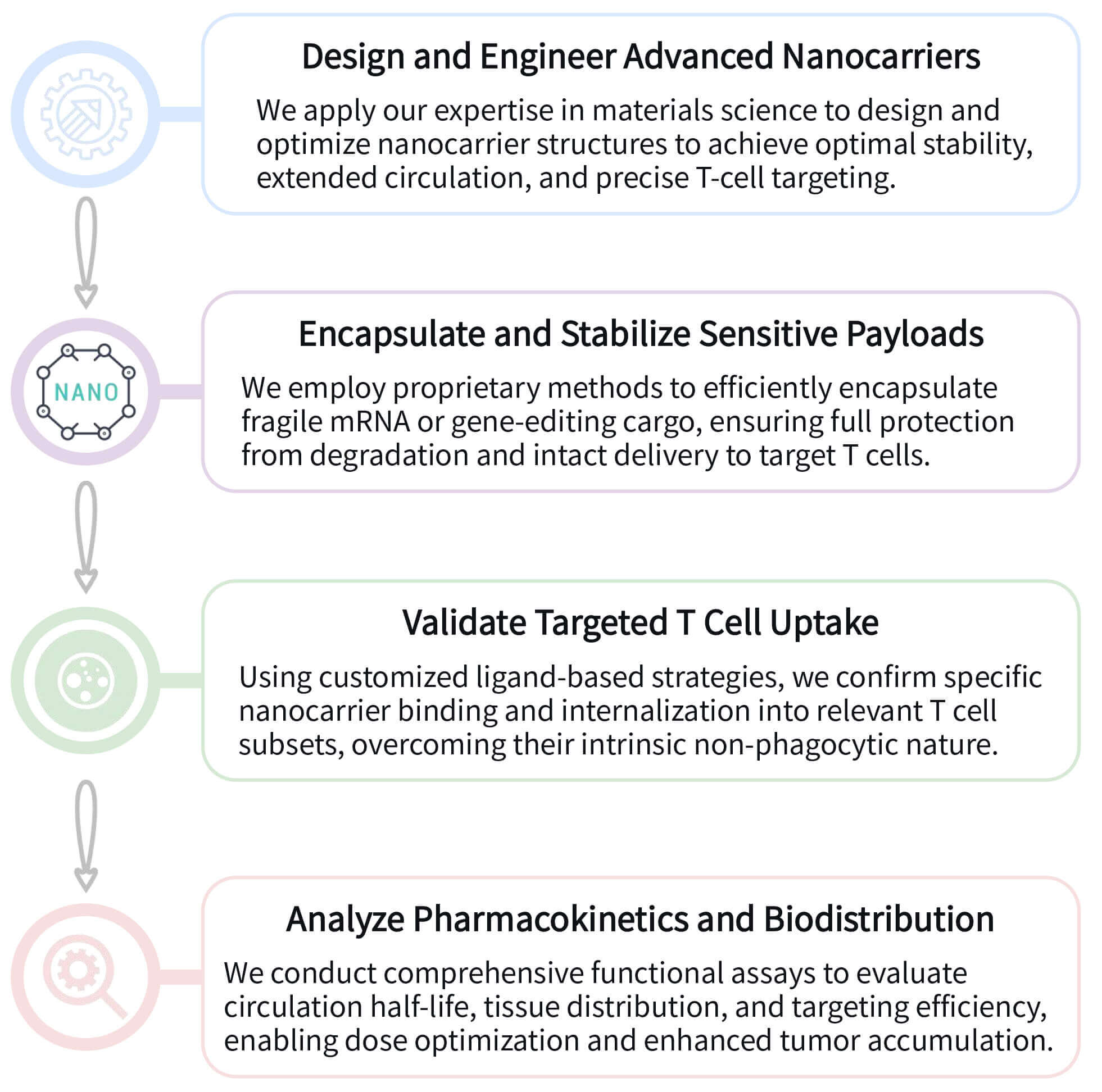
Final Deliverables:
What are the principal advantages of in vivo CAR-T generation over conventional ex vivo methods?
Traditional ex vivo CAR-T manufacturing is constrained by high costs, extended timelines, and dependency on complex manufacturing infrastructure. Our in vivo strategy employs synthetic nanocarriers with RNA-based constructs to enable direct intravenous administration. This streamlined production process significantly lowers the cost of goods while providing a transient, safer therapeutic window—critical for mitigating cytokine release syndrome—and supports scalable patient access.
How is your nanocarrier platform designed to overcome the challenges of solid tumors and the TME?
Solid tumors often resist therapy due to an immunosuppressive TME. Our nanocarriers feature a modular payload capacity, enabling co-delivery of CAR-encoding RNA with immunomodulatory agents targeting the TME. This integrated strategy reprograms the multicellular network, disrupts stromal barriers, and enhances infiltration and persistence of in vivo generated CAR-T cells.
Our in vivo CAR-T platform employs synthetic nanocarriers for non-viral, RNA-based cellular engineering, effectively bypassing viral vector dependencies while significantly reducing manufacturing costs. The technology demonstrates particular efficacy against solid tumors through active tumor microenvironment modulation and achieves precise T cell targeting via ligand-mediated delivery. Our integrated approach creates new possibilities for both novel cell therapies and existing oncology pipeline enhancement.
"Using Creative Biolabs' In vivo CAR-T Development with Synthetic Nanocarrier Technology in our research has significantly improved the transfection efficiency of our T cells. The ligand-based targeting capability provided an unparalleled level of delivery fidelity compared to electroporation, resulting in a cleaner, more homogeneous population for downstream in vivo studies." Dr. Ana, Senior Immunologist.
"The ability of their nanocarriers to specifically combat multidrug resistance (MDR) mechanisms has been a game-changer. We successfully reformulated a previously shelved small molecule, and the resulting nanocarrier complex showed dramatically improved bioavailability and reduced systemic toxicity, moving the drug back into late-stage development." Elizabeth M., Head of Translational Science.
"We are focused on safety and scalability. Creative Biolabs' focus on RNA-mediated non-viral delivery and the prospect of in vivo CAR-T generation has allowed us to envision a truly simplified clinical model. Their PK data is impeccable, giving us confidence in proceeding without the complexity of traditional viral vector manufacturing." Chrstopher K., Chief Technology Officer.
Advance your cell therapy initiatives with our pioneering in vivo CAR-T platform. By leveraging programmable nanocarrier technology, we enable efficient, non-viral T-cell engineering that accelerates timelines and reduces complexity. Partner with us to translate innovation into clinical success.
Reach out to start a conversation toward joint success.
Reference
For any technical issues or product/service related questions, please leave your information below. Our team will contact you soon.
All products and services are For Research Use Only and CANNOT be used in the treatment or diagnosis of disease.
 NEWSLETTER
The latest newsletter to introduce the latest breaking information, our site updates, field and other scientific news, important events, and insights from industry leaders
LEARN MORE NEWSLETTER NEW SOLUTION
CellRapeutics™ In Vivo Cell Engineering: One-stop in vivo T/B/NK cell and macrophage engineering services covering vectors construction to function verification.
LEARN MORE SOLUTION NOVEL TECHNOLOGY
Silence™ CAR-T Cell: A novel platform to enhance CAR-T cell immunotherapy by combining RNAi technology to suppress genes that may impede CAR functionality.
LEARN MORE NOVEL TECHNOLOGY NEW SOLUTION
Canine CAR-T Therapy Development: From early target discovery, CAR design and construction, cell culture, and transfection, to in vitro and in vivo function validation.
LEARN MORE SOLUTION