Creative Biolabs has a tradition of commitment. To achieve efficient execution and regulatory approval, we offer careful considerations of your program for the development of a cellular or gene therapy product – now and in the future.
EXPLORE MORE HighlightsWe focus on unmet needs and develop novel cellular and gene drugs and solutions that offer significant benefits over existing options.
EXPLORE MORE HighlightsThe advent of Chimeric Antigen Receptor T-cell (CAR-T) therapies has revolutionized the field of oncology, providing new avenues for treating various forms of cancer. Our 20 years of experience in the biotechnology sector have equipped us with the expertise and technological capabilities to support the entire lifecycle of CAR-T products, from early development to commercialization.
EXPLORE MORETo accelerate advanced breakthroughs of your projects, we offer broad range of platforms which enable our clients be free to tackle problems with cutting-edge technologies from different angles and in different methods.
EXPLORE MORE HighlightsUse the resources in our library to help you understand your options and make critical decisions for your study. We offer oncolytic virus, CAR-T, and dendritic cell related documents, as well as newsletter. If you don't find the answers you're looking for, contact us for additional assistance.
EXPLORE MORE HighlightsGet a real taste and understanding of the business and culture of one of the world's great research-based cellular and gene therapy discovery and development companies.
EXPLORE MORE
Creative Biolabs provides an AI-Accelerated scFv Library Screening Service for CAR-T Development to address challenges in antibody fragment discovery, including the identification of high-affinity scFv binders from large antibody libraries, prolonged experimental screening cycles, and difficulty selecting optimal CAR targeting domains. This service enables rapid discovery and prioritization of antibody fragments through in silico high-throughput screening, structure-guided modeling, and AI-driven affinity prediction platforms. By integrating computational antibody engineering with advanced predictive analytics, Creative Biolabs accelerates the selection of high-performance scFv candidates for next-generation CAR-T therapeutics.
Single-chain variable fragments (scFvs) form the antigen-recognition domain of most CAR-T receptors. Computational modeling, high-throughput sequencing, and machine learning can efficiently analyze large antibody libraries and predict antigen-binding potential. These approaches enable rapid prioritization of functional scFv candidates before experimental validation. AI-assisted screening strategies therefore reduce development timelines and improve the probability of identifying high-affinity binders for CAR-T engineering.
Creative Biolabs provides a robust computational bridge between antibody discovery and functional CAR expression. Our service transforms raw sequence data into validated lead candidates, ensuring that only the most stable and high-affinity binders proceed to expensive wet-lab validation. We solve the affinity-efficacy gap by predicting how an scFv will perform under the mechanical stress of a T-cell synapse before you ever engineer a cell.
Our key capabilities include rapid candidate identification via AI-guided screening of vast antibody variants to isolate promising scFv sequences. Structure-based modeling enables affinity-focused prioritization of stable binders, while computational assessment evaluates developability for stability and aggregation risks. Selected scFvs are further optimized for CAR compatibility to streamline downstream construct design.
Discover How We Can Help - Request a Consultation.
Advanced bioinformatic pipelines analyze antibody repertoires to identify variable regions, framework patterns, and complementarity-determining region (CDR) diversity associated with antigen recognition.
Three-dimensional modeling predicts scFv structures and antigen-binding interfaces, enabling evaluation of conformational stability and binding accessibility.
Computational docking and interaction scoring estimate the binding potential between candidate scFv fragments and the target antigen.
Machine learning models evaluate sequence and structural features to prioritize scFv variants with higher predicted affinity and specificity.
Additional screening evaluates properties influencing CAR performance, including stability, solubility, and potential immunogenicity risks.
To initiate the service, clients typically provide amino acid sequences of the variable heavy and variable light chains of candidate monoclonal antibodies, target antigen information, including the specific protein or extracellular domain sequence of the tumor antigen, as well as design preferences covering the desired scFv orientation and specific linker types.
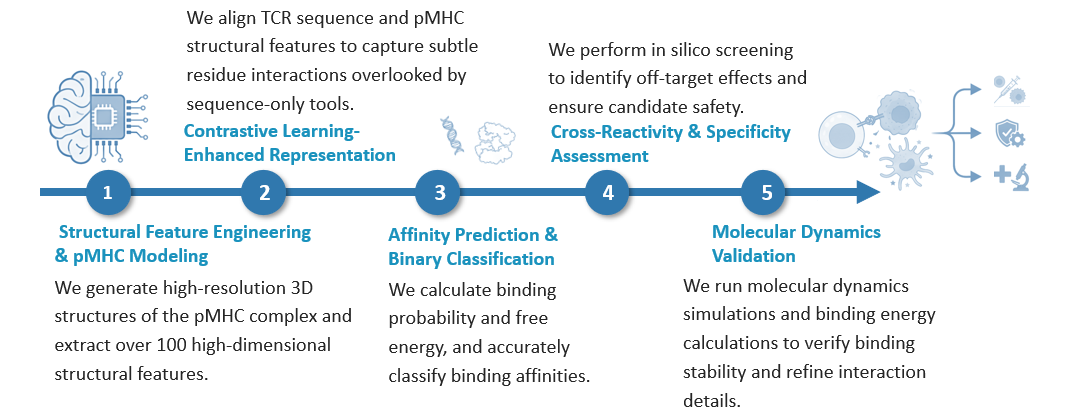
Final deliverables include a comprehensive screening report ranking scFv candidates by predicted affinity, stability and rupture force, high-resolution 2D and 3D molecular interaction maps, and validated optimized scFv sequences ready for lentiviral vector construction and CAR-T engineering.
Q: How accurate are AI predictions compared to wet-lab SPR?
A: Our AI-driven umbrella sampling simulations provide affinity rankings and binding free energy calculations that show high consistency with SPR results, often achieving KD predictions in the sub-nanomolar range.
Q: Does this service help in reducing CAR-T toxicity?
A: We can identify scFvs with specific affinity thresholds to target high-antigen-density tumor cells while sparing low-density healthy tissues, a crucial strategy for safety in solid tumors.
Q: What is the advantage of Steered Molecular Dynamics (SMD) over simple docking?
A: Simple docking only looks at a static snapshot. SMD simulates the physical pulling force, which is more representative of how a CAR-T cell actually interacts with a tumor cell under physiological stress.
Q: Is my sequence data secure?
A: Creative Biolabs adheres to strict intellectual property and data protection policies. Your sequences are used solely for your specific project and are never shared or added to public training sets.
Creative Biolabs is dedicated to removing the bottlenecks of traditional immunotherapy development. Our AI-Accelerated scFv Library Screening Service provides a fast, cost-effective, and scientifically rigorous path to discovering the next generation of CAR-T leads. By combining deep learning with advanced physics-based simulations, we ensure your project is built on a foundation of precision and efficacy. Ready to revolutionize your CAR-T workflow? Our team of specialist biologists is available to discuss your specific target and design requirements. Please contact our team.
For any technical issues or product/service related questions, please leave your information below. Our team will contact you soon.
All products and services are For Research Use Only and CANNOT be used in the treatment or diagnosis of disease.
 NEWSLETTER
The latest newsletter to introduce the latest breaking information, our site updates, field and other scientific news, important events, and insights from industry leaders
LEARN MORE NEWSLETTER NEW SOLUTION
CellRapeutics™ In Vivo Cell Engineering: One-stop in vivo T/B/NK cell and macrophage engineering services covering vectors construction to function verification.
LEARN MORE SOLUTION NOVEL TECHNOLOGY
Silence™ CAR-T Cell: A novel platform to enhance CAR-T cell immunotherapy by combining RNAi technology to suppress genes that may impede CAR functionality.
LEARN MORE NOVEL TECHNOLOGY NEW SOLUTION
Canine CAR-T Therapy Development: From early target discovery, CAR design and construction, cell culture, and transfection, to in vitro and in vivo function validation.
LEARN MORE SOLUTION