Creative Biolabs has a tradition of commitment. To achieve efficient execution and regulatory approval, we offer careful considerations of your program for the development of a cellular or gene therapy product – now and in the future.
EXPLORE MORE HighlightsWe focus on unmet needs and develop novel cellular and gene drugs and solutions that offer significant benefits over existing options.
EXPLORE MORE HighlightsThe advent of Chimeric Antigen Receptor T-cell (CAR-T) therapies has revolutionized the field of oncology, providing new avenues for treating various forms of cancer. Our 20 years of experience in the biotechnology sector have equipped us with the expertise and technological capabilities to support the entire lifecycle of CAR-T products, from early development to commercialization.
EXPLORE MORETo accelerate advanced breakthroughs of your projects, we offer broad range of platforms which enable our clients be free to tackle problems with cutting-edge technologies from different angles and in different methods.
EXPLORE MORE HighlightsUse the resources in our library to help you understand your options and make critical decisions for your study. We offer oncolytic virus, CAR-T, and dendritic cell related documents, as well as newsletter. If you don't find the answers you're looking for, contact us for additional assistance.
EXPLORE MORE HighlightsGet a real taste and understanding of the business and culture of one of the world's great research-based cellular and gene therapy discovery and development companies.
EXPLORE MORE
Creative Biolabs provides an AI-Enhanced Non-Viral Delivery System Modeling Service to address key challenges in genetic medicine, including toxicity associated with viral vectors, low transfection efficiency in difficult-to-target tissues, and the unpredictability of lipid nanoparticle (LNP) formulations. This service enables the design of precision-engineered delivery systems, including optimized lipid nanoparticles and transposon-based platforms. By integrating molecular dynamics simulations, machine learning architectures, digital-twin modeling, and predictive chemical mapping, Creative Biolabs delivers stable, targeted, and efficient non-viral delivery solutions, accelerating research and development while improving safety and therapeutic performance.
Non-viral delivery systems such as lipid nanoparticles and transposons have emerged as safer alternatives to viral vectors due to their lower immunogenicity and flexible design. Recent studies demonstrate that machine learning models can accurately predict delivery efficiency and reveal key formulation parameters, enabling rational design instead of empirical screening. These advances establish AI-driven modeling as a powerful approach to optimizing delivery systems for gene and cell engineering applications.
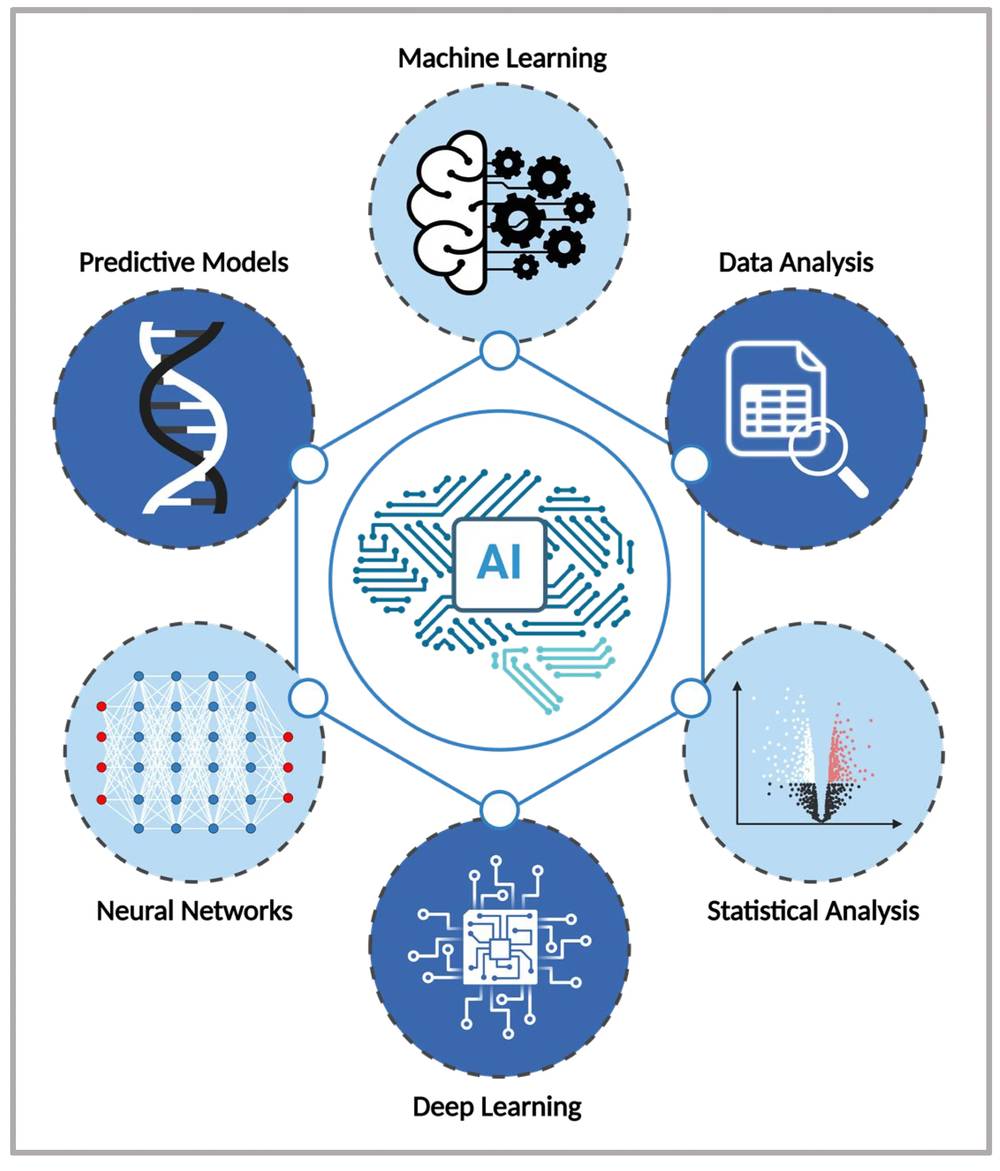 Fig.1 Core AI modules and methodologies for LNP design and optimization. 1
Creative Biolabs bridges the gap between theoretical chemistry and clinical success. By simulating the molecular interactions of your payload with its delivery vehicle, we eliminate the need for thousands of "blind" wet-lab experiments. Our models provide atomistic clarity on how LNPs interact with cellular membranes and how transposon sequences integrate into the host genome.
Creative Biolabs provides AI-guided design of lipid nanoparticles (LNPs) and transposon-based systems tailored to your specific cell types and therapeutic goals. We help improve delivery efficiency, reduce cytotoxicity, and enhance gene expression stability.
Our service integrates experimental datasets and computational modeling to identify optimal material compositions, nucleic acid formats, and delivery parameters, minimizing trial-and-error cycles.
We support diverse applications, including mRNA delivery, gene editing, and cell therapy engineering, ensuring solutions are adaptable from early research to preclinical development.
Discover How We Can Help - Request a Consultation.
| AI-Guided Lipid Nanoparticle Design | Transposon System Engineering |
|
|
| Multi-Modal Data Integration Platforms | In Silico Screening & Predictive Modeling |
|
|
Required Starting Materials include sequence data for the genetic payload, such as mRNA, pDNA, or transposon systems, alongside target cell-type profiles, as well as specific lipid candidates or polymer structures to be prioritized in formulation.
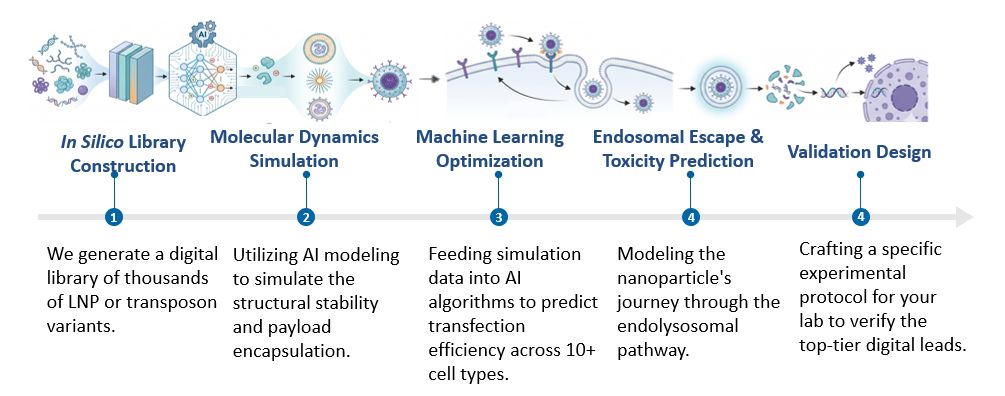
Final Deliverables include a predictive performance report with detailed data on transfection efficiency, stability scores, and particle size distribution, high-resolution atomistic visualizations illustrating molecular interactions, and an optimized formulation recipe outlining exact molar ratios and chemical compositions ready for direct synthesis.
Q: How does AI modeling improve over standard high-throughput screening?
A: Standard high-throughput screening is physically limited by the number of samples you can synthesize. Our AI modeling can screen millions of virtual combinations, identifying hot spots in the chemical space that humans would likely miss.
Q: Can you model delivery for hard-to-transfect cells like neurons?
A: Yes. We utilize cell-specific membrane models that account for unique lipid compositions and receptor densities, allowing for the design of "targeted" nanoparticles.
Q: What is the accuracy of your transfection predictions?
A: According to Published Data and our internal benchmarks, our ML models typically achieve a 5-10% error rate compared to in vitro experimental results.
Q: How does this compare to viral vector delivery?
A: Non-viral systems modeled by AI offer lower immunogenicity, larger payload capacity (especially for transposons), and significantly lower manufacturing costs compared to AAV or Lentivirus.
Creative Biolabs delivers a sophisticated AI-enhanced modeling service for non-viral delivery systems, enabling researchers to design highly optimized LNPs and transposons with exceptional precision. Drawing on over 20 years of biological expertise paired with state-of-the-art machine learning, we help de-risk drug development and speed up clinical translation. For further details and to discuss your specific project needs, please contact our team directly.
Reference
For any technical issues or product/service related questions, please leave your information below. Our team will contact you soon.
All products and services are For Research Use Only and CANNOT be used in the treatment or diagnosis of disease.
 NEWSLETTER
The latest newsletter to introduce the latest breaking information, our site updates, field and other scientific news, important events, and insights from industry leaders
LEARN MORE NEWSLETTER NEW SOLUTION
CellRapeutics™ In Vivo Cell Engineering: One-stop in vivo T/B/NK cell and macrophage engineering services covering vectors construction to function verification.
LEARN MORE SOLUTION NOVEL TECHNOLOGY
Silence™ CAR-T Cell: A novel platform to enhance CAR-T cell immunotherapy by combining RNAi technology to suppress genes that may impede CAR functionality.
LEARN MORE NOVEL TECHNOLOGY NEW SOLUTION
Canine CAR-T Therapy Development: From early target discovery, CAR design and construction, cell culture, and transfection, to in vitro and in vivo function validation.
LEARN MORE SOLUTION