Creative Biolabs has a tradition of commitment. To achieve efficient execution and regulatory approval, we offer careful considerations of your program for the development of a cellular or gene therapy product – now and in the future.
EXPLORE MORE HighlightsWe focus on unmet needs and develop novel cellular and gene drugs and solutions that offer significant benefits over existing options.
EXPLORE MORE HighlightsThe advent of Chimeric Antigen Receptor T-cell (CAR-T) therapies has revolutionized the field of oncology, providing new avenues for treating various forms of cancer. Our 20 years of experience in the biotechnology sector have equipped us with the expertise and technological capabilities to support the entire lifecycle of CAR-T products, from early development to commercialization.
EXPLORE MORETo accelerate advanced breakthroughs of your projects, we offer broad range of platforms which enable our clients be free to tackle problems with cutting-edge technologies from different angles and in different methods.
EXPLORE MORE HighlightsUse the resources in our library to help you understand your options and make critical decisions for your study. We offer oncolytic virus, CAR-T, and dendritic cell related documents, as well as newsletter. If you don't find the answers you're looking for, contact us for additional assistance.
EXPLORE MORE HighlightsGet a real taste and understanding of the business and culture of one of the world's great research-based cellular and gene therapy discovery and development companies.
EXPLORE MORE
Creative Biolabs provides an AI-Enhanced TCR-pMHC Affinity Modeling Service to address key challenges in TCR-T development, including the identification of high-affinity TCR candidates, accurate prediction of TCR–pMHC binding strength, and the reduction of time-consuming experimental screening. This service enables rapid prioritization of optimal TCR candidates through advanced computational modeling, structural simulations, and machine-learning-guided affinity analysis. By integrating structural immunology with predictive analytics, Creative Biolabs delivers data-driven insights that accelerate TCR candidate optimization and support efficient development of next-generation TCR-T immunotherapies.
TCR recognition of peptide-MHC complexes is the central mechanism underlying T-cell immune responses and TCR-T therapies. Studies integrating structural biology, molecular simulation, and machine learning demonstrate that computational modeling can effectively predict TCR-pMHC binding affinity and interaction stability. Recent research indicates that structural interface features, sequence motifs, and energetic calculations can be integrated to estimate binding free energy and identify promising TCR candidates. AI-assisted modeling, therefore, provides a powerful strategy to accelerate TCR discovery and reduce experimental screening workloads.
Creative Biolabs offers a computational platform for TCR-T candidate discovery and optimization via predictive modeling of TCR-peptide-MHC interactions. This service allows research teams to rapidly evaluate candidate receptors prior to experimental validation, converting the complexity of T cell receptor recognition into actionable data. By delivering quantitative insights, it moves beyond trial-and-error approaches and helps prioritize candidates with the highest potential for clinical success.
Our project support encompasses high-accuracy TCR-pMHC binding energy prediction, structure-guided candidate ranking, mutational optimization of CDR and interface residues, cross-reactivity risk assessment, and data-driven candidate selection to enhance affinity, specificity, safety, and rational prioritization of TCR-T candidates.
Discover How We Can Help - Request a Consultation.
Creative Biolabs integrates multiple computational approaches to evaluate TCR-pMHC interactions and predict binding strength. The service incorporates several mainstream analysis strategies commonly used in immunotherapy research.
| Structural Modeling of TCR-pMHC Complexes | |
|
|
| AI-Driven Binding Affinity Prediction | Molecular Interaction Energy Analysis |
|
|
| Computational Mutagenesis Analysis | Interface Feature Profiling |
|
|
To initiate the project, clients typically provide TCR sequences, specifically the CDR3 beta region or full alpha\beta chains, and Target Epitope/MHC Allele details.
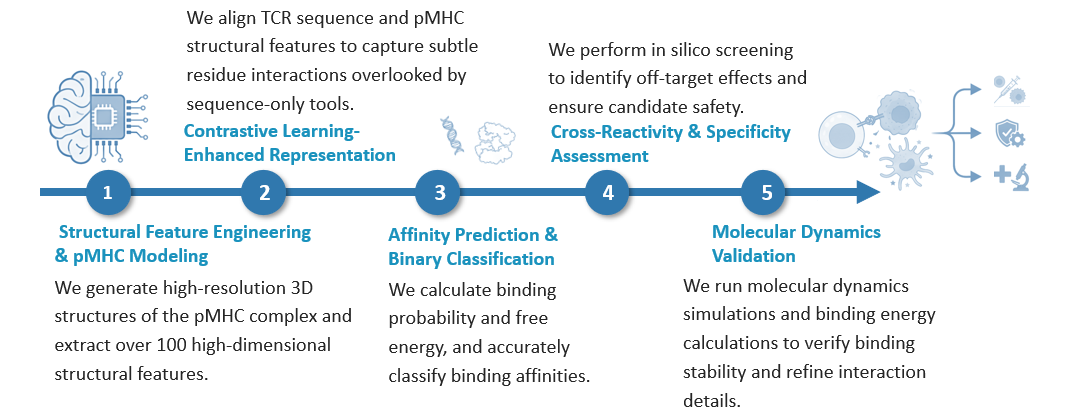
Final Deliverables: Clients receive a detailed Therapeutic Candidate Evaluation Report, including ranked affinity scores, Cross-Reactivity Risk Profiles, and high-resolution Binding Interaction Maps visualizing key hydrogen bonds and hydrophobic contacts.
Q: How does your AI model handle epitopes not present in the training data?
A: We utilize a contrastive learning framework that aligns TCR and pMHC features in a shared representation space, allowing the model to generalize based on biophysical patterns rather than just memorizing sequences.
Q: Can your service distinguish between Class I and Class II MHC alleles?
A: Yes, we support modeling for various alleles. While much of the recent work focuses on Class I, our feature space is designed to integrate the structural parameters of both MHC classes.
Q: What is the advantage of including structural data over sequence-only models?
A: Structural modeling captures conformational changes near the epitope that sequence data misses. This is critical for distinguishing subtle variations in binding strength and predicting true cross-reactivity.
Q: Is this service suitable for large-scale TCR repertoire screening?
A: Absolutely. Our computational pipeline is designed for high-throughput analysis, allowing you to screen thousands of sequences and narrow them down to a handful of validated hits.
Creative Biolabs stands as your trusted and innovative partner in pioneering the next generation of highly specific and effective TCR-T immunotherapies. Our state-of-the-art AI-Enhanced TCR-pMHC Affinity Modeling Service effectively bridges the critical gap between high-throughput omics sequencing and successful, safe clinical translation, empowering researchers to accelerate rational candidate design, optimize therapeutic performance, and drive breakthroughs in adaptive cell therapy. Contact Our Expert Team today for more detailed information, customized solutions, and in-depth discussions about your unique project goals and requirements.
For any technical issues or product/service related questions, please leave your information below. Our team will contact you soon.
All products and services are For Research Use Only and CANNOT be used in the treatment or diagnosis of disease.
 NEWSLETTER
The latest newsletter to introduce the latest breaking information, our site updates, field and other scientific news, important events, and insights from industry leaders
LEARN MORE NEWSLETTER NEW SOLUTION
CellRapeutics™ In Vivo Cell Engineering: One-stop in vivo T/B/NK cell and macrophage engineering services covering vectors construction to function verification.
LEARN MORE SOLUTION NOVEL TECHNOLOGY
Silence™ CAR-T Cell: A novel platform to enhance CAR-T cell immunotherapy by combining RNAi technology to suppress genes that may impede CAR functionality.
LEARN MORE NOVEL TECHNOLOGY NEW SOLUTION
Canine CAR-T Therapy Development: From early target discovery, CAR design and construction, cell culture, and transfection, to in vitro and in vivo function validation.
LEARN MORE SOLUTION