Creative Biolabs has a tradition of commitment. To achieve efficient execution and regulatory approval, we offer careful considerations of your program for the development of a cellular or gene therapy product – now and in the future.
EXPLORE MORE HighlightsWe focus on unmet needs and develop novel cellular and gene drugs and solutions that offer significant benefits over existing options.
EXPLORE MORE HighlightsThe advent of Chimeric Antigen Receptor T-cell (CAR-T) therapies has revolutionized the field of oncology, providing new avenues for treating various forms of cancer. Our 20 years of experience in the biotechnology sector have equipped us with the expertise and technological capabilities to support the entire lifecycle of CAR-T products, from early development to commercialization.
EXPLORE MORETo accelerate advanced breakthroughs of your projects, we offer broad range of platforms which enable our clients be free to tackle problems with cutting-edge technologies from different angles and in different methods.
EXPLORE MORE HighlightsUse the resources in our library to help you understand your options and make critical decisions for your study. We offer oncolytic virus, CAR-T, and dendritic cell related documents, as well as newsletter. If you don't find the answers you're looking for, contact us for additional assistance.
EXPLORE MORE HighlightsGet a real taste and understanding of the business and culture of one of the world's great research-based cellular and gene therapy discovery and development companies.
EXPLORE MORE
While CAR-T therapy holds great promise, its efficacy is frequently compromised by T cell exhaustion, limited infiltration into solid tumors, and a metabolically suppressive tumor microenvironment. Creative Biolabs' Metabolic TME Remodeling service is designed to overcome these obstacles, thereby bolstering CAR-T persistence and overall therapeutic outcomes. We offer an integrated platform that combines nutrient reprogramming, enzymatic modulation, and precision LNP-based metabolic delivery. This strategy effectively restores intratumoral fitness, endowing your CAR-T products with enhanced durability and clinical promise.
Metabolic TME remodeling involves the deliberate reshaping of the tumor microenvironment, modulating nutrient supply, metabolic waste products, and immunosuppressive cell populations, to establish a more supportive setting for adoptive T cell therapy. Such remodeling is essential for sustaining CAR‑T persistence, as it directly counteracts the metabolic stressors that lead to T cell exhaustion, thus promoting durable effector function and enhancing long‑term therapeutic efficacy.
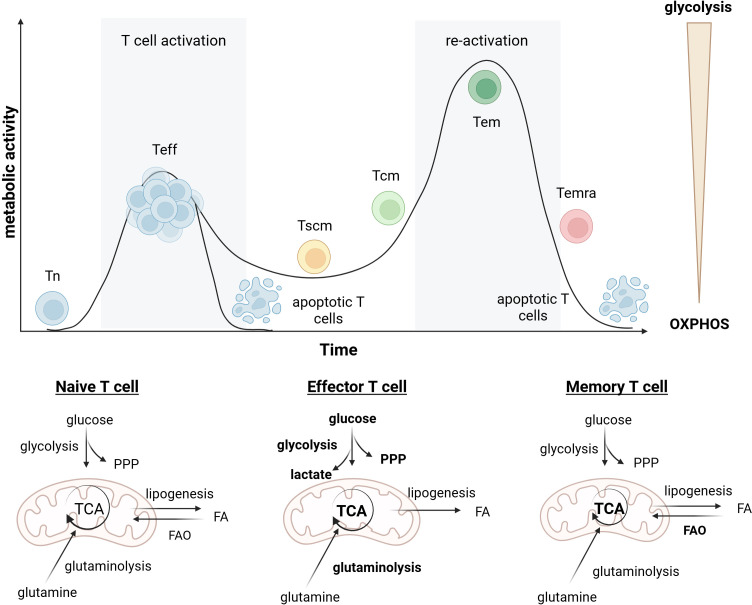 Fig.1 Metabolic pathways shaping T cell differentiation.1
Creative Biolabs offers a dedicated suite of solutions engineered to bridge the divide between persistence and potency. Rather than focusing solely on CAR-T engineering, our approach reshapes the metabolic interplay between therapeutic cells and the suppressive tumor microenvironment. Through targeted neutralization of inhibitory metabolites and enhancement of oxidative capacity, we enable your candidates to endure where conventional strategies fall short.
This platform addresses the immunosuppressive acidic tumor microenvironment, which impairs CAR-T cell metabolism and effector function. By utilizing enzyme-loaded vesicles that locally neutralize extracellular protons, this approach restores a physiological pH at the tumor site, thereby reversing T cell metabolic acidosis and preserving cytotoxic activity. This technology is particularly suited for solid tumors characterized by profound lactic acid accumulation, enabling sustained CAR-T cell fitness and enhanced tumor clearance.
Learn More →Chronic hypoxia within the tumor microenvironment drives CAR-T cell exhaustion and limits their proliferative capacity. This strategy employs localized oxygen delivery systems to relieve hypoxic stress, creating a permissive niche that supports T cell oxidative metabolism and memory differentiation. Applications include combination with CAR-T therapy for poorly vascularized or necrotic tumors, where improved oxygen availability translates to enhanced persistence, reduced exhaustion, and more durable antitumor responses.
Learn More →L-arginine is a critical nutrient for T cell survival, proliferation, and the formation of central memory subsets, yet its availability is frequently depleted in the tumor microenvironment. This approach delivers L-arginine in a targeted, sustained manner directly to the tumor site, selectively fueling CAR-T cells to maintain robust metabolic activity and long-term persistence. This modality is particularly valuable for enhancing the durability of CAR-T therapy in metabolically hostile tumors, supporting both immediate effector function and sustained immunological memory.
Learn More →
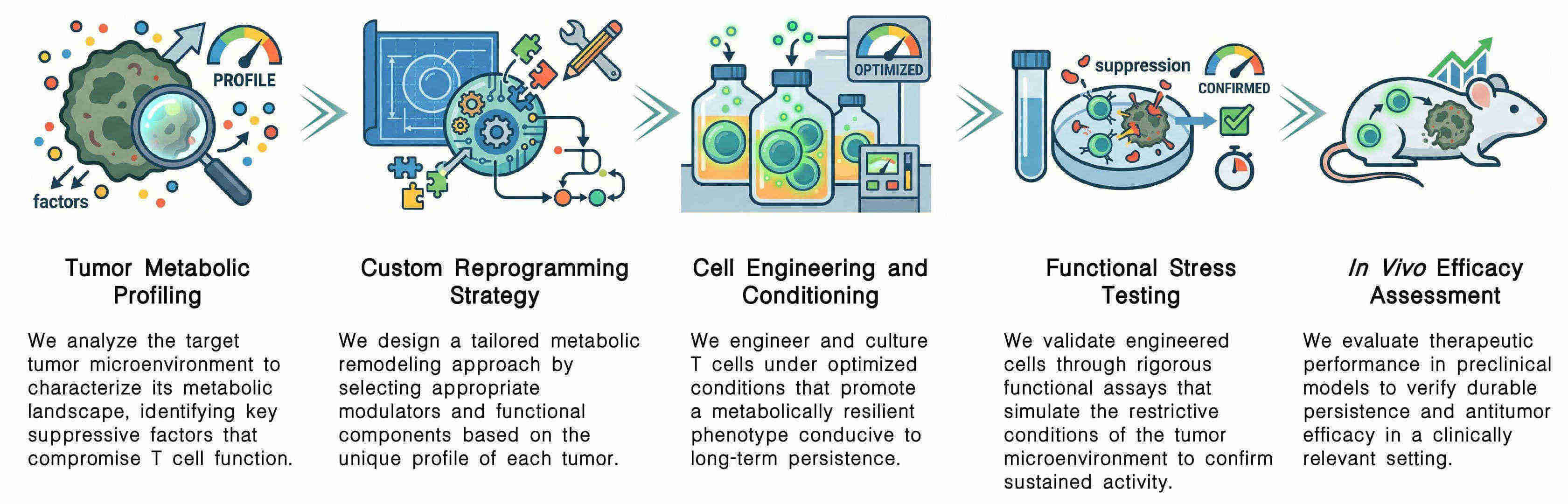
Final Deliverables:
Q1: How does metabolic remodeling differ from standard CAR-T engineering?
A1: Conventional CAR-T engineering primarily focuses on enhancing tumor recognition and activation. In contrast, our approach centers on metabolic fitness, equipping T cells with optimized energy pathways that allow them to survive and function effectively within the nutrient-deprived, suppressive TME, thereby supporting long-term persistence.
Q2: Does metabolic remodeling increase the risk of over-activation?
A2: No. Rather than driving hyper-activation, our strategy emphasizes cellular resilience and metabolic adaptability. By improving the T cell's capacity to withstand environmental stress, this approach typically reduces the likelihood of excessive inflammatory responses, while preserving potent and sustained antitumor activity.
We specialize in metabolic TME remodeling, an approach that goes beyond conventional CAR‑T engineering. By combining advanced cell programming with strategies to reshape the tumor microenvironment, we enable sustained T‑cell persistence, functional resilience, and durable antitumor activity where traditional platforms fall short.
We invite inquiries from research groups and industry partners seeking to advance CAR‑T persistence through metabolic TME remodeling. Reach out to discuss collaboration, technology access, or tailored solutions, our team is ready to support your program from discovery to translation.
Reference
For any technical issues or product/service related questions, please leave your information below. Our team will contact you soon.
All products and services are For Research Use Only and CANNOT be used in the treatment or diagnosis of disease.
 NEWSLETTER
The latest newsletter to introduce the latest breaking information, our site updates, field and other scientific news, important events, and insights from industry leaders
LEARN MORE NEWSLETTER NEW SOLUTION
CellRapeutics™ In Vivo Cell Engineering: One-stop in vivo T/B/NK cell and macrophage engineering services covering vectors construction to function verification.
LEARN MORE SOLUTION NOVEL TECHNOLOGY
Silence™ CAR-T Cell: A novel platform to enhance CAR-T cell immunotherapy by combining RNAi technology to suppress genes that may impede CAR functionality.
LEARN MORE NOVEL TECHNOLOGY NEW SOLUTION
Canine CAR-T Therapy Development: From early target discovery, CAR design and construction, cell culture, and transfection, to in vitro and in vivo function validation.
LEARN MORE SOLUTION