Creative Biolabs has a tradition of commitment. To achieve efficient execution and regulatory approval, we offer careful considerations of your program for the development of a cellular or gene therapy product – now and in the future.
EXPLORE MORE HighlightsWe focus on unmet needs and develop novel cellular and gene drugs and solutions that offer significant benefits over existing options.
EXPLORE MORE HighlightsThe advent of Chimeric Antigen Receptor T-cell (CAR-T) therapies has revolutionized the field of oncology, providing new avenues for treating various forms of cancer. Our 20 years of experience in the biotechnology sector have equipped us with the expertise and technological capabilities to support the entire lifecycle of CAR-T products, from early development to commercialization.
EXPLORE MORETo accelerate advanced breakthroughs of your projects, we offer broad range of platforms which enable our clients be free to tackle problems with cutting-edge technologies from different angles and in different methods.
EXPLORE MORE HighlightsUse the resources in our library to help you understand your options and make critical decisions for your study. We offer oncolytic virus, CAR-T, and dendritic cell related documents, as well as newsletter. If you don't find the answers you're looking for, contact us for additional assistance.
EXPLORE MORE HighlightsGet a real taste and understanding of the business and culture of one of the world's great research-based cellular and gene therapy discovery and development companies.
EXPLORE MORE
Current solid tumor immunotherapies are often hindered by persistent T cell exhaustion, antigen-mediated fratricide, and insufficient infiltration into the immunosuppressive tumor microenvironment. Creative Biolabs' Vesicle-Mediated Checkpoint Blockade for Sustained CAR-T Activation platform engineers proprietary armored CAR-T cells equipped with advanced small extracellular vesicle shielding technologies. Our service provides a comprehensive solution that integrates exosome pathway neutralization with sustained checkpoint inhibition to maintain CAR-T cell fitness. By preserving cytotoxic activity and protecting cellular assets from molecular sabotage, we enable superior antitumor durability and enhanced therapeutic outcomes for your clinical programs.
Vesicle-mediated checkpoint blockade represents a targeted strategy in which immunomodulatory signals are delivered locally through engineered vesicles, effectively uncoupling checkpoint inhibition from systemic exposure. Applied to sustained CAR-T activation, this approach integrates localized protection against tumor-derived suppression with programmable enhancement of T cell persistence and function, offering a refined solution for overcoming the limitations of conventional cell therapy in solid tumors.
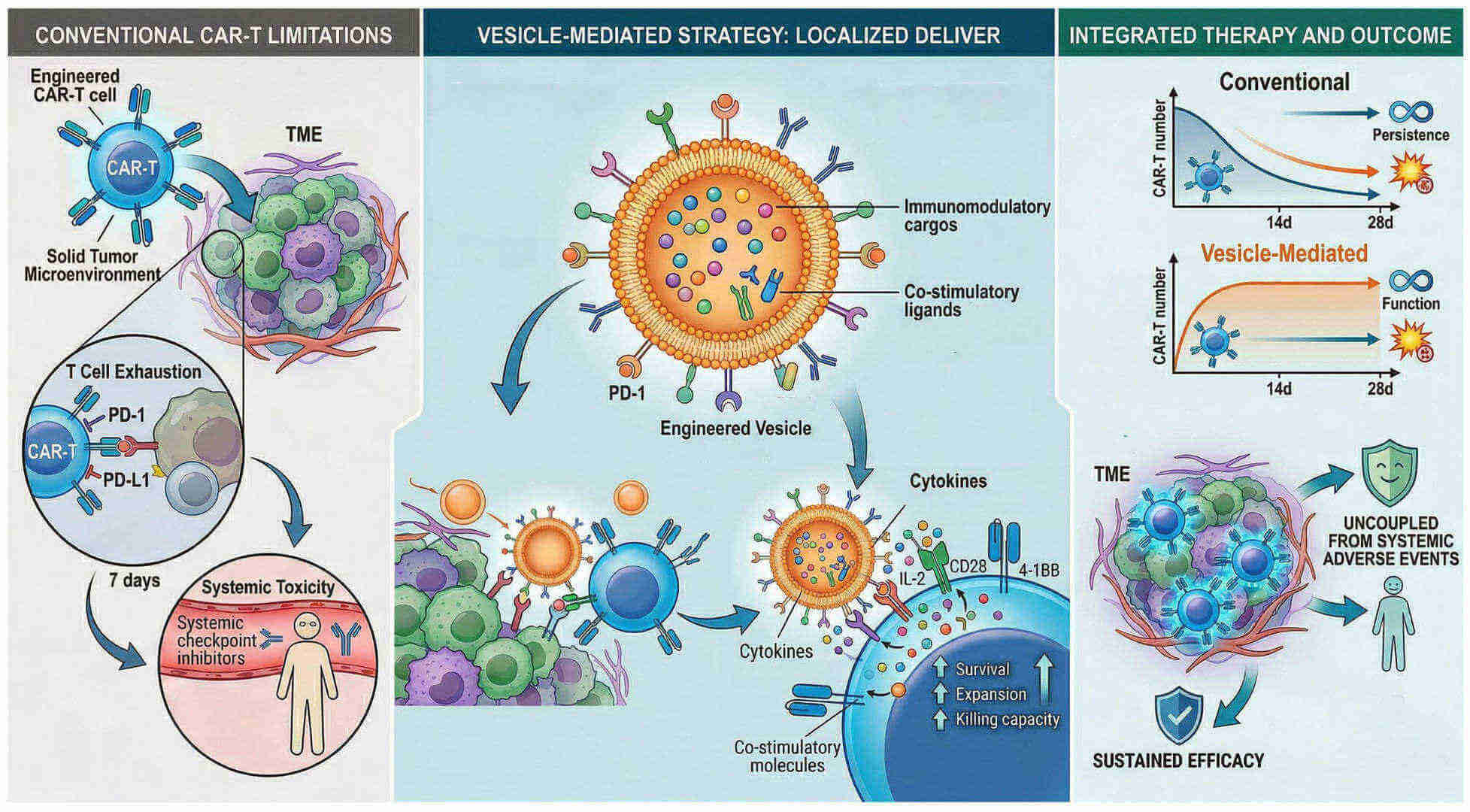 Fig.1 Vesicle-delivered immune checkpoint inhibition for prolonged CAR-T function.
Creative Biolabs offers a suite of engineering strategies that repurpose the tumor's own suppressive mechanisms to support T-cell activation. Our approach yields optimized CAR-T constructs capable of withstanding the immunosuppressive vesicle networks prevalent in solid tumor environments.
This service details the development of engineered vesicles designed to deliver nucleic acid payloads, such as siRNA or CRISPR-Cas9 components, specifically to tumor cells or antigen-presenting cells within the tumor microenvironment. By mediating the genetic silencing of key checkpoint ligands (PD-L1) and co-inhibitory receptors (TIGIT), this approach eliminates the primary suppressive signals that typically exhaust CAR-T cells.
Learn More →This section focuses on the engineering of high-affinity competitive decoy receptors that are packaged into vesicles to act as molecular "sponges." These receptors function independently of the CAR-T cell's own signaling machinery, binding to immunosuppressive ligands present in the tumor microenvironment before they can engage native inhibitory receptors on the T cell surface. By intercepting these "off-signals" extracellularly, this technology provides a robust shield for CAR-T cells, maximizing their therapeutic efficacy in solid tumors characterized by highly suppressive stromal barriers.
Learn More →This service describes the implementation of a localized vesicle-based depot system designed for the sustained release of checkpoint inhibitors directly at the tumor site. Rather than relying on systemic administration, this approach utilizes biocompatible vesicles that anchor within the tumor stroma or scaffold biomaterials, providing a continuous supply of therapeutic agents to maintain prolonged blockade of the PD-1/PD-L1 or TIGIT axes.
Learn More →
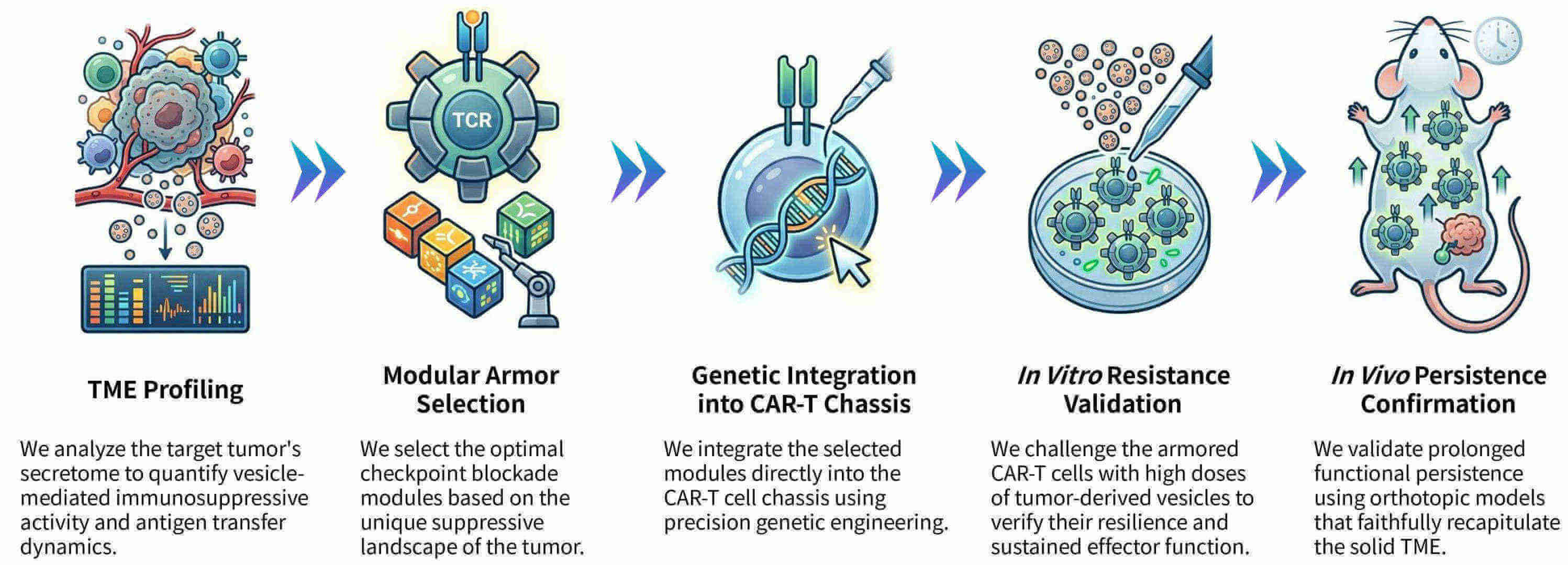
Final Deliverables:
Q1: How does vesicle-mediated checkpoint blockade differ from systemic anti-PD-1 therapy?
A1: Systemic anti-PD-1 therapy distributes broadly throughout the body, frequently leading to off-target toxicities and immune-related adverse events. In contrast, the vesicle-mediated approach enables checkpoint blockade to be expressed intrinsically by the CAR-T cells themselves. This autonomous mechanism concentrates immunomodulatory activity precisely at the site of antigen engagement, achieving high-potency local protection while minimizing systemic exposure and associated toxicity.
Q2: Can this technology be applied to existing CAR-T designs?
A2: Yes, the platform is designed with modular flexibility, allowing it to be retrofitted onto existing CAR constructs regardless of their original scFv specificity. This plug-and-play compatibility means that previously developed CAR-T products can be functionally armored to resist suppressive tumor microenvironments and exhibit improved persistence and efficacy in solid tumors without requiring complete redesign of the antigen-recognition module.
Our platform uniquely integrates localized checkpoint blockade with sustained CAR-T activation through engineered vesicles. This modular approach overcomes tumor heterogeneity, prevents antigen escape, and minimizes systemic toxicity, delivering durable efficacy where conventional CAR-T therapies fall short.
To explore partnership opportunities or request detailed pricing, please contact our business development team. We welcome inquiries regarding platform licensing, collaborative research, and customized CAR‑T engineering solutions tailored to your pipeline. Reach out today to accelerate next‑generation cell therapy development.
For any technical issues or product/service related questions, please leave your information below. Our team will contact you soon.
All products and services are For Research Use Only and CANNOT be used in the treatment or diagnosis of disease.
 NEWSLETTER
The latest newsletter to introduce the latest breaking information, our site updates, field and other scientific news, important events, and insights from industry leaders
LEARN MORE NEWSLETTER NEW SOLUTION
CellRapeutics™ In Vivo Cell Engineering: One-stop in vivo T/B/NK cell and macrophage engineering services covering vectors construction to function verification.
LEARN MORE SOLUTION NOVEL TECHNOLOGY
Silence™ CAR-T Cell: A novel platform to enhance CAR-T cell immunotherapy by combining RNAi technology to suppress genes that may impede CAR functionality.
LEARN MORE NOVEL TECHNOLOGY NEW SOLUTION
Canine CAR-T Therapy Development: From early target discovery, CAR design and construction, cell culture, and transfection, to in vitro and in vivo function validation.
LEARN MORE SOLUTION