Creative Biolabs has a tradition of commitment. To achieve efficient execution and regulatory approval, we offer careful considerations of your program for the development of a cellular or gene therapy product – now and in the future.
EXPLORE MORE HighlightsWe focus on unmet needs and develop novel cellular and gene drugs and solutions that offer significant benefits over existing options.
EXPLORE MORE HighlightsThe advent of Chimeric Antigen Receptor T-cell (CAR-T) therapies has revolutionized the field of oncology, providing new avenues for treating various forms of cancer. Our 20 years of experience in the biotechnology sector have equipped us with the expertise and technological capabilities to support the entire lifecycle of CAR-T products, from early development to commercialization.
EXPLORE MORETo accelerate advanced breakthroughs of your projects, we offer broad range of platforms which enable our clients be free to tackle problems with cutting-edge technologies from different angles and in different methods.
EXPLORE MORE HighlightsUse the resources in our library to help you understand your options and make critical decisions for your study. We offer oncolytic virus, CAR-T, and dendritic cell related documents, as well as newsletter. If you don't find the answers you're looking for, contact us for additional assistance.
EXPLORE MORE HighlightsGet a real taste and understanding of the business and culture of one of the world's great research-based cellular and gene therapy discovery and development companies.
EXPLORE MORE
Are you struggling with the low fidelity of conventional antigen presentation systems, the functional uncertainty in predicting CAR-T efficacy, or the "potency paradox" where high-affinity binders fail to trigger effective synapse formation? Creative Biolabs' Construction of Bispecific Vesicles for Artificial CAR-T Immunological Synapse offers a precision platform that replicates the native immunological synapse using engineered bispecific vesicles. We provide a custom service that designs and produces these biomimetic vesicles, incorporating both target antigen and co-stimulatory signals, to enable more predictive functional validation of your CAR candidates. This service delivers high-fidelity screening data, helping you identify truly potent lead candidates early and reduce late-stage clinical failures.
The efficacy of CAR-T immunotherapy is fundamentally governed by the formation of a functional immunological synapse between effector and target cells. To precisely control and enhance this interaction, we focus on the construction of bispecific vesicles. By engineering synthetic platforms that either present dual-targeting antibodies or display native, conformationally intact membrane proteins, these biomimetic vesicles serve as programmable interfaces. This approach enables the direct redirection of cytotoxic T cells toward malignancies while simultaneously providing advanced tools for modeling the synaptic environment to optimize CAR-T cell screening and functional validation.
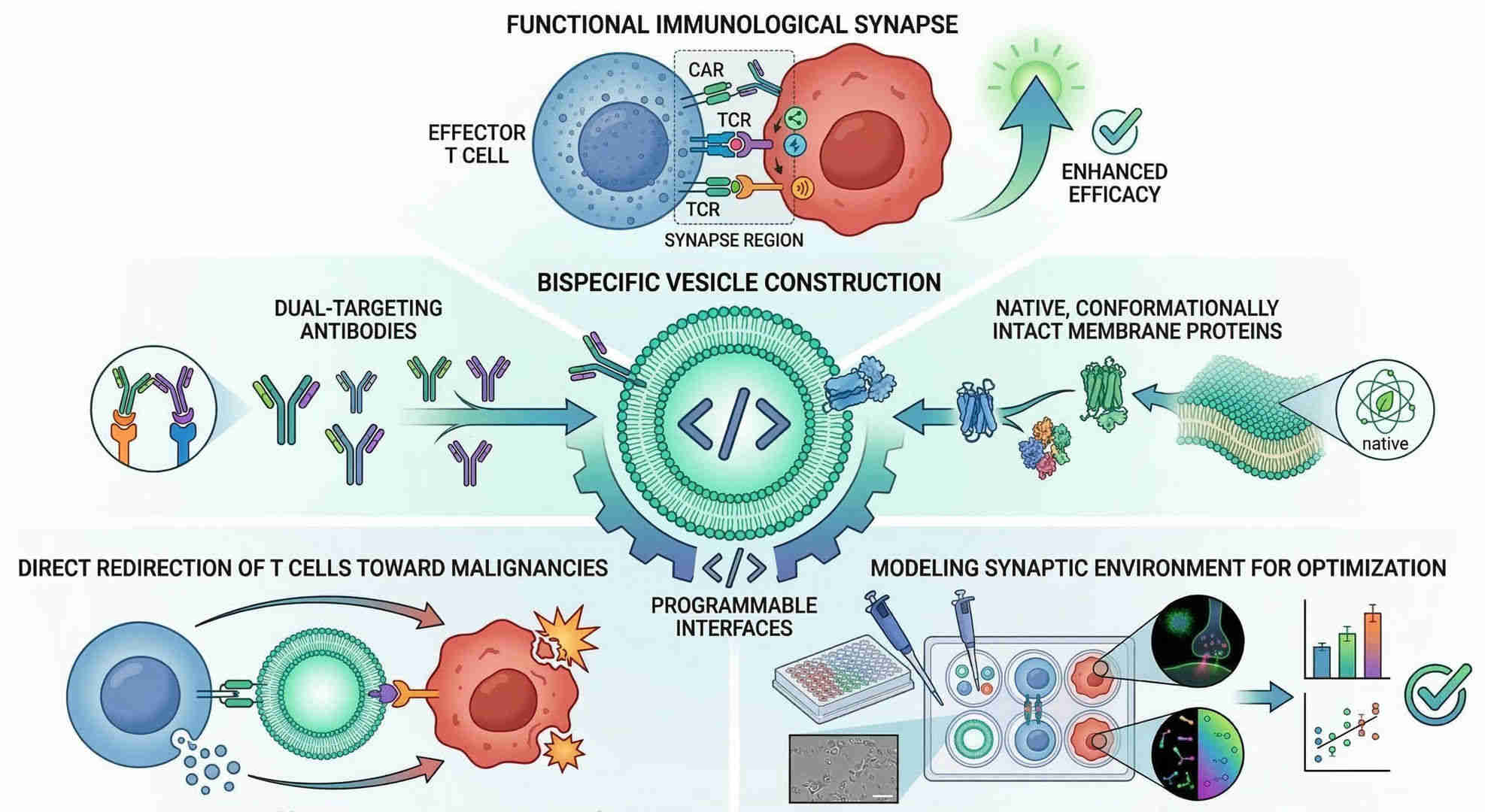 Fig.1 Development of dual-targeting vesicles for synthetic CAR-T synapse formation.
Our Construction of Bispecific Vesicles for Artificial CAR-T Immunological Synapse delivers a biomimetic platform that replicates the native immune synapse using dual-functional vesicles displaying both target antigen and co-stimulatory signals. This service enables precise functional validation of CAR candidates by simulating physiological T-cell activation. By providing high-fidelity screening data early in development, we empower clients to de-risk pipelines and accelerate the selection of clinically potent lead candidates.
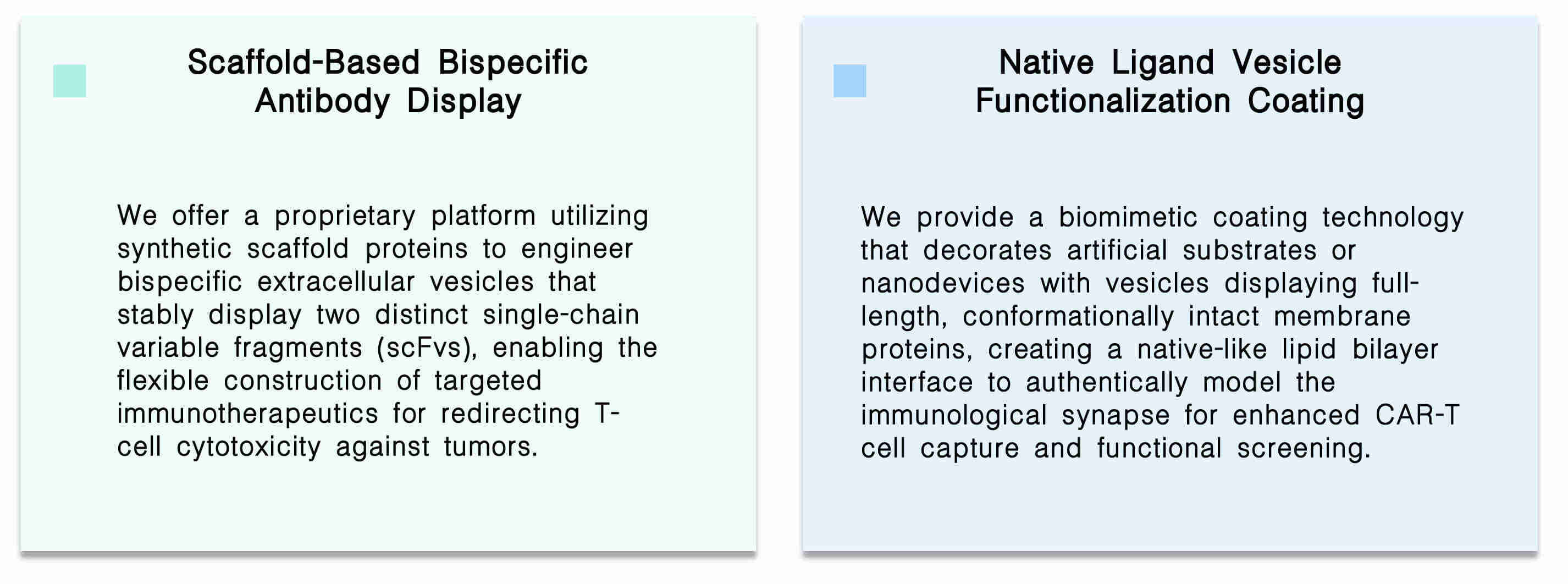
Leveraging advanced vesicle engineering, we offer a dual-platform approach to construct artificial CAR-T immunological synapses: one enabling the flexible design of bispecific therapeutic vesicles for targeted tumor killing, and another providing a biomimetic coating for authentic immune synapse modeling to facilitate superior T-cell screening and interrogation.
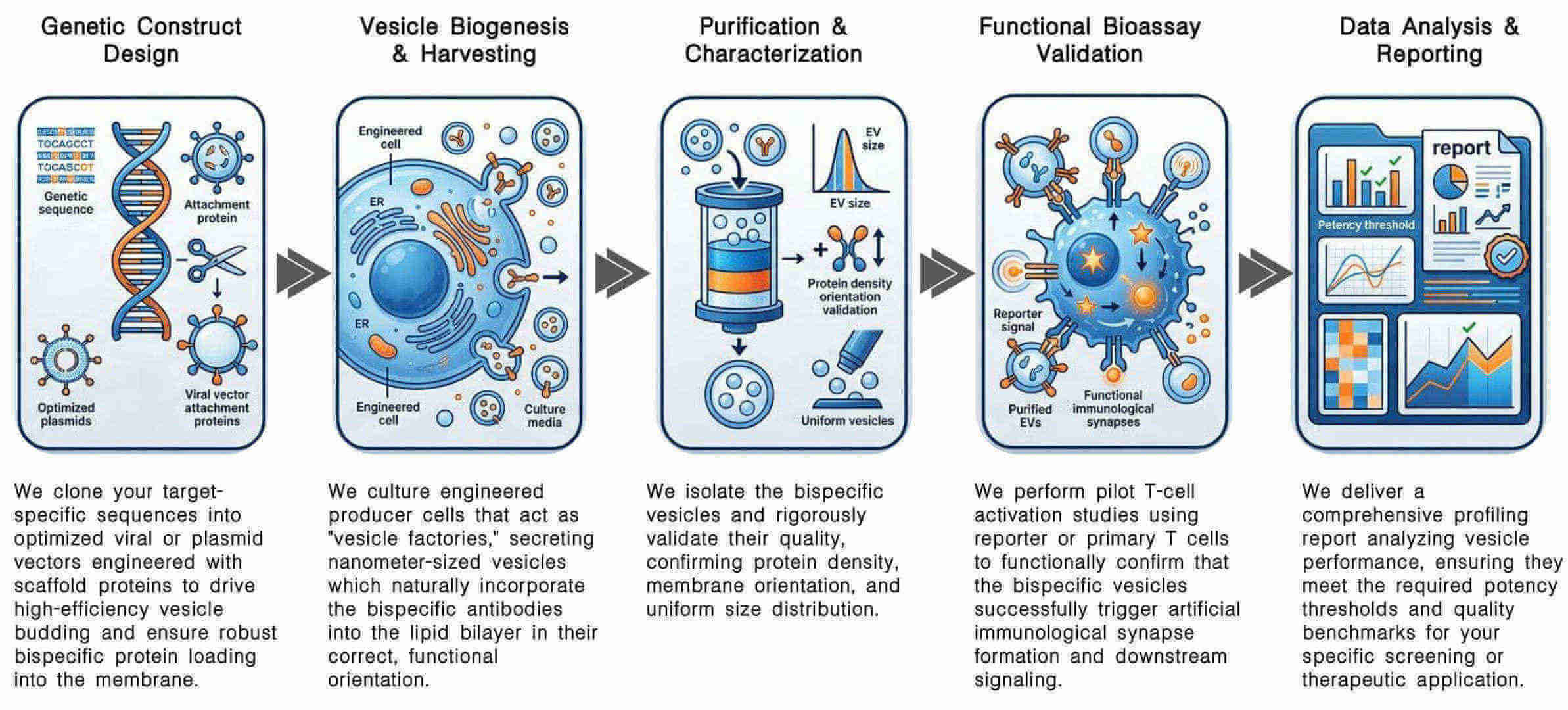
Final Deliverables:
Q1: How do bispecific vesicles compare to traditional pMHC tetramers?
A1: Unlike tetramers, our vesicles provide a lipid bilayer environment that allows for receptor mobility and the inclusion of co-stimulatory molecules, leading to more natural activation and better predictive value for in vivo success.
Q2: Can I customize the lipid composition of the vesicles?
A2: Yes. While we use standard high-yield cell lines, we can adjust the biogenesis environment or perform post-isolation modifications to meet specific lipid raft or membrane fluidity requirements.
Q3: Are these vesicles compatible with high-throughput screening?
A3: Absolutely. They are specifically designed for use in microfluidic platforms, nanovials, and standard FACS workflows to facilitate massively parallel screening.
Creative Biolabs stands at the forefront of biomimetic engineering. Our proprietary platform ensures that membrane proteins are not just present, but functional and mobile within the lipid bilayer, accurately simulating the lateral rearrangement of receptors during T-cell activation. Unlike standard recombinant protein coating, our bispecific vesicles preserve post-translational modifications and the structural integrity of multi-pass membrane proteins.
"Integrating Creative Biolabs' bispecific vesicles into our workflow allowed us to effectively differentiate functional TCRs from inactive high-affinity binders, accelerating the prioritization of potent lead candidates." Dr. Albert M.
"Our nanovial-based discovery of rare polyfunctional T cells was made possible by these vesicles, outperforming traditional soluble protein assays in identifying therapeutically relevant subsets." Sarah L.*en.
"The native pMHC architecture on these vesicles yielded superior dose-response sensitivity in our activation assays, surpassing the performance of recombinant protein alternatives." Prof. Ki** H.*.
Ready to move beyond binding assays and unlock true functional potency? Partner with our scientific team to integrate high-fidelity bispecific vesicles into your discovery pipeline. Contact us today for a confidential project consultation and a customized quote tailored to your specific CAR-T candidates.
For any technical issues or product/service related questions, please leave your information below. Our team will contact you soon.
All products and services are For Research Use Only and CANNOT be used in the treatment or diagnosis of disease.
 NEWSLETTER
The latest newsletter to introduce the latest breaking information, our site updates, field and other scientific news, important events, and insights from industry leaders
LEARN MORE NEWSLETTER NEW SOLUTION
CellRapeutics™ In Vivo Cell Engineering: One-stop in vivo T/B/NK cell and macrophage engineering services covering vectors construction to function verification.
LEARN MORE SOLUTION NOVEL TECHNOLOGY
Silence™ CAR-T Cell: A novel platform to enhance CAR-T cell immunotherapy by combining RNAi technology to suppress genes that may impede CAR functionality.
LEARN MORE NOVEL TECHNOLOGY NEW SOLUTION
Canine CAR-T Therapy Development: From early target discovery, CAR design and construction, cell culture, and transfection, to in vitro and in vivo function validation.
LEARN MORE SOLUTION