Creative Biolabs has a tradition of commitment. To achieve efficient execution and regulatory approval, we offer careful considerations of your program for the development of a cellular or gene therapy product – now and in the future.
EXPLORE MORE HighlightsWe focus on unmet needs and develop novel cellular and gene drugs and solutions that offer significant benefits over existing options.
EXPLORE MORE HighlightsThe advent of Chimeric Antigen Receptor T-cell (CAR-T) therapies has revolutionized the field of oncology, providing new avenues for treating various forms of cancer. Our 20 years of experience in the biotechnology sector have equipped us with the expertise and technological capabilities to support the entire lifecycle of CAR-T products, from early development to commercialization.
EXPLORE MORETo accelerate advanced breakthroughs of your projects, we offer broad range of platforms which enable our clients be free to tackle problems with cutting-edge technologies from different angles and in different methods.
EXPLORE MORE HighlightsUse the resources in our library to help you understand your options and make critical decisions for your study. We offer oncolytic virus, CAR-T, and dendritic cell related documents, as well as newsletter. If you don't find the answers you're looking for, contact us for additional assistance.
EXPLORE MORE HighlightsGet a real taste and understanding of the business and culture of one of the world's great research-based cellular and gene therapy discovery and development companies.
EXPLORE MORE
Despite the transformative potential of CAR-T therapy, solid tumor applications remain hindered by poor T-cell infiltration, antigen heterogeneity, and a highly suppressive tumor microenvironment. Creative Biolabs' OMV Surface Engineering for Precision CAR-T Homing & Synapse platform addresses these barriers by leveraging programmable outer membrane vesicles to transform "cold" tumors into highly visible targets. We provide modular engineering services utilizing SpyTag/SpyCatcher technology and dual-responsive gating to create vesicles that precisely guide CAR-T cells and remodel the tumor-immune interface. This approach enhances tumor-specific homing and synapse formation, enabling you to overcome the immunosuppressive TME and advance your next-generation immunotherapies with greater precision and efficacy.
Outer membrane vesicle (OMV) surface engineering is a bio-inspired nanotechnology platform that leverages genetically programmable bacterial vesicles to display multifunctional ligands on their surface, serving as modular carriers for targeted therapeutic delivery. By incorporating tumor-specific recognition elements and immunological synapse-stabilizing molecules, engineered OMV platforms facilitate precise CAR-T homing to solid tumor microenvironments while enhancing the formation of stable and functional immune synapses, ultimately improving cytotoxic efficiency and mitigating off-target recognition.
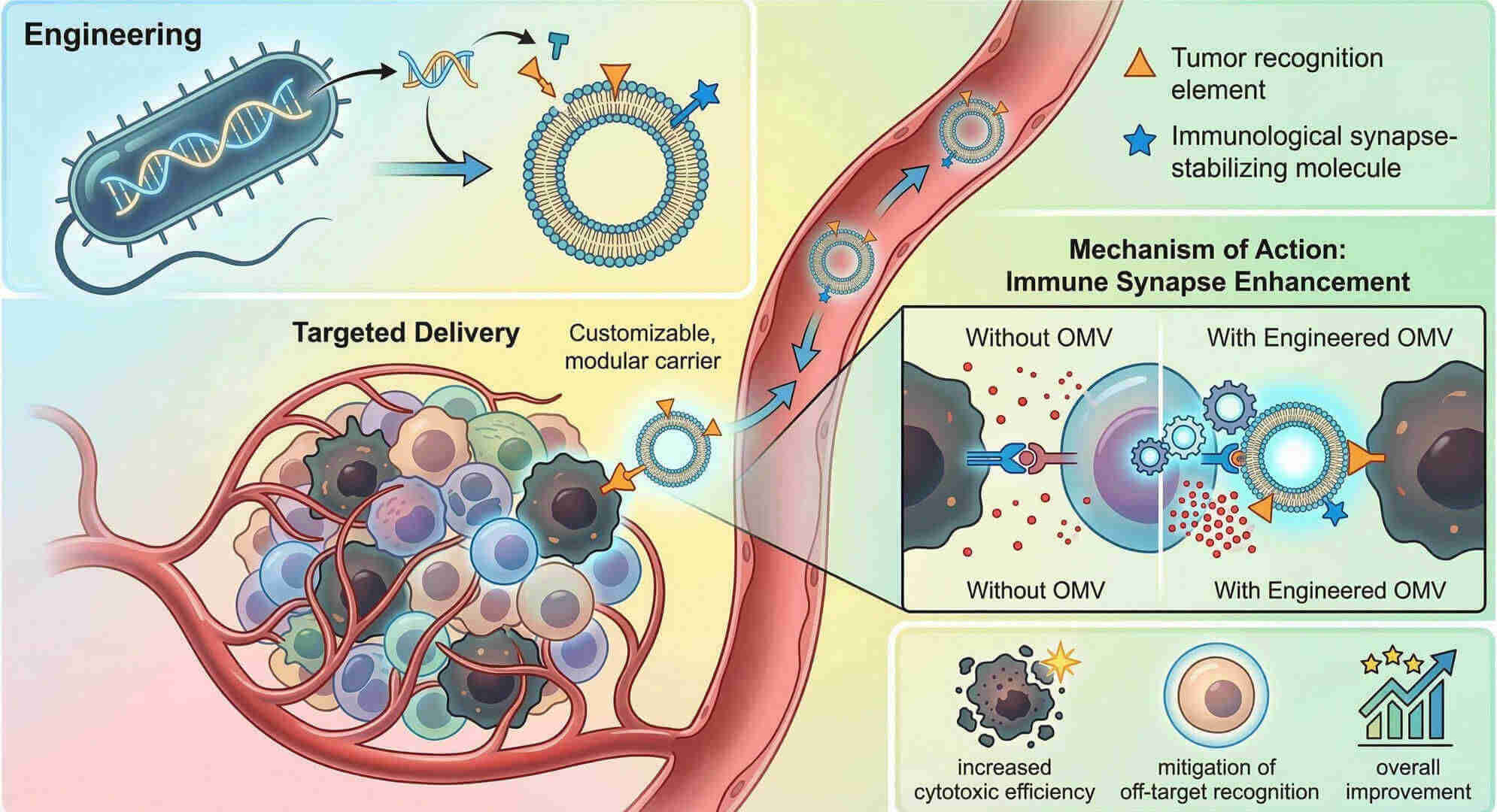 Fig.1 Leveraging OMV surface engineering to enhance CAR-T homing and synapse formation.
Creative Biolabs offers a comprehensive modular platform engineered to functionally bridge CAR-T lymphocytes with solid tumor microenvironments. By utilizing advanced OMVs as dual-functional intermediaries, we empower your program to target and eliminate heterogeneous tumor populations that evade conventional CAR recognition. Our deliverable portfolio includes fully characterized, surface-engineered OMVs alongside the corresponding genetic constructs, all customizable to your specific oncological targets.
This page details our proprietary technology platform for the rapid and site-specific functionalization of OMVs. By leveraging the irreversible isopeptide bond formation between SpyTag and SpyCatcher, we enable the modular decoration of the OMV surface with a variety of targeting ligands or tumor antigens. This plug-and-play system allows for the high-throughput screening of homing signals and the creation of customized OMV populations designed to precisely redirect or capture specific CAR-T cell subsets.
Learn More →This section focuses on the engineering of synthetic vesicles designed to function as artificial antigen-presenting platforms. We describe the co-display of both a tumor-targeting moiety and a co-stimulatory ligand on a single OMV. This bispecific architecture mimics the natural antigen-presenting cell to construct a controlled, artificial immunological synapse, providing a powerful tool for studying CAR-T activation thresholds, delivering synergistic signals to enhance T-cell proliferation, or priming CAR-T cells ex vivo with superior functionality.
Learn More →This page presents our comprehensive biophysical characterization of the interaction between engineered OMVs and their target tumor cells. Using techniques, we quantify the affinity, avidity, and binding kinetics of our functionalized vesicles. These critical parameters serve as a predictive guide for subsequent in vitro and in vivo CAR-T homing studies, ensuring that only OMV formulations with optimal binding profiles are advanced to guide CAR-T cells to solid tumors.
Learn More →
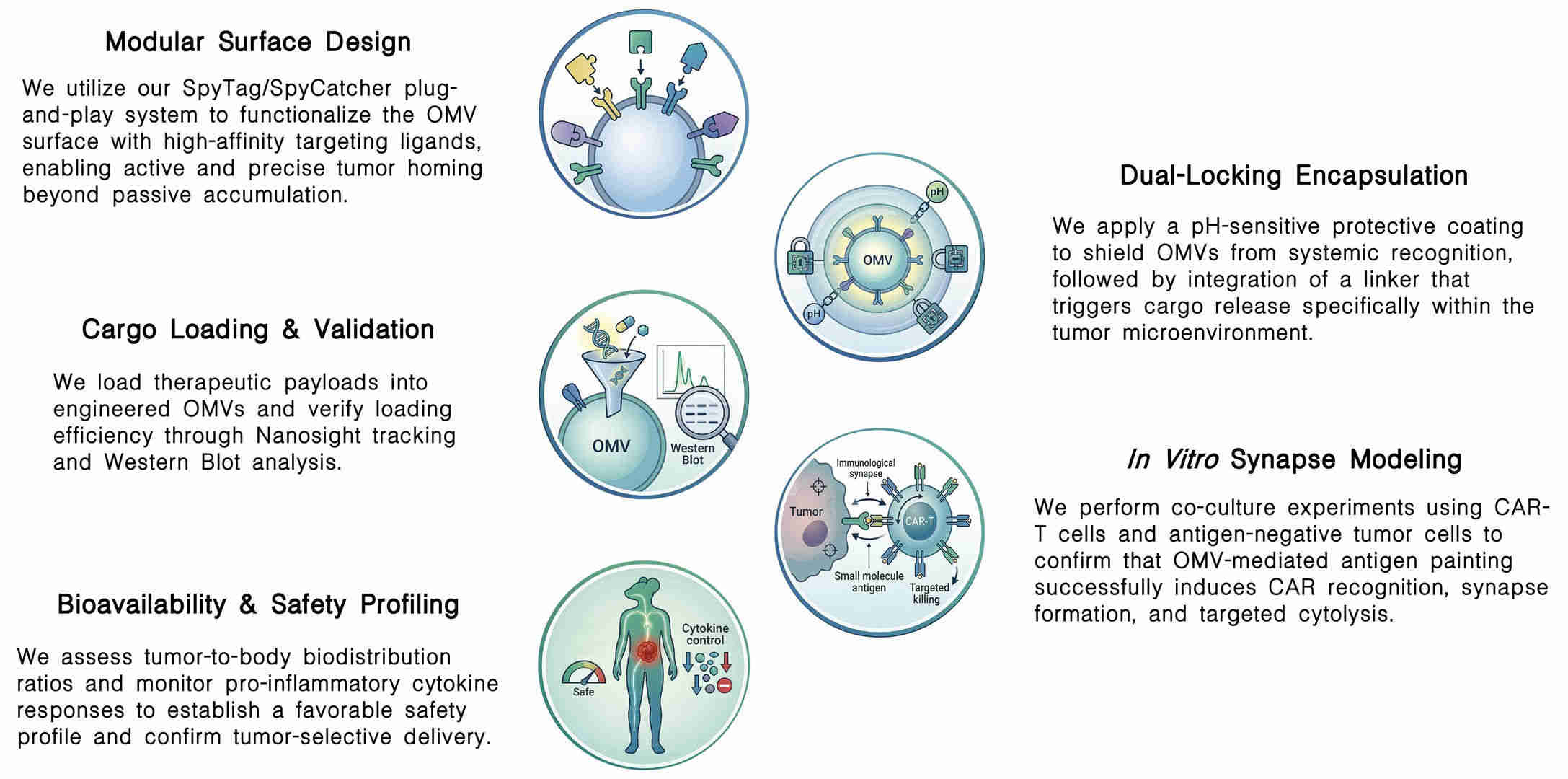
Final Deliverables: You will receive a complete characterization report, functional validation data, and the purified, engineered OMV batches.
Q1: Does the OMV itself trigger a cytokine storm?
A1: No. The formulation employs an advanced acid-responsive coating that effectively masks the immunogenic bacterial lipids during circulation in the bloodstream. This protective layer ensures that the OMV's adjuvant activity is spatially restricted, initiating its potent immune-stimulating functions only upon reaching the acidic TME.
Q2: Can we use this for any CAR-T target?
A2: Yes. The core of this technology lies in its modular architecture. The surface display system is fully decoupled from the target antigen; it functions as a universal carrier. To redirect specificity, one simply exchanges the targeting ligand or scFv, making the platform adaptable to virtually any predefined tumor-associated antigen without requiring complex re-engineering of the OMV backbone.
We uniquely merge synthetic biology with deep immunological insight to transform the OMV from a simple carrier into a programmable navigator for your CAR-T cells. Our platform is engineered for precision, offering superior tumor homing and unmatched modularity that accelerates your path from target discovery to validated therapy.
Creative Biolabs offers a state-of-the-art OMV surface engineering platform that integrates high-resolution analysis with a programmable dual-locking mechanism for targeted therapeutic delivery. By leveraging advanced bioengineering strategies, we address the key limitations in CAR-T therapy for solid tumors, namely tumor heterogeneity, T-cell exhaustion, and on-target off-tumor toxicity. For further discussion or to request a customized project proposal, please contact our team.
For any technical issues or product/service related questions, please leave your information below. Our team will contact you soon.
All products and services are For Research Use Only and CANNOT be used in the treatment or diagnosis of disease.
 NEWSLETTER
The latest newsletter to introduce the latest breaking information, our site updates, field and other scientific news, important events, and insights from industry leaders
LEARN MORE NEWSLETTER NEW SOLUTION
CellRapeutics™ In Vivo Cell Engineering: One-stop in vivo T/B/NK cell and macrophage engineering services covering vectors construction to function verification.
LEARN MORE SOLUTION NOVEL TECHNOLOGY
Silence™ CAR-T Cell: A novel platform to enhance CAR-T cell immunotherapy by combining RNAi technology to suppress genes that may impede CAR functionality.
LEARN MORE NOVEL TECHNOLOGY NEW SOLUTION
Canine CAR-T Therapy Development: From early target discovery, CAR design and construction, cell culture, and transfection, to in vitro and in vivo function validation.
LEARN MORE SOLUTION