

This is perhaps the most prominent application. Targeted probes can identify highly specific cancer biomarkers (e.g., HER2, PSMA, or VEGFR). Our systems allow for non-invasive, high-resolution imaging of small tumors, metastatic sites, and the complex tumor microenvironment, including visualization of angiogenesis or immune cell infiltration, which are often overlooked by conventional methods.
Targeted Delivery for Diagnostics & Imaging
Targeted Delivery for Diagnostics and Imaging is the cornerstone of precision medicine, moving beyond generalized detection to high-resolution, site-specific visualization. Our comprehensive Targeted Delivery for Diagnostics and Imaging services at Creative Biolabs help you streamline the preclinical imaging pipeline and obtain high-contrast, specific diagnostic data through innovative nanocarrier design and sophisticated bioconjugation techniques.
Click Here to View more about our Service
Targeted Delivery for Diagnostics and Imaging
Traditional diagnostic imaging agents often suffer from poor contrast, short circulation times, and non-specific accumulation in both healthy and diseased tissues, leading to suboptimal signal-to-noise ratios and ambiguous results. Targeted delivery systems revolutionize this landscape by specifically guiding diagnostic payloads—such as fluorescent dyes, magnetic resonance contrast agents, or radioisotopes—to their molecular targets with high affinity.
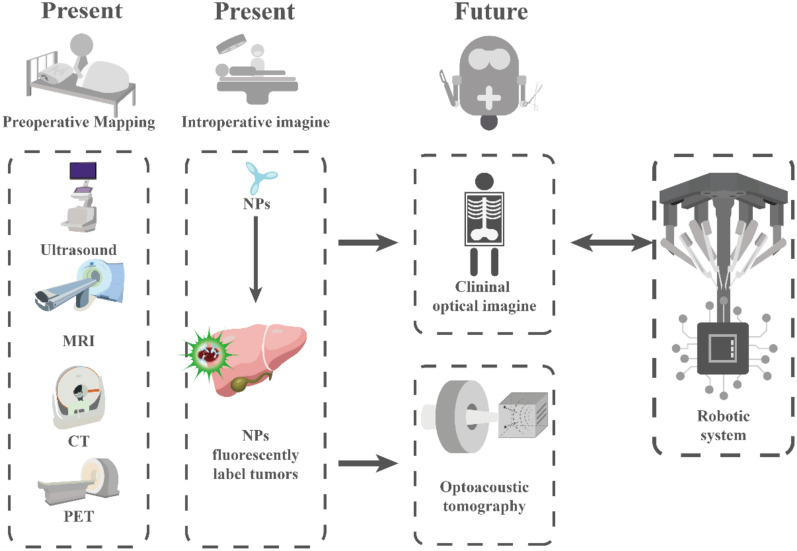 Fig.1 The current and future role of NPs in imaging-guided treatment in HCC.1
The core technology often relies on nanoscale carriers, like specialized liposomes, polymeric nanoparticles, or protein scaffolds. These nanocarriers are engineered to encapsulate the imaging agent, protecting it from degradation in circulation and enhancing its pharmacokinetics. Crucially, their surfaces are modified with targeting ligands—including antibodies, peptides, aptamers, or small molecules—that recognize and bind to biomarkers uniquely expressed on the surface of target cells (e.g., cancer cells, activated immune cells, or atherosclerotic plaques).
This strategy of active targeting allows for the selective concentration of the imaging agent at the site of interest, dramatically increasing local signal intensity and minimizing background noise from surrounding healthy tissue. Furthermore, this foundation is critical for developing Theranostics, a powerful fusion concept where the same targeted nanocarrier simultaneously carries both a therapeutic payload and a diagnostic agent, enabling real-time monitoring of drug accumulation and therapeutic response in a personalized manner. The literature consistently highlights the improved detection limits and diagnostic specificity achieved through these targeted approaches, positioning them as essential tools for early disease detection and personalized treatment planning.
Targeted delivery systems enable a dual application across diagnostics, spanning both the analysis of external biological samples and non-invasive visualization within the body. Click the button below to learn more.
In vitro diagnostics (IVD) analyze biological samples (blood, urine, biopsies) outside the body. Nanotechnology significantly enhances IVD precision, particularly in biosensing. Targeted nanocarriers use functionalized aptamers or antibodies to selectively capture and concentrate scarce biomarkers (e.g., cancer-related proteins or nucleic acids) from complex biological fluids. This signal amplification, often leveraging nanomaterials like quantum dots (QDs) and metallic nanoparticles, enables earlier, more accurate, and point-of-care diagnosis of diseases like cancer and viral infections.
In vivo imaging visualizes biological processes and disease states non-invasively within a living organism. Targeted nanocarriers are transformative in this field, functioning as 'smart' contrast agents. Functionalizing the particle surface with specific ligands ensures the imaging payload selectively accumulates at the diseased site, significantly improving the signal-to-noise ratio in modalities like Magnetic Resonance Imaging (MRI), Computed Tomography (CT), Positron Emission Tomography (PET), and optical imaging. For instance, targeted Superparamagnetic Iron Oxide Nanoparticles (SPIONs) enhance T2 contrast in MRI for clearer tissue boundaries. Successful targeted in vivo imaging is crucial for advanced theranostic applications, allowing visualization of the target before, during, and after treatment.
Application of Targeted Delivery for Diagnostics and Imaging
Targeted delivery systems are rapidly broadening the scope and precision of diagnostic medicine across several major disease areas and research fields:
Oncology and Tumor Microenvironment Visualization
Inflammation and Autoimmune Disease
Imaging inflammation is challenging due to its systemic nature. Targeted delivery vehicles can home in on activated immune cells (e.g., macrophages, T-cells) or elevated expression of adhesion molecules at inflamed tissue sites, providing a quantitative and localized measure of disease activity in conditions like rheumatoid arthritis or multiple sclerosis.
Cardiovascular Diagnostics
Targeted nanoparticles are crucial for visualizing subtle indicators of heart disease, such as vulnerable atherosclerotic plaques that are prone to rupture. By delivering contrast agents to markers like collagen or specific matrix metalloproteinases, we enable earlier and more precise risk stratification.
Personalized Medicine and Theranostics
The ultimate application is the integration of diagnosis and therapy. A targeted nanocarrier can first confirm the presence and location of the target (Diagnosis/Imaging) and then release an active drug at the exact same location (Therapy). This allows clinicians to confirm drug delivery efficacy in vivo and guide treatment decisions based on real-time feedback.
What We Can Offer: Tailored Diagnostic & Imaging Solutions
The success of a diagnostic or imaging project hinges on the reliability and specificity of the detection probe. Creative Biolabs' targeted delivery expertise transforms unstable, non-specific agents into high-performance diagnostic tools. We focus on four specific deliverables that address the most common challenges faced by our clients:
Enhanced Target-to-Background Ratio
By developing highly specific targeting modules (e.g., scFvs, small peptides) conjugated to optimally sized nanocarriers, we ensure your imaging agent accumulates almost exclusively at the disease site, yielding superior imaging contrast and reducing false positives.
Increased Imaging Agent Stability and Circulation Time
Our proprietary formulation methods protect fragile payloads, allowing them to remain intact and active during extended systemic circulation, which is essential for reaching deep-seated or slowly accumulating targets.
Multimodal Imaging Integration
We specialize in creating single delivery platforms capable of carrying agents for different modalities (e.g., MRI, Fluorescence, PET). This allows for complementary data acquisition and streamlined transition between preclinical and clinical imaging workflows.
Batch-to-Batch Consistency and Scalability
We provide rigorous quality control throughout the entire development process, guaranteeing that the final targeted imaging probe is consistent, stable, and produced using processes scalable for large-scale preclinical or future clinical needs.
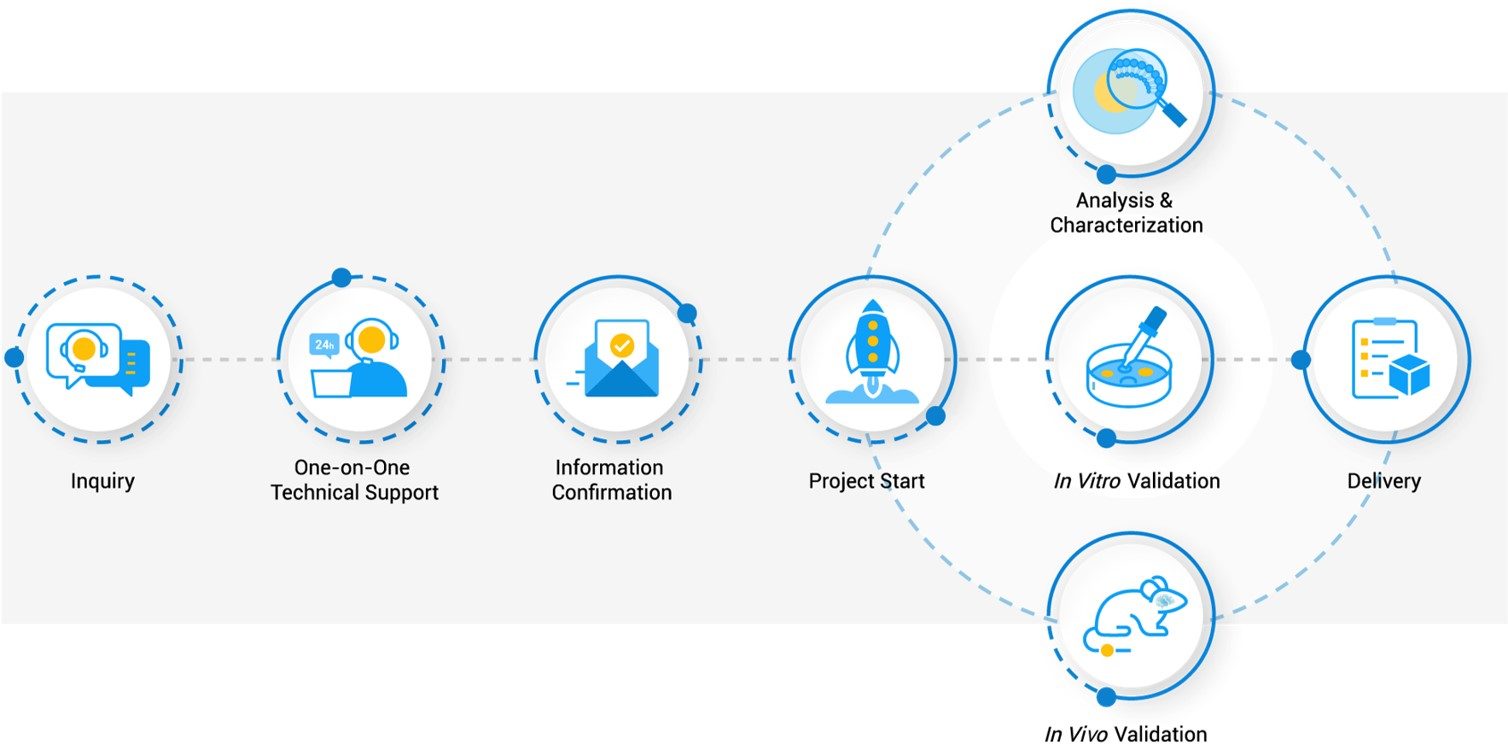
Workflow
FAQs
How do targeted delivery systems for imaging improve upon traditional contrast agents?
The main advantage is specificity. Traditional agents often passively accumulate in leaky vasculature or are rapidly cleared. Targeted systems, however, are engineered with specific recognition molecules (ligands) that bind only to biomarkers on diseased cells. This allows the imaging payload to concentrate precisely at the area of interest, leading to much higher local contrast and a clearer, more accurate diagnostic image with reduced non-specific background signal.
What type of imaging agents can be incorporated into these targeted delivery platforms?
These platforms are highly versatile. They can encapsulate or conjugate a wide range of payloads for different imaging modalities, including organic fluorescent dyes (for optical imaging), metallic chelates or iron oxides (for MRI), and various radioisotopes (for PET or SPECT imaging). The selection depends entirely on the desired detection method and the size/nature of the delivery vehicle being used.
What is the typical development timeline for a custom targeted diagnostic nanocarrier?
The timeline can vary significantly based on the complexity of the targeting ligand and the chosen nanocarrier system. A project involving the use of a pre-validated ligand and a standard liposome formulation might take less time, whereas developing a novel peptide ligand and a complex polymer nanoparticle will require a more extensive validation phase. It is always best to initiate a detailed discussion with specialists to outline a precise project plan tailored to your specific goals.
Are there any potential challenges with toxicity or immunogenicity when using nanocarriers for imaging?
This is a genuine and important concern. Reputable systems are typically built from biocompatible and biodegradable materials (like lipids or safe polymers) to minimize toxicity. Immunogenicity is addressed through surface modification techniques, such as PEGylation (the "stealth" effect), which helps the system evade immune recognition. Careful selection of materials and rigorous in vivo testing are essential precautions to mitigate these risks.
How do I ensure my selected targeting ligand will work effectively in vivo once incorporated into a nanocarrier?
Efficacy requires optimization beyond simple binding affinity. The ligand must remain active and correctly oriented on the particle surface; the entire system must circulate long enough to reach the target; and the payload must be released effectively or generate a signal upon arrival. We recommend a structured development process that includes comprehensive in vitro binding assays and careful evaluation of the nanocarrier's stability and biodistribution in preclinical models.
Targeted Delivery for Diagnostics and Imaging is not just an incremental improvement—it is a paradigm shift toward truly personalized, high-precision detection. Creative Biolabs stands ready to be your partner, offering custom nanocarrier development, expert bioconjugation, and rigorous characterization services that transform your diagnostic vision into reality.
Reference
- Yu, Xianzhe et al. "Engineered nanoparticles for imaging and targeted drug delivery in hepatocellular carcinoma." Experimental hematology & oncology vol. 14,1 62. 30 Apr. 2025, Distributed under Open Access license CC BY 4.0, without modification. https://doi.org/10.1186/s40164-025-00658-z
Our services are For Research Use Only. We do not provide services to individuals.
Online Inquiry