
Delivery of peptides, growth factors, and retinoids directly to dermal fibroblasts to stimulate collagen and elastin production, resulting in demonstrable reductions in fine lines and wrinkles.
Targeted Delivery for Cosmetic Efficacy
In the competitive landscape of cosmeceuticals, achieving genuine, visible skin transformation hinges on ingredient efficacy, which is often limited by poor absorption and degradation. Protecting and guiding fragile actives to their precise cellular targets in the skin are the cornerstones of next-generation cosmetic science. Our Creative Biolabs' Targeted Delivery Platform helps you maximize cosmetic ingredient performance and penetration through advanced nanocarrier design and proprietary skin-targeting modules. This innovative approach ensures superior stability, enhanced bioavailability, and localized action for true functional beauty.
Click Here to View more about our Service
Targeted Delivery for Cosmetic Efficacy
Targeted delivery in cosmetics is the science of transporting an active ingredient (the payload) to a specific anatomical or cellular location within the skin (the target) using a biocompatible carrier system. This revolutionary approach moves beyond simple dermal absorption to achieve highly localized and efficient ingredient action, leading to superior cosmetic outcomes. The core principle involves overcoming the skin's inherent barrier function—the stratum corneum—which is highly effective at keeping foreign substances out. By employing sophisticated nanocarrier technology, we can engineer molecular vehicles, often composed of lipids or polymers, that mimic or utilize natural skin pathways to reach specific targets like the basal layer of the epidermis (for pigmentation control) or the dermis (for collagen stimulation). This precision minimizes wastage of expensive actives and drastically reduces the potential for surface irritation, thereby maximizing the therapeutic index of the cosmetic formulation.
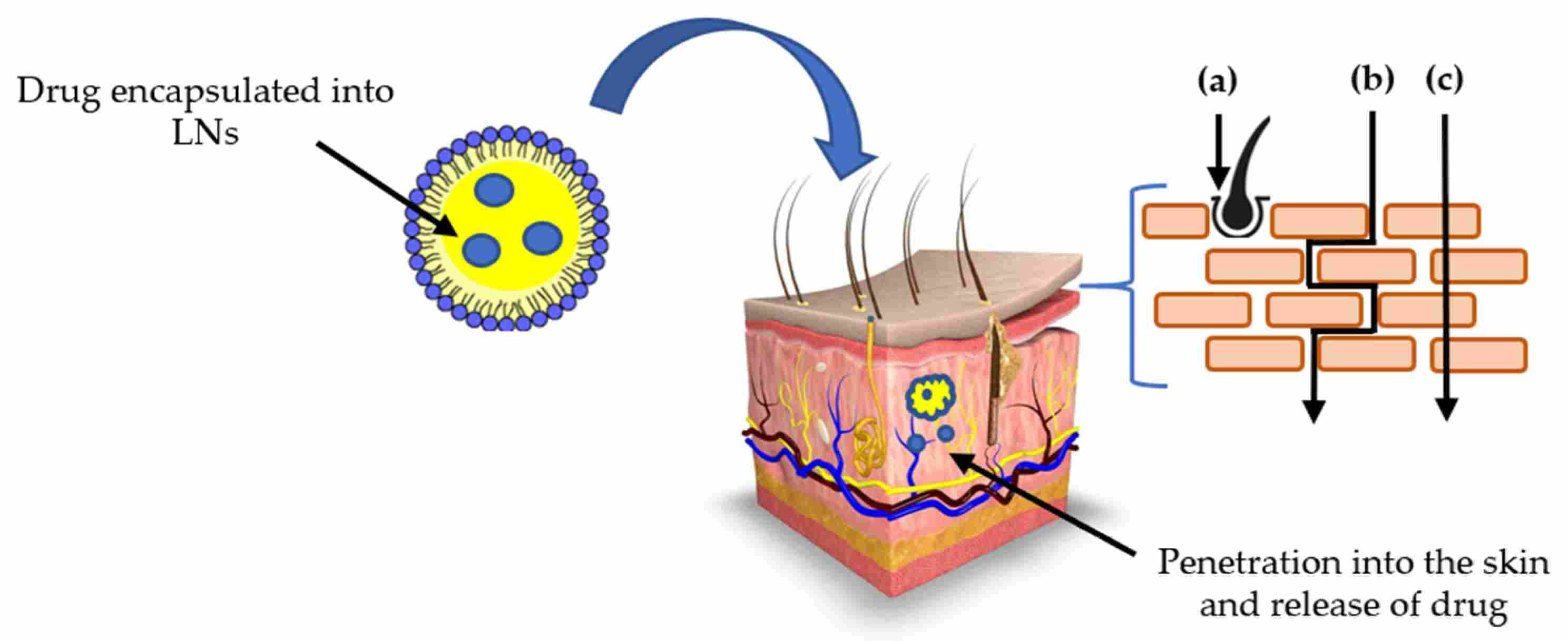 Fig.1 Nanoparticle skin penetration pathways.1
The success of a cosmetic active relies on overcoming two major hurdles:
-
Transdermal Delivery
The stratum corneum, while essential for protection, severely limits the permeation of most molecules. Traditional delivery methods rely on passive diffusion, which is often inefficient. Modern targeted delivery utilizes advanced nanocarriers, such as specialized liposomes, nanoemulsions, and solid lipid nanoparticles, which are engineered to navigate this barrier. Research has shown that utilizing these nanocarriers can increase the skin permeation rate of actives by orders of magnitude compared to free-form ingredients, providing critical support for claims of deep-acting efficacy. -
Formulation Stability & Efficacy
Many high-value cosmetic ingredients are chemically fragile. For instance, potent antioxidants or nucleic acid-based components are highly susceptible to degradation upon exposure to air, light, or water, often losing efficacy before the product even reaches the consumer. Encapsulation within a robust delivery vehicle not only protects the payload but also enables the formulation of previously incompatible ingredients, thus broadening the scope of what is possible in a single product.
Applications of Advanced Targeted Delivery
The precision offered by targeted delivery systems unlocks new potential across all major areas of cosmetic formulation, enabling ingredients to act where they are needed most.
Advanced Anti-Aging Formulations
Precision Skin Brightening
Targeting melanin-producing melanocytes with encapsulated tyrosinase inhibitors (e.g., Kojic acid, arbutin) to ensure a controlled and localized effect, maximizing efficacy while minimizing systemic exposure and irritation.
Deep Hydration and Barrier Repair
Embedding ceramides, hyaluronic acid fragments, and specific lipids within carrier systems to repair the compromised skin barrier and ensure long-lasting moisture retention in the deeper epidermal layers.
Targeted Anti-Inflammation and Redness Reduction
Directing soothing ingredients (e.g., botanical extracts, cannabinoids) to inflammatory cells and receptors in the skin, providing rapid and sustained relief from conditions like rosacea and general irritation.
What We Can Offer: Comprehensive Delivery System Development
The primary barrier to effective cosmetic formulation is the stratum corneum—the skin's protective outermost layer—which inherently resists the penetration of large, polar, or unstable molecules. This results in most active ingredients sitting inertly on the surface or degrading before reaching their site of action (e.g., fibroblasts, melanocytes).
Creative Biolabs' specialized platform resolves these key challenges by custom-engineering delivery vehicles that are designed to bypass the skin barrier and unload their payload at the intended site within the epidermis or dermis. We focus on two critical deliverables for our clients:
Enhanced Bioavailability & Penetration
We design ultrafine nanocarriers that penetrate the stratum corneum via specific routes (e.g., transcellular, intercellular, or follicular), significantly increasing the concentration of the active ingredient delivered to the targeted layer.
Payload Protection & Extended Release
Our systems encapsulate sensitive compounds (like high-potency Vitamin C, Retinoids, or Peptides), shielding them from environmental factors such as UV light, oxidation, and heat, ensuring their activity is preserved until they reach their target cells. This also allows for controlled, sustained release, maximizing the ingredient's therapeutic window.
By partnering with Creative Biolabs, you gain a competitive edge by transforming conventional formulations into high-efficacy, evidence-based cosmetic products.
Workflow
FAQs
How do these advanced delivery systems ensure my ingredient reaches the deep dermal layers, rather than just the skin surface?
The mechanism relies on engineering the carrier to be nanoscale (typically under 200 nm) and designing its surface properties. These carriers can utilize various pathways, including navigating the intercellular lipid pathways or targeting hair follicles and sweat glands. This optimization, based on particle size, charge, and lipid composition, ensures the carrier either fuses with or traverses the cell membranes to deposit the active ingredient precisely where collagen and elastin synthesis occurs.
My current active ingredient, a potent antioxidant, is highly prone to oxidation. Can a delivery system truly protect it and maintain its full potency?
Absolutely. The core function of these systems is encapsulation. By sealing the sensitive molecule within a robust, chemically inert lipid or polymer shell, we create a barrier that shields it from environmental triggers like oxygen, UV radiation, and heavy metals. This dramatically extends the ingredient's half-life and ensures that 100% of its potency is preserved until the carrier releases it at the target site.
What are the primary scientific milestones and material quantity needed for the feasibility assessment of a novel nanocarrier?
The feasibility phase is centered on two scientific milestones: initial formulation optimization (tuning lipid ratios, processing parameters) and preliminary analytical characterization (determining encapsulation efficiency, particle size/PDI, and zeta potential). This phase typically requires only a small, manageable quantity of the active compound (usually milligram-scale) to minimize resource expenditure. We focus on rapidly identifying the most promising carrier composition that meets the critical quality attributes before scaling up.
Are these nanocarrier formulations safe for consumer use, especially for sensitive skin types, compared to traditional formulations?
Yes, the carriers are typically constructed from biocompatible, non-toxic, and biodegradable materials already widely accepted in the cosmetic and pharmaceutical industries, such as natural phospholipids. Furthermore, because these systems effectively target the active to a specific layer, they often result in reduced overall exposure to healthy tissue, which can translate into a lower risk of irritation or sensitization compared to high concentrations of the free active sitting on the stratum corneum.
How do I compare the performance of a nanocarrier-based formulation versus a simple oil-based formulation for lipid-soluble actives?
While oil-based formulations rely on passive diffusion through the lipid matrix of the skin barrier, nanocarriers offer an active strategy. The key difference lies in efficiency and control. Nanocarriers not only penetrate deeper but also allow for precise control over the release rate, preventing rapid metabolism. We recommend starting with in vitro permeation studies which provide quantitative data on penetration depth and bioavailability, offering a clear, scientific comparison to demonstrate superior efficacy.
Creative Biolabs is your dedicated partner for overcoming the limitations of conventional cosmetic formulation. Our Targeted Delivery Platform—built on decades of drug delivery science—provides custom nanocarrier solutions that guarantee enhanced active ingredient stability, superior transdermal penetration, and highly localized efficacy. Transform your vision for next-generation cosmeceuticals into reality with our robust, scientific, and quality-driven approach.
Reference
- Santonocito, Debora, and Carmelo Puglia. "Lipid nanoparticles and skin: Discoveries and advances." Cosmetics 12.1 (2025): 22. Distributed under Open Access license CC BY 4.0, without modification. https://doi.org/10.3390/cosmetics12040138
Our services are For Research Use Only. We do not provide services to individuals.
Online Inquiry