
In the chemical and petrochemical industry, encapsulation is vital for protecting sensitive reagents and catalysts. For instance, creating yolk@shell or core@shell nanocatalysts with porous silica shells dramatically prevents aggregation and thermal deactivation, allowing for sustained high-temperature reactions without loss of catalytic efficiency. Similarly, encapsulation is crucial for separating incompatible components that must only mix upon application, such as in two-part epoxy systems or complex chemical kits.
Encapsulation Solutions in Industrial & Material Field
In the pursuit of groundbreaking industrial and material innovations, the journey from a novel active agent to a high-performance product often hinges on one critical factor: controlled delivery and protection. Fragile materials, volatile compounds, and performance additives must be shielded from harsh manufacturing environments and released precisely when, where, and how they are needed. Our Encapsulation Solutions helps you unlock unprecedented performance and lifetime for active materials through advanced micro- and nano-engineering techniques, accelerating product development and delivering superior value to end-users.
Click Here to View more about our Service
Introduction of Encapsulation Solutions
Encapsulation, in the context of materials science and industry, refers to the process of enclosing a core substance (liquid, solid, or gas) within a protective shell material (the wall) to form micro- or nano-sized capsules. This technology, borrowed and adapted from advanced biopharmaceutical principles, allows for the precise management of active ingredients.
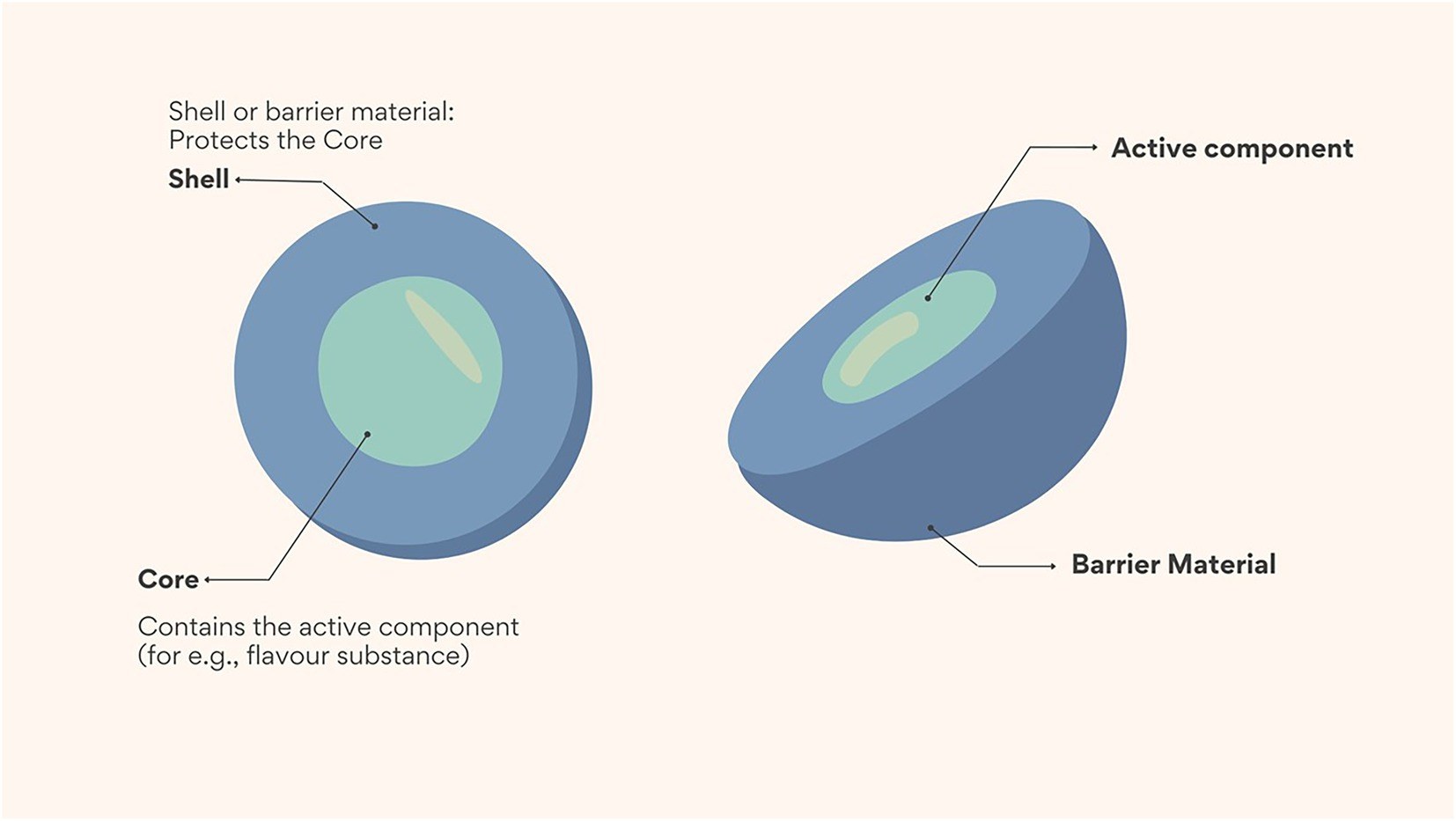 Fig.1 Schematic showing the main structure of a microcapsule.1
The capsules typically range from nanometers (for integration into transparent coatings or high-surface-area catalysts) to several hundred micrometers (for textile applications or slow-release systems). The fundamental function of the wall material—often a polymer, ceramic, or lipid—is to act as a semi-permeable or impermeable barrier, isolating the core from the environment until its function is required. This system provides a new dimension of functionality to conventional materials, enabling them to become "smart" or "responsive."
This innovative platform is driving key advancements across diverse sectors:
| Textiles | Embedding functional compounds (e.g., fragrances, antimicrobials, phase change materials) into fabrics for long-lasting, controlled-release properties, enhancing consumer comfort and material lifespan. |
| Catalysts | Creating stable core@shell structures to protect high-surface-area nanocatalysts from sintering and deactivation in harsh chemical environments, significantly extending catalyst lifetime and efficiency. |
| Biofouling Control | Encapsulating active agents (e.g., biocides or anti-adhesive compounds) into marine coatings for sustained and environmentally responsible release, preventing the buildup of organisms on submerged surfaces. |
| Environmental Remediation | Encapsulating living microbial cells or chemical agents into matrices for targeted delivery and controlled release in contaminated soil or groundwater, optimizing bioremediation efficacy. |
| Functional Nano-Coatings | Incorporating microcapsules into protective layers to create self-healing polymers, pH-triggered corrosion inhibitors, or thermally responsive paints. |
Application: Broadening the Scope of Advanced Materials
The flexibility and control offered by microencapsulation translate into a vast array of high-value industrial applications, moving far beyond simple protection and towards intelligent material design.
Chemical and Petrochemical Industry
Construction and Infrastructure
For construction and infrastructure, microcapsules form the basis of self-healing materials. Encapsulated healing agents (e.g., monomers or epoxy resins) are embedded in cementitious or polymer matrices. When a micro-crack forms, it ruptures the capsules, releasing the agent to fill and repair the damage autonomously, thus extending the lifespan of roads, bridges, and buildings.
Consumer Goods
In the consumer goods sector, encapsulation transforms everyday items. In textiles, encapsulated phase change materials (PCMs) absorb and release thermal energy to regulate body temperature, offering superior comfort in performance wear. In cleaning products, encapsulated fragrances provide a burst of scent triggered by friction or dissolution, enhancing the sensory experience and perceived quality.
Environmental Systems
Encapsulation in environmental systems is equally transformative. For agricultural use, the technology enables precision farming by delivering encapsulated fertilizers and pesticides with sustained release kinetics that align with crop uptake, minimizing runoff and environmental contamination. Furthermore, encapsulating specialized microbes for bio-augmentation in wastewater treatment ensures the survival and targeted deployment of the remediating agents.
What We Can Offer: Comprehensive Industrial Encapsulation Services
Encapsulation technology is no longer a niche method; it is the core enabler for next-generation functional materials. At Creative Biolabs, we focus on engineering a customized shell around your active ingredient—whether it is a catalyst, a flavor, a flame retardant, or a healing agent—to solve four fundamental industrial challenges:
Stability and Protection
We prevent premature degradation, oxidation, or reaction of sensitive core materials caused by external factors like heat, light, moisture, or chemical incompatibility within a product matrix.
Controlled Release
We design release profiles that are sustained (slow, steady diffusion over time) or triggered (released by a specific stimulus like heat, friction, pH, or UV light), ensuring maximum efficacy and minimal waste.
Handling and Compatibility
We transform liquids or highly reactive substances into free-flowing, compatible powders that are easier and safer to incorporate into complex systems like polymers, coatings, or resins.
Targeted Functionality
We ensure the active agent is delivered only to the specific location or only upon a specific environmental signal, vastly increasing efficiency in applications like smart coatings or self-healing materials.
Our deliverables include comprehensive proof-of-concept data, scalability assessments, and prototypes of customized microcapsules tailored to meet specific industrial demands for size uniformity, shell thickness, and durability.
Workflow

Frequently Asked Questions
What dictates the optimal wall material choice for encapsulation?
The selection of the shell material is primarily determined by two factors: the chemical nature and volatility of the core substance, and the intended release mechanism and final application environment. Highly volatile or chemically sensitive cores require robust, impermeable walls (often polyurea or melamine-formaldehyde type resins) to prevent leakage and degradation. For applications requiring a sustained, slow release, walls utilizing natural biopolymers or semi-permeable polymeric matrices are often preferred, as they allow diffusion over time. The material must also be physically compatible with the target product matrix (e.g., solvent compatibility in coatings or thermal stability during polymer processing).
How does particle size impact the functionality and application of the encapsulated material?
Particle size is critical and defines the practical application. Nanocapsules (<100 nm) are necessary for applications where visual clarity is required, such as transparent coatings or varnishes, or where high surface-area-to-volume ratio is needed (e.g., catalysis). Microcapsules (from 1μm to 500μm) are suitable for embedding in textiles, self-healing systems, or bulk additives, where the capsule needs sufficient physical strength to withstand processing but large enough capacity to hold a functional payload. A smaller size generally means faster release kinetics, while a larger size offers more sustained delivery.
What are the key advantages of microencapsulation compared to simple mixing or physical adsorption of an active agent?
Simple mixing often leads to rapid degradation, leaching, or premature reaction of the active agent, resulting in short product shelf-life and inconsistent performance. Encapsulation fundamentally solves these issues by providing a physical, customizable barrier. This barrier ensures: 1) Isolation and Stabilization against incompatible materials in the product matrix; 2) Controlled Release only upon a specific environmental trigger (e.g., heat or moisture); and 3) Enhanced Handling, converting problematic liquids into manageable solids. This dramatically improves product durability, consistency, and end-user performance.
What are the primary concerns regarding the durability and release kinetics of capsules during high-temperature manufacturing processes?
The major concern during high-temperature processing (like compounding plastics or thermal curing of coatings) is the potential rupture or sublimation of the capsule core. To mitigate this, encapsulation requires shell materials with high glass transition temperatures or robust ceramic-like properties. The release mechanism must be specifically tuned to ensure the capsule survives the manufacturing heat but remains responsive to the lower temperatures of its final operational environment. Successful integration requires detailed thermal gravimetric analysis (TGA) of the final encapsulated product to confirm thermal stability.
When comparing encapsulation to molecular inclusion techniques, how do I determine the better strategy for my chemical ingredient?
The choice depends on the size and concentration of the active ingredient. Molecular inclusion, such as cyclodextrin complexation, is suitable for small molecules that need short-term protection or basic solubility enhancement. Encapsulation is the superior strategy for larger payloads, including oils, polymers, pigments, or catalysts, and when a precisely controlled or delayed release profile is mandatory. Encapsulation offers higher loading capacity and significantly better protection against harsh environments and incompatibility issues over long durations.
Creative Biolabs stands as your trusted partner for engineering bespoke Encapsulation Solutions for the Industrial and Material field. We provide the scientific rigor, cutting-edge technology, and scalability required to transition your functional agents from concept to commercial reality, delivering enhanced stability, controlled release, and superior performance across textiles, catalysts, coatings, and beyond.
Reference
- English, Marcia et al. "Flavour encapsulation: A comparative analysis of relevant techniques, physiochemical characterisation, stability, and food applications." Frontiers in nutrition vol. 10 1019211. 2 Mar. 2023, Distributed under Open Access license CC BY 4.0, without modification. https://doi.org/10.3389/fnut.2023.1019211
Our services are For Research Use Only. We do not provide services to individuals.
Online Inquiry