
Capsosomes are uniquely suited for conditions requiring long-term, localized therapeutic presence, such as osteoarthritis (OA) and neurological disorders. For instance, the sustained release of neurotrophic factors, critical for neuro-regeneration, can be maintained for weeks or months, a duration unobtainable with traditional carriers.
Capsosome based Targeted Drug Delivery Solution
In the pursuit of groundbreaking therapies, controlled release and target specificity are often the single, formidable obstacles to success. Protecting fragile nucleic acids, enzymes, and proteins while guiding therapeutics to their precise site of action requires next-generation technology. Our Capsosome-based Delivery Systems Solution helps you achieve unparalleled control over drug pharmacokinetics and biodistribution through hierarchical, multi-compartmentalized nanocarrier platforms.
Click Here to View more about our Services
Introduction of Capsosome-based Delivery Systems Solution
Capsosomes represent a revolutionary step in drug delivery, mimicking the complex, multi-compartmentalized structure of biological cells. They are defined as polymer microcapsules containing multiple liposomal vesicles (liposomal subcompartments).
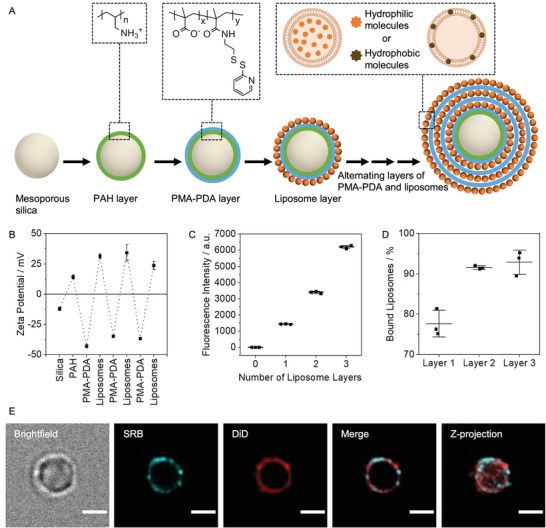 Fig.1 Multilayer assembly of capsosomes.1
Structure and Function:
The formation typically relies on the Layer-by-Layer (LbL) assembly technique. This method involves the sequential deposition of oppositely charged polyelectrolytes and liposomes onto a sacrificial template, which is subsequently removed to yield a hollow polymer shell filled with numerous smaller liposomes. The key structural elements are:
Polymer Capsule
Provides mechanical robustness, prevents aggregation, and significantly extends circulation time by inhibiting immune clearance (opsonization).
Liposomal Subcompartments
These internal vesicles are the primary loading sites, capable of encapsulating both water-soluble and water-insoluble therapeutics. The lipid composition can be fine-tuned to dictate drug interaction and release rate.
This design overcomes the inherent instability and rapid clearance of traditional, single-membrane liposomes, offering a flexible platform for delivering highly potent but fragile biopharmaceuticals like Brain-Derived Neurotrophic Factor (BDNF) and other protein therapeutics, ensuring they remain viable and functional for extended periods.
Applications of Capsosome Technology in Biopharma
The mechanical strength and highly adaptable, subcompartmentalized architecture of capsosomes make them ideal candidates for tackling challenging therapeutic areas, extending far beyond the capabilities of standard liposomes.
Sustained Release for Chronic Conditions
Targeted Cancer Therapy
By incorporating targeting ligands (e.g., peptides, antibodies) onto the outer polymer shell, capsosomes can be directed to tumor-specific receptors. This approach, combined with dual-drug loading, allows for highly concentrated, synergistic delivery of cytotoxic agents (like thiocoraline or paclitaxel) directly to the malignancy, minimizing systemic toxicity.
Infectious Disease and Enzyme Therapy
The robust polymer shell protects encapsulated enzymes, making capsosomes perfect nanoreactors for enzyme therapy in metabolic disorders or detoxification. Furthermore, specialized capsosomes have been developed to release antibiotics in response to specific bacterial toxins (e.g., S. aureus toxins), offering a novel approach for fighting antibiotic-resistant infections by only triggering drug release when a pathogen is present.
Gene and RNA Delivery
Capsosomes offer superior protection for nucleic acids (DNA, siRNA) over simple lipid nanoparticles in certain environments. The hierarchical structure ensures the integrity of the genetic payload until it reaches the intracellular machinery, making it a powerful tool for complex gene editing or RNA interference applications.
Practical Research Case Studies
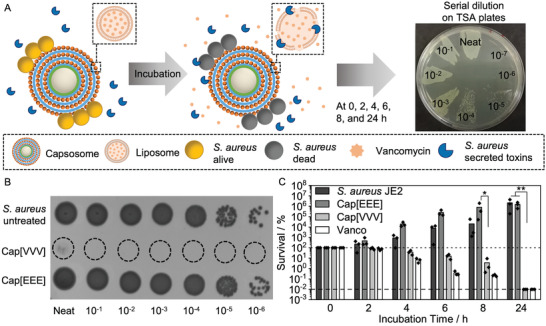
Bacteria-Activated Single & Dual Antibiotic Delivery (against MRSA)
A hierarchical capsosome system was developed for bacteria-activated antibiotic release to combat MRSA. The capsosomes, loaded with vancomycin (and an antimicrobial peptide for dual delivery), were engineered to release their cargo only in the presence of MRSA toxins, regulated by the Agr quorum sensing system. The system successfully killed MRSA in vitro and significantly improved survival in a Drosophila melanogaster infection model, demonstrating a localized, on-demand drug delivery strateg.1
What We Can Offer
Creative Biolabs' Capsosome-based Delivery Systems Solution addresses the critical limitations of conventional drug carriers, such as rapid clearance, insufficient payload protection, and burst release kinetics. We offer a sophisticated architecture—a robust polymer capsule encapsulating multiple liposomal subcompartments—that dramatically enhances therapeutic stability and functionality.
Specific Deliverables and Solutions:
Extended Pharmacokinetics
We engineer capsosomes for sustained release kinetics, demonstrating drug efficacy over periods exceeding 60 days in simulated physiological environments (Published Data). This translates directly into reduced dosing frequency and improved patient compliance.
Dual Payload Capacity
The hierarchical design allows for the co-encapsulation of diverse therapeutic agents, such as combining a hydrophobic small molecule drug within the liposomal bilayer and a hydrophilic protein or nucleic acid within the liposome's aqueous core. This enables synergistic combination therapies in a single delivery vehicle.
Enhanced Stability
The external polymer shell acts as a protective barrier, shielding the internal liposomes and their delicate cargo (e.g., enzymes, neurotrophic factors) from enzymatic degradation and harsh environmental conditions, significantly improving shelf-life and in vivo retention.
Tunable Release Mechanisms
Our specialists can modulate the polymer shell composition, liposome lipid profile (e.g., anionic lipids for slower release), and cross-linking agents to program release based on specific stimuli (e.g., pH, redox potential) present at the target disease site.
FAQs
What is the primary advantage of using a multi-compartmentalized carrier like this over a standard PEGylated liposome?
The main advantage lies in stability and release control. While PEGylated liposomes primarily extend circulation time, the dual-layered structure—an outer polymer shell protecting inner liposomes—provides exceptional mechanical strength and unparalleled protection against systemic degradation (enzymes, serum components). This hierarchical architecture enables significantly longer sustained release kinetics, often extending the therapeutic effect from days to weeks or even months.
How is the loading of both hydrophobic and hydrophilic drugs managed within this single system?
The system's architecture naturally accommodates both. Hydrophobic compounds are efficiently integrated into the fatty acid chains of the inner liposome bilayers, leveraging lipid affinity. Simultaneously, hydrophilic molecules, such as peptides or nucleic acids, are dissolved and trapped within the aqueous core of these same internal liposomes. This capability for co-encapsulation is ideal for combination therapies requiring precise ratios of different payloads.
What methods are used to achieve targeted drug delivery with these systems?
Targeting can be achieved through two main strategies: passive and active. Passive targeting exploits the leaky vasculature of diseased tissues (like tumors) to accumulate the carrier (the enhanced permeability and retention or EPR effect). Active targeting involves conjugating specific ligands (like antibodies or peptides) onto the outer polymer surface. These ligands bind selectively to receptors overexpressed on the target cells, ensuring high local drug concentrations and minimizing off-target effects.
Can the release profile be tailored to respond to the disease environment?
Absolutely. The release profile can be programmed using stimuli-responsive materials in the carrier's construction. For instance, incorporating specific cross-linkers or lipids that break down under acidic conditions (common in tumors or inflamed tissues) or in high redox potential environments allows the payload to be rapidly released only when the carrier reaches the pathological site. This minimizes drug wastage and improves the therapeutic index.
What critical physicochemical parameters should be controlled when developing these carriers for clinical use?
The most critical parameters are the overall size, surface charge (zeta potential), and monodispersity. Particle size must be carefully maintained, typically below 200nm to avoid rapid clearance by the mononuclear phagocyte system (MPS) and to facilitate optimal biodistribution. The zeta potential dictates stability and interaction with biological membranes. Strict control over these variables is essential for consistent in vivo performance and successful regulatory submission.
Creative Biolabs' Capsosome-based Delivery Systems Solution offers the next evolution in drug delivery: robust protection, controlled dual-drug loading, and exceptionally long-term sustained release. We provide the scientific expertise and advanced platform necessary to transform your challenging therapeutic molecules—whether proteins, nucleic acids, or small molecules—into highly stable, site-specific nanomedicines.
Reference
- Tonkin, Renée L et al. "Bacterial Toxin-Triggered Release of Antibiotics from Capsosomes Protects a Fly Model from Lethal Methicillin-Resistant Staphylococcus aureus (MRSA) Infection." Advanced healthcare materials vol. 11,14 (2022): e2200036. Distributed under Open Access license CC BY 4.0, without modification. https://doi.org/10.1002/adhm.202200036
Our services are For Research Use Only. We do not provide services to individuals.
Online Inquiry