
This is the flagship application. GRTD systems, often delivered via subcutaneous injection of micro/nanogels or transdermal microneedle patches, aim to eliminate the need for manual blood glucose monitoring and multiple daily injections. They provide an 'artificial pancreas' functionality in a drug formulation format, releasing insulin only when required by the body's hyperglycemic state, leading to superior glycemic control and reduced patient burden.
Glucose-Responsive Delivery Solution for Targeted Drug Delivery
In the pursuit of groundbreaking therapies, the journey from a promising molecule to a viable treatment often stalls at a single, formidable obstacle: targeted delivery. Protecting fragile payloads and guiding therapeutics to their precise site of action are challenges that can make or break a project. Our Glucose-Responsive Targeted Delivery (GRTD) platform helps you achieve dose-on-demand drug delivery and minimize systemic side effects through innovative biomaterial engineering and closed-loop sensing mechanisms, transforming passive carriers into intelligent therapeutic agents.
Click Here to View more about our Service
Introduction of Glucose-Responsive Targeted Delivery
Glucose-Responsive Targeted Delivery (GRTD) refers to advanced delivery systems that automatically regulate the release of a therapeutic agent in direct response to fluctuations in local or systemic glucose concentrations. This represents a paradigm shift from conventional drug delivery, moving towards true precision medicine by creating a dynamic, adaptive therapeutic mechanism.
System Architecture and Mechanism
GRTD systems typically consist of two main functional components integrated into a single carrier platform (nanogel, micelle, or microcapsule):
Glucose Sensing Element
The moiety responsible for detecting glucose concentration. Common mechanisms involve:
- Enzymatic Systems (GOx-Based): Glucose Oxidase (GOx) catalyzes the oxidation of glucose, producing gluconic acid and hydrogen peroxide. This reaction consumes local oxygen and, crucially, lowers the pH. This change in pH or oxygen level acts as the secondary trigger signal.
- Non-Enzymatic Systems (PBA-Based): Phenylboronic Acid (PBA) derivatives bind reversibly to the cis-diol groups of glucose under physiological conditions, forming a boronate ester. This binding alters the charge, hydrophilicity, or spatial conformation of the polymer matrix, inducing structural changes (e.g., swelling or dissolution) that release the encapsulated drug.
Drug Release Element
The carrier matrix, often composed of stimuli-responsive polymers (hydrogels) or specialized liposomes/nanovesicles, undergoes a physical change (swelling, shrinking, dissolution, or pore opening) when triggered by the sensed signal (pH drop, oxygen depletion, or PBA complexation).
The principle is to mimic the regulatory function of pancreatic β-cells. When the glucose level rises (hyperglycemia), the sensing element triggers the structural change in the release element, liberating the drug (e.g., insulin) until the glucose level returns to the normal range, at which point the system automatically shuts off the release. This closed-loop functionality offers unparalleled control, minimizing the severe risk of hypoglycemia associated with fixed-dose treatments.
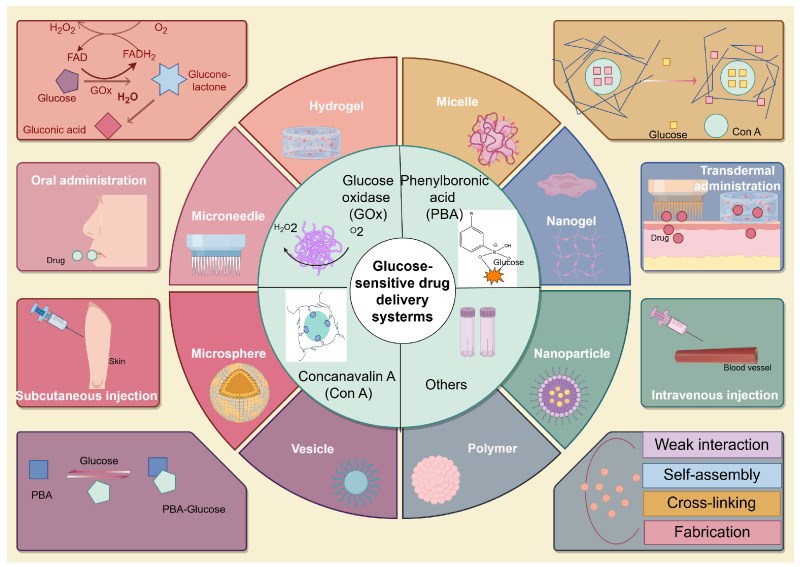 Fig.1 The classification and application of glucose-responsive drug delivery systems.1
Key Glucose-Responsive Materials
The core innovation in GRTD lies in the materials used for sensing and transformation. These materials must be highly biocompatible, stable, and exhibit precise, rapid response kinetics.
| Material | Type/Function | Mechanism/Action | Key Advantages/Considerations |
|---|---|---|---|
| Glucose Oxidase (GOx) | Enzyme / Sensing Element | Catalyzes glucose oxidation, resulting in a signal (pH decrease/oxygen depletion) that triggers polymer change. | Highly efficient, but prone to denaturation and may trigger immunogenicity; requires effective encapsulation. |
| Phenylboronic Acid (PBA) Derivatives | Synthetic Molecule / Non-Enzymatic Sensing Element | Reversibly binds to the cis-diol groups of glucose, altering polymer charge and conformation (e.g., swelling). | High stability, scalability, and reduced immunogenicity; forms the backbone of advanced non-enzymatic carriers. |
| Glucose-Binding Proteins (Lectins) | Protein / Competitive Sensing Element | Reversibly bind to glucose; used in competitive assays where glucose displaces the therapeutic payload. | Effective binding mechanism, but toxicity concerns (e.g., Concanavalin A) limit clinical application. |
| Stimuli-Responsive Hydrogels | Polymer Network / Drug Reservoir & Release Element | Cross-linked networks (e.g., chitosan, poly(acrylic acid)) that undergo a structural change (swelling/shrinking) when triggered by the localized signal (pH drop or PBA charge change). | Forms the drug reservoir; customizable with cationic groups or PBA for tailored responsiveness. |
Application of Glucose-Responsive Targeted Delivery
While the most developed and cited application for GRTD is in the management of Type 1 and advanced Type 2 Diabetes Mellitus (DM), its principles are highly relevant to other domains, leveraging glucose metabolism as a unique internal biomarker.
Diabetes Management (Closed-Loop Insulin Delivery)
Cancer Therapy and Tumor Targeting
The tumor microenvironment often exhibits a dramatically different metabolism than healthy tissue, characterized by a phenomenon known as the Warburg effect, resulting in high localized glucose consumption and often, lower pH. GRTD systems can be engineered to specifically respond to these distinct glucose fluxes, enabling:
Targeted Release: Nanocarriers can be designed to release chemotherapy or immunotherapeutics preferentially when they encounter the high glucose concentration gradient near a tumor.
Dual-Responsive Systems: Combining glucose responsiveness with other tumor-specific stimuli (like low pH or high reductase activity) ensures highly specific, localized drug action, minimizing systemic toxicity to healthy tissues.
Wound Healing and Infection Control
In chronic wounds, particularly those associated with diabetes, elevated local glucose levels can impair the healing process and promote microbial growth. Responsive delivery systems can be designed to release antibiotics, growth factors, or anti-inflammatory agents only when high glucose levels are detected, thus providing targeted, on-demand treatment for chronic diabetic wounds.
What We Can Offer: Tailored GRTD Platform Services
Traditional drug delivery relies on fixed dosing schedules, regardless of the patient's real-time physiological need, often leading to suboptimal efficacy or severe side effects. The GRTD platform at Creative Biolabs is specifically designed to overcome this by introducing an inherent 'smart' element to your therapeutic system.
We assist your project by integrating a glucose-sensing component directly into your drug carrier (nanoparticles, hydrogels, microneedle patches), transforming it into a self-regulating, closed-loop delivery device. This is particularly critical for managing metabolic diseases like diabetes, where precise, timely insulin release is necessary to maintain tight glycemic control and avoid life-threatening hypoglycemia. Beyond diabetes, this technology is invaluable for targeting environments with altered glucose metabolism, such as certain tumor microenvironments, offering a novel strategy for oncology drug delivery.
Specific Deliverables:
Rapid Kinetic Response
Developing systems that exhibit fast and reversible drug release kinetics, crucial for mimicking natural pancreatic function.
Tunable Sensitivity
Engineering carriers (often hydrogels or nanogels) where the volume phase transition or membrane permeability is finely tuned to respond to specific, physiologically relevant glucose concentration thresholds.
High Payload Compatibility
Integrating various therapeutic payloads, including proteins (like insulin), peptides, and nucleic acids, into the responsive matrix while maintaining their stability and bioactivity.
Novel Sensing Chemistries
Implementing both enzymatic (e.g., Glucose Oxidase, GOx) and non-enzymatic (e.g., Phenylboronic Acid, PBA) sensing elements to maximize biocompatibility and long-term stability in vivo.
FAQs
What is the main hurdle in translating these responsive systems from the lab to the clinic?
The primary challenge is ensuring the system's long-term operational stability and biocompatibility. Protein-based systems (like those using Glucose Oxidase) can degrade or trigger an immune response over time. Synthetic systems need precise tuning to maintain their glucose sensitivity under complex, fluctuating in vivo conditions for extended periods. This requires sophisticated material engineering and rigorous toxicology testing to ensure reliable, sustained performance.
How is the drug release precisely controlled to prevent under or overdose?
The control relies on the material's carefully designed volume phase transition or chemical kinetics. In a well-designed system, the increase in glucose concentration triggers a proportional change (e.g., swelling of a hydrogel) that opens transient pores for drug diffusion. Once the drug is released and the glucose level drops, the material reverts to its 'closed' state, halting the release. The dosage is therefore inherently self-regulated by the real-time physiological signal.
Can these carriers accommodate different types of therapeutic payloads besides insulin?
Absolutely. The core mechanism is a response to glucose, which acts as the trigger. The release element can be designed to encapsulate and release a wide range of molecules, including peptides, anti-inflammatory compounds, or chemotherapy agents. This is especially relevant for treating conditions where glucose metabolism itself is implicated in the pathology, such as certain tumors or inflammatory disorders.
What factors determine the speed and duration of the drug release profile?
The speed is primarily determined by the carrier's size (nanoscale systems react faster due to shorter diffusion distances) and the polymer's chemical composition (e.g., the pKa of PBA-containing polymers). The duration of effect depends on the total drug load, the stability and degradation rate of the carrier material, and the quantity of the sensing element (e.g., the concentration of GOx). Optimization involves finding the perfect balance between fast response and long-term stability.
Creative Biolabs' Glucose-Responsive Targeted Delivery platform represents the future of smart, automated therapeutics. By harnessing endogenous glucose signals, we empower our clients to develop drug products that achieve unparalleled precision, efficacy, and patient compliance, particularly in metabolic and oncology indications. Our comprehensive service portfolio, spanning customized polymer synthesis, nanocarrier formulation, and rigorous in vitro and in vivo testing, is designed to rapidly advance your project from concept to clinic.
Reference
- Rudko, Michał et al. "Recent Developments in Ion-Sensitive Systems for Pharmaceutical Applications." Polymers vol. 13,10 1641. 18 May. 2021, Distributed under Open Access license CC BY 4.0, without modification. https://doi.org/10.3390/polym13101641
Our services are For Research Use Only. We do not provide services to individuals.
Online Inquiry