
Light-responsive systems are foundational for combined photodynamic therapy (PDT) and chemotherapy. Nanocarriers can simultaneously deliver a photosensitizer and a cytotoxic drug. Illumination triggers not only the generation of toxic reactive oxygen species (PDT) but also the instantaneous release of the chemotherapy drug, achieving a potent localized cytotoxic synergy. Furthermore, deep-tissue cancers can be targeted using NIR-activated photothermal agents to induce hyperthermia, further disrupting the tumor microenvironment while simultaneously releasing drugs.
Light-Responsive Delivery Solution for Targeted Drug Delivery
In the pursuit of next-generation therapeutics, the ability to control drug activation with unparalleled precision is transformative. Light-Responsive Targeted Delivery represents the pinnacle of this control, enabling on-demand, localized therapeutic release with minimal off-target effects. Our Light-Responsive Targeted Delivery service at Creative Biolabs helps you minimize systemic toxicity and maximize localized efficacy through customized photothermal and photochemical nanocarrier engineering, accelerating your project from concept to clinic.
Click Here to View more about our Service
Introduction of Enzyme-Responsive Targeted Delivery
Light-Responsive Targeted Delivery systems utilize external optical energy to induce controlled structural or chemical changes in a carrier material, leading to the rapid release of an encapsulated therapeutic payload. This technology leverages the unique properties of certain photo-sensitive molecules or materials that undergo precise transformation when exposed to light of a specific wavelength (e.g., UV, visible, or NIR light).
The core of this strategy relies on three major scientific mechanisms, which dictate the carrier design and therapeutic application:
Photochemical Reactions
Involves the direct cleavage or bond rearrangement of photosensitive linkers (e.g., o-nitrobenzyl derivatives) incorporated into the nanocarrier structure. High-energy UV or visible light provides the necessary energy to break these covalent bonds, causing carrier disassembly and immediate payload release.
Photoisomerization
Uses chromophores, such as azobenzene, which undergo reversible conformational changes (e.g., trans to cis) upon light exposure. This geometric shift alters the packing density or porosity of the nanocarrier membrane, facilitating controlled drug diffusion.
Photothermal Effect
Employs photothermal agents (like gold nanoparticles or certain dyes) that efficiently absorb light, typically NIR due to its deep tissue penetration, and convert that energy into localized heat. This thermal spike disrupts thermally sensitive carrier structures (e.g., phase transition lipids in liposomes), leading to rapid, on-demand drug ejection.
The use of NIR light is particularly advantageous in clinical translation, as it falls within the "biological window" (650–900 nm), allowing for deeper penetration through tissue with minimal scattering or harm to surrounding healthy cells. This non-invasive and highly controllable mechanism provides superior temporal and spatial resolution compared to passive targeting methods like the Enhanced Permeation and Retention (EPR) effect alone.
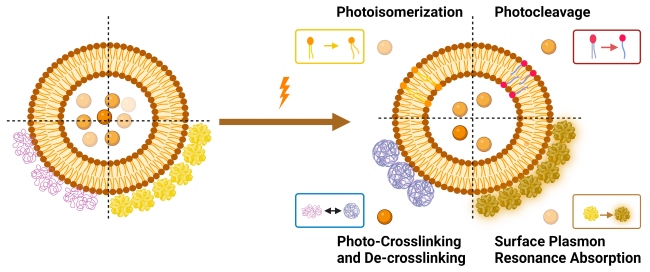 Fig.1 Light-triggered mechanisms used in triggering drug release from liposomes.1
Key Light-Responsive Materials
The selection of the appropriate material is crucial for dictating the efficiency, safety, and ultimate clinical viability of the delivery system. These materials are integrated into nanocarriers (liposomes, micelles, polymers) to confer light sensitivity:
| Material Class | Example Compound/Structure | Mechanism Triggered | Key Wavelengths |
|---|---|---|---|
| Photocleavable Moieties | o-Nitrobenzyl groups, Coumarin derivatives | Photochemical Cleavage | UV, High-Energy Visible |
| Photoisomerizable Moieties | Azobenzene, Spiropyran | Photoisomerization (Conformational Change) | UV, Specific Visible |
| Photothermal Agents (PTAs) | Gold Nanoparticles (AuNPs), Carbon Nanomaterials (e.g., Graphene Oxide), Phthalocyanine Dyes | Photothermal Effect (Heat Generation) | Near-Infrared (NIR) |
| Photosensitizers | Porphyrin derivatives | Photochemical (Reactive Oxygen Species generation) | Visible, Red/NIR |
Application of Light-Responsive Nanocarriers
The unparalleled spatiotemporal control offered by light-responsive systems has opened up exciting applications across various fields, extending the utility of powerful but toxic therapeutic agents.
Advanced Cancer Therapy
Localized Gene and Nucleic Acid Delivery
The controlled nature of photo-release is ideal for gene editing components or therapeutic mRNA/siRNA. By caging the nucleic acid payload within a light-sensitive polymer or lipid nanoparticle, researchers can ensure that the genetic material is only released once the carrier has successfully internalized into the target cell or tissue, significantly boosting transfection efficiency and preventing premature degradation.
Infection and Inflammation Management
For localized conditions such as joint inflammation or chronic wounds, light-activated release allows for precise dosing of anti-inflammatory or antimicrobial agents exactly where needed, minimizing systemic exposure and associated side effects. This method ensures drug action is confined to the diseased area, offering a highly localized treatment strategy.
Neuroscience and Neuromodulation
The high spatial accuracy of light allows for the remote and non-genetic modulation of cellular processes. Researchers use light-sensitive liposomes to release neurotransmitters or signaling molecules at defined sites in the brain or nervous system, offering a powerful tool for studying neuronal communication and developing targeted treatments for neurological disorders.
What We Can Offer
Traditional drug delivery methods often struggle with systemic toxicity and poor drug bioavailability at the disease site. Light-responsive systems overcome these hurdles by offering exquisite spatiotemporal control over payload release, providing a powerful lever for advanced therapeutic strategies.
We engineer sophisticated nanocarriers, such as specialized liposomes, micelles, or polymeric nanoparticles, that remain inert until activated by a specific light source (often Near-Infrared or NIR light). This remote activation capability is crucial for:
Overcoming Biological Barriers
Ensuring fragile payloads (like nucleic acids or complex biologics) remain protected throughout circulation and only release their cargo upon reaching the target tissue.
Combating Drug Resistance
Achieving high, localized drug concentrations in tumors or infection sites instantly upon illumination, overwhelming resistance mechanisms that develop against sustained, low-level exposure.
Combination Therapy Synchronization
Perfectly timing the release of multiple therapeutic agents (e.g., chemotherapeutics and photosensitizers) to maximize synergistic effects.
Creative Biolabs' expertise ensures your delivery platform is optimized for the intended biological window and activation mechanism, providing a reliable and repeatable therapeutic trigger.
FAQs
What is the primary advantage of using a light-triggered system over a pH- or temperature-responsive system?
The main advantage lies in exogenous, remote control. While pH or temperature triggers are driven by internal, often heterogeneous, biological environments, light allows for unparalleled spatiotemporal precision. You can direct the light source to a specific location and activate the drug release instantaneously and repeatedly, offering precise dosage control at the disease site, which is vital for minimizing systemic exposure.
Does the use of light, particularly near-infrared (NIR), pose safety concerns for deep tissue delivery?
NIR light (typically 700–1000 nm) is generally considered safe for biological tissues, falling within the "biological window" where tissue absorption and scattering are minimized. The challenge is ensuring sufficient light irradiance reaches the target. Successful systems utilize highly efficient photothermal or photochemical agents combined with non-invasive fiber optic delivery methods, allowing for activation several centimeters beneath the skin with minimal thermal damage to intervening healthy tissue.
Can these light-responsive carriers encapsulate large biological payloads like proteins or nucleic acids?
Yes, these systems are highly versatile. The encapsulation success depends less on the light-responsive mechanism itself and more on the type of carrier used. Carriers like liposomes and polymeric nanoparticles are specifically engineered with aqueous cores or hydrophobic domains that readily accommodate large macromolecules, providing the necessary structural integrity until the light-induced trigger causes destabilization and release.
How do I select the right photo-responsive mechanism (photothermal, photochemical, or photoisomerization) for my specific therapeutic?
The choice depends on the payload, the target site, and the desired release kinetics. Photochemical release is often irreversible and rapid, suitable for highly toxic agents requiring an immediate burst. Photothermal release offers reversible control and is excellent for deep tissue using NIR. Photoisomerization provides subtle, reversible changes ideal for modulating carrier permeability. We recommend consulting with experts to match the mechanism to your therapeutic needs and tissue environment.
What is the main challenge in scaling up light-responsive nanocarrier production for clinical trials?
The primary challenge often involves maintaining the consistency and homogeneity of the photo-responsive material during large-scale synthesis. Any slight variation in the lipid-to-photosensitizer ratio or polymer molecular weight can affect the final particle size, stability, and critically, the triggered release efficiency. Robust, validated manufacturing protocols and rigorous quality control (QC) testing are essential to ensure batch-to-batch reproducibility.
Creative Biolabs' Light-Responsive Targeted Delivery service provides the scientific foundation and technical expertise required to successfully translate your therapeutic vision into a highly precise, externally controllable nanomedicine. By mastering photochemical, photothermal, and photoisomerization mechanisms, we offer customized solutions that address the critical challenge of localized drug activation, enhancing efficacy while drastically reducing systemic toxicity.
Reference
- Agiba, Ahmed M et al. "Light-Responsive and Dual-Targeting Liposomes: From Mechanisms to Targeting Strategies." Molecules (Basel, Switzerland) vol. 29,3 636. 30 Jan. 2024, Distributed under Open Access license CC BY 4.0, without modification. https://doi.org/10.3390/molecules29030636
Our services are For Research Use Only. We do not provide services to individuals.
Online Inquiry