

This is the most established application. MNPs combined with chemotherapy agents (e.g., Doxorubicin) are guided to tumors, followed by AMF activation for both localized drug release and magnetic hyperthermia. Magnetic hyperthermia (heating tumor cells to 41°C to 4°C) sensitizes cancer cells to chemotherapy and radiation, making it a powerful synergistic approach.
Magnetic Field Responsive Delivery Solution for Targeted Drug Delivery
In the pursuit of groundbreaking therapies, the journey from a promising molecule to a viable treatment often stalls at a single, formidable obstacle: non-specific delivery. Protecting fragile payloads and guiding therapeutics to their precise site of action are challenges that can compromise efficacy and increase systemic toxicity. Our Magnetic Field Responsive Targeted Delivery solutions help you achieve unparalleled control over drug biodistribution and release through innovative magnetic nanoparticle engineering and remote activation technology. We turn the challenge of targeted drug delivery into a competitive advantage.
Click Here to View more about our Service
Introduction of Magnetic Field Responsive Targeted Delivery
Magnetic Field Responsive Targeted Delivery is an advanced stimuli-responsive drug delivery strategy that harnesses the unique properties of magnetic nanoparticles (MNPs) in combination with external magnetic fields. This approach offers a powerful solution to the long-standing challenge of achieving spatial and temporal control over drug administration.
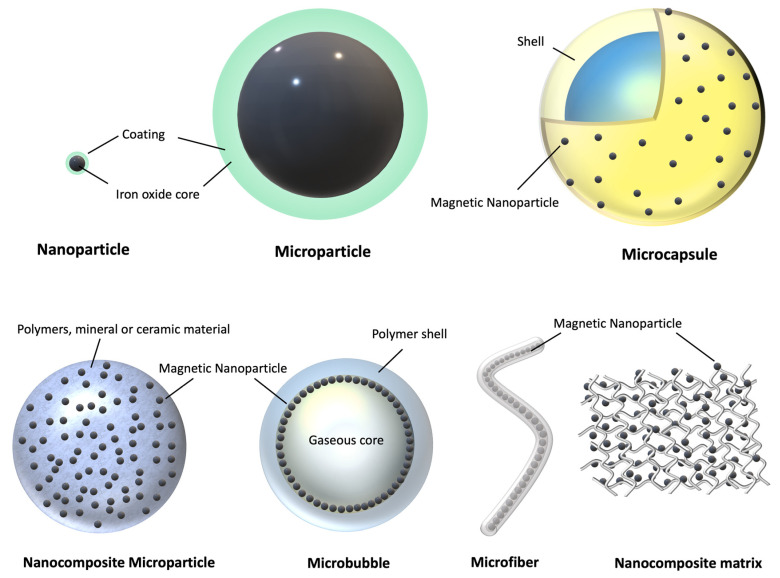 Fig.1 Different morphologies of micro/nanosystems for the magnetic targeted delivery of bioagents.1
The core components of this system are often iron oxide nanoparticles, such as magnetite (Fe3O4) or maghemite (γ-Fe2O3), typically synthesized to exhibit superparamagnetism. Superparamagnetic nanoparticles are unique because they only become magnetic when an external field is applied, and quickly lose their magnetism when the field is removed, preventing aggregation and embolism concerns in vivo.
These MNPs are integrated into a biocompatible carrier structure (e.g., magnetoliposomes or magnetic polymeric micelles) which also encapsulates the therapeutic agent. Once administered intravenously or locally, the MNP component acts as a remote actuator and guidance system.
Mechanism of Magnetic Field Activation
Harnessing the power of magnetic activation relies on two principles: magnetic targeting and triggered release.
Magnetic Targeting
A non-uniform static magnetic field gradient (from magnet arrays) is applied near the target organ, drawing superparamagnetic carriers circulating in the bloodstream to the highest magnetic flux density. This "trapping" effect accumulates drug concentration over time, ensuring a superior local therapeutic dose.
Remote-Triggered Drug Release
For precise, on-demand release, an Alternating Magnetic Field (AMF) is applied as a non-invasive external stimulus. This activation occurs through two primary effects: Magnetic Hyperthermia (Thermal), where rapid flipping of MNP moments generates localized heat (SAR) that exceeds the phase transition temperature of thermo-sensitive carriers, causing rapid drug release; and the Mechanical/Oscillatory Effect, where AMF causes MNPs to oscillate, creating physical stress or structural defects in the carrier shell, inducing drug leakage. Controlling the AMF frequency and intensity grants exquisite spatial and temporal control over drug action.
Magnetic Field Responsive Materials
The efficacy of these systems fundamentally relies on the magnetic properties of the incorporated materials. Key materials include: Superparamagnetic Iron Oxide Nanoparticles (SPIONs), which are most common due to their high biocompatibility and ability to transition between magnetic states; Magnetite (Fe3O4) and Maghemite (γ-Fe2O3), which form the basis of most SPIONs; other ferrites like Cobalt ferrite (CoFe2O4) or Manganese ferrite (MnFe2O4) used when higher magnetization is required, often with specialized surface coatings; and certain ferromagnetic metals like Iron (Fe) or Nickel (Ni), although these are less frequently used in clinical applications due to higher toxicity and aggregation risks.
Key Hypoxia-Responsive Materials
The precision and control offered by Magnetic Field Responsive Targeted Delivery open numerous avenues for highly effective, less toxic therapies across various medical fields:
Oncology and Cancer Therapy
Gene and Nucleic Acid Delivery (Magnetofection)
Magnetic carriers are used to complex with fragile nucleic acids (like siRNA or plasmid DNA). The external magnetic field concentrates the complexes near the target cells, dramatically enhancing cellular uptake and transfection efficiency in tissues such as the retina or lungs.
Cardiovascular and Thrombolytic Therapy
Magnetic carriers loaded with clot-dissolving agents can be guided to the site of an acute thrombosis, ensuring high local concentration and rapid action, which is critical in time-sensitive emergencies like stroke or heart attack.
Bioimaging and Theranostics
Because superparamagnetic iron oxide nanoparticles are excellent T2 contrast agents, the drug delivery vehicle itself can be used for Magnetic Resonance Imaging (MRI). This creates a theranostic platform—combining therapy and diagnostic imaging—allowing researchers to track the precise location of the drug and monitor treatment efficacy in real-time.
Applications in Advanced Therapeutics
The most significant barrier in therapeutic development is ensuring a high concentration of the drug reaches the disease site (e.g., a deep-seated tumor) while minimizing exposure to healthy tissues. Traditional passive and even active targeting methods can still result in drug leakage and off-target accumulation.
Creative Biolabs' Magnetic Field Responsive Targeted Delivery system addresses this by incorporating magnetic nanoparticles (MNPs), typically superparamagnetic iron oxide nanoparticles (SPIONs), into nanocarriers (such as liposomes, polymeric micelles, or nanogels). This integration provides two powerful, externally controllable levers for therapeutic enhancement:
Magnetic Guidance (Targeting)
By applying a localized, external static or low-frequency magnetic field, the drug-loaded nanocarriers can be physically steered or held at the desired target site, significantly increasing local drug concentration. This overcomes natural biological clearance mechanisms and poor tissue penetration.
Triggered Release (Control)
Applying an alternating magnetic field (AMF) causes the MNPs to generate localized heat (magnetic hyperthermia) or mechanical oscillation. This physical action induces a change in the carrier structure, resulting in the "on-demand" release of the encapsulated therapeutic payload only at the targeted location.
This dual functionality allows clients to develop therapies with superior therapeutic indices, higher efficacy, and reduced systemic side effects. Whether your project involves small molecules, nucleic acids, or proteins, integrating magnetic responsiveness is a transformative strategy.
FAQs
How deeply into tissue can an external magnetic field effectively guide the carriers?
The effective depth and force of magnetic guidance depend significantly on the strength and design of the external magnet system, as well as the magnetic moment of the carriers themselves. While deep-seated targets remain a challenge for simple external magnets, advanced systems like superconducting or specialized yoke magnets are being developed to target internal organs more effectively. We can help you engineer carriers with enhanced magnetic moments to optimize deep-tissue guidance.
What are the main safety concerns regarding the magnetic nanoparticles in vivo?
The primary concern is the potential for aggregation or toxicity. We exclusively utilize superparamagnetic iron oxide nanoparticles (SPIONs) which are considered highly biocompatible and biodegradable, naturally clearing from the body over time. Furthermore, their superparamagnetic nature ensures they only become magnetized under the applied field, minimizing the risk of permanent aggregation or emboli upon cessation of the field.
How can I ensure the magnetically-induced heat doesn't damage surrounding healthy tissue?
The key is precise engineering and calibration. We formulate the carriers to be triggered at specific, safe temperatures (e.g., 42°C for thermo-sensitive liposomes). By precisely controlling the frequency and power of the Alternating Magnetic Field (AMF), the generated heat is highly localized to the nanoparticles, minimizing thermal spread and ensuring that only the target tissue, where the nanoparticles are concentrated, is affected.
Are magnetic carriers compatible with all types of therapeutic payloads?
Magnetic carriers, typically hybrid systems (e.g., magnetic cores within liposomes or polymers), are highly versatile. They can effectively encapsulate both hydrophobic small molecules within the lipid/polymer matrix and hydrophilic molecules (including proteins and nucleic acids) within the aqueous core. The magnetic component enhances the delivery of virtually any payload carried by the nanocarrier.
How does this approach compare to light- or pH-responsive delivery systems?
Magnetic field activation offers a key advantage: deep tissue penetration. Unlike light-responsive systems, which are limited to superficial tissues due to light scattering, magnetic fields penetrate virtually all biological tissues non-invasively. Compared to pH-responsive systems, which rely on the inherent pH difference between healthy and diseased tissue, magnetic fields offer superior temporal and spatial control, allowing activation to be turned "on" and "off" instantly from outside the body.
Creative Biolabs provides industry-leading solutions for Magnetic Field Responsive Targeted Delivery, transforming non-specific therapeutics into precision-controlled agents. We offer end-to-end expertise in MNP synthesis, advanced carrier formulation, characterization, and in vivo testing. Our goal is to empower your project with the ultimate level of drug localization and release control.
Reference
- Garello, Francesca et al. "Micro/Nanosystems for Magnetic Targeted Delivery of Bioagents." Pharmaceutics vol. 14,6 1132. 26 May. 2022, Distributed under Open Access license CC BY 4.0, without modification. https://doi.org/10.3390/pharmaceutics14061132.
Our services are For Research Use Only. We do not provide services to individuals.
Online Inquiry