Are you currently facing challenges in developing effective treatments for complex neurological disorders like multiple sclerosis (MS), particularly concerning blood-brain barrier (BBB) penetration, targeted delivery, and overcoming treatment limitations for progressive forms? Creative Biolabs' lipid-based drug delivery systems in MS treatment helps you accelerate therapeutic innovation and obtain high-quality, targeted drug delivery solutions through advanced nanomedicine engineering and high-precision formulation techniques.
Multiple Sclerosis (MS) is a long-term, often disabling neurodegenerative disease marked by central nervous system (CNS) demyelination and axonal injury. This progressive disorder leads to a wide range of neurological symptoms, including sensory deficits, motor impairments, and cognitive dysfunction, significantly impacting patients' quality of life. Potential causes of MS include genetic factors, environmental exposures (such as toxins and smoking), obesity, various infections (microbial and viral), and low levels of vitamin D. The unpredictable nature and varied progression of MS make effective long-term management challenging.
Core Challenge
Effective treatment of MS is hindered by several major obstacles. The most significant is the BBB, a highly selective membrane that protects the central nervous system but also blocks most therapeutic drugs from reaching their intended targets.
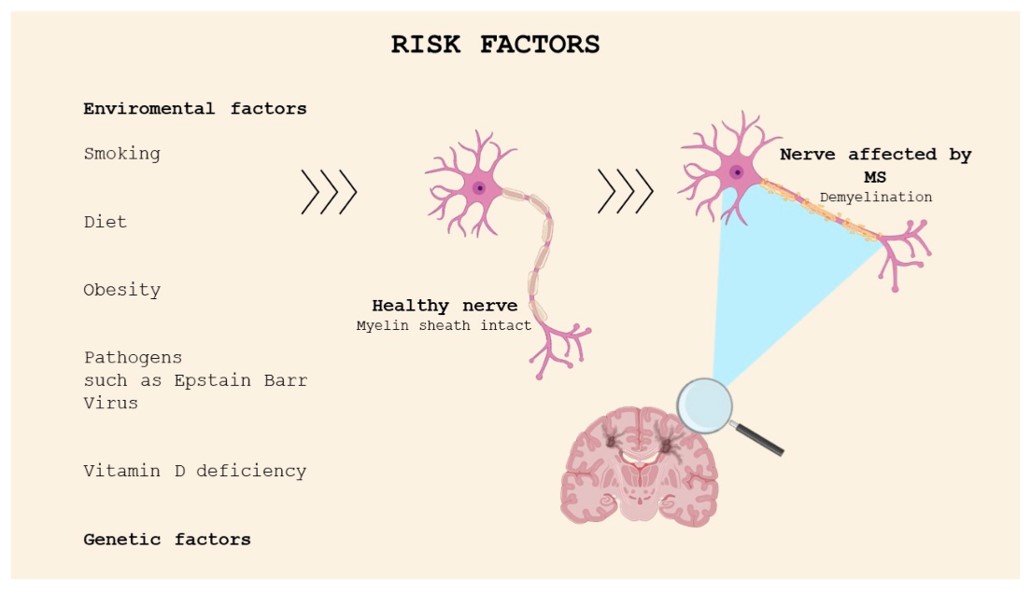 Fig. 1 Risk factors for MS. 1
MS is broadly classified into several types based on its clinical course:
MS is a complex neurological condition that requires a multifaceted treatment approach.
| Treatment Strategies | Characteristics | Common Agent/ Methods |
|---|---|---|
| Treatment of Exacerbations | Short-term administration of anti-inflammatory agents to reduce severity and promote recovery. |
Glucocorticosteroids Plasmapheresis |
| Disease-Modifying Therapies (DMTs) | This is the main treatment strategy for MS, which alters the course of MS by suppressing or regulating immune function (T and B cells). |
Interferons Glatiramer acetate Fingolimod Teriflunomide Dimethyl fumarate Siponimod Cladribine |
| Symptomatic Therapies | Individualized treatment to minimize the impact of MS symptoms on daily activities and improve quality of life. | Drugs for fatigue, spasticity, pain, bladder dysfunction. |
| Stem Cell-Based Therapies | A newer modality focusing on repairing the immune system, modulating immune responses, and replacing damaged myelin sheath. |
Hematopoietic stem cells (HPSCs) Mesenchymal stem cells (MSCs) Neural stem cells (NSCs) Induced pluripotent stem cells (iPSCs) Embryonic stem cells (ESCs) |
Current treatment strategies for MS face significant limitations, primarily the challenge of delivering therapeutic agents across the restrictive BBB to reach CNS lesions effectively. This often results in low treatment efficacy and systemic side effects due to poor targeting. These challenges highlight an urgent need for innovative solutions that can enhance drug delivery and minimize off-target effects. Creative Biolabs' advanced lipid-based drug delivery systems in MS treatment offer a targeted approach to address these critical issues.
Adaptive immunity plays a crucial role in the pathological process of MS, with various immune cells (dendrocytes, macrophages, T Cells, and B Cells) serving as key targets for therapeutic intervention. By precisely modulating the activity of these cells, lipid-based drug delivery systems offer a promising avenue for more effective and targeted MS treatment. Creative Biolabs' expertise in this area allows for the development of highly specific nanocarriers.
Dendrocytes (DCs)
The importance of dendrocytes in initiating MS-related immunity stems from their function as major antigen-presenters. Lipid-based drug delivery systems can deliver immunomodulatory agents to them, regulating downstream immune attacks and inducing tolerance.
DC targeting can be achieved through expressing specific receptors like DC inhibitory receptor-2 (DCIR2) or C-type lectin receptors (CLRs).
Macrophages
Abundant in MS lesions, macrophages can be both destructive and reparative. Lipid-based drug delivery systems can selectively target pro-inflammatory macrophages, shifting the inflammatory microenvironment towards a more reparative state.
Our lipid-based systems can target pro-inflammatory macrophage subtypes (e.g., CD64+ macrophages) while sparing or even boosting reparative ones (e.g., CD163+ and CD206+).
T-Cells
In MS, autoreactive T cells play a pivotal role in attacking the myelin sheath, causing inflammation and damage in the central nervous system.
Our advanced lipid-based systems are designed to encapsulate and deliver specific immunomodulatory agents directly to these T cells.
B-Cells
Inhibiting B cells' antigen presentation, plasma cell autoantibody release, and pathogenic pro-inflammatory cytokine production can treat MS.
Our cutting-edge lipid-based systems enable the effective encapsulation and targeted delivery of monoclonal antibodies or other B cell-specific agents to the desired site.
The lipid-based delivery platforms from Creative Biolabs are tailored to tackle the complex obstacles in MS therapy.
Leveraging its specialized knowledge and technology, Creative Biolabs is dedicated to helping researchers progress their work in this area, with the goal of fostering more effective treatments for MS. If you are engaged in MS research and wish to explore lipid-based drug delivery systems, please feel free to contact us.
Reference
 For Research Use Only. Not For Clinical Use
Applications
Online Inquiry

Creative Biolabs is a world-leading liposome provider with extensive experience in liposome preparation, custom formulation development, and characterization.

© 2026 Creative Biolabs. All rights reserved.