
Sphingolipids are essential components of cell membranes and serve as key materials for the development of lipid-based delivery systems. Creative Biolabs is dedicated to providing high-quality products and development services in this field. We have innovatively introduced liposomal solutions that utilize sphingomyelin as a substitute for phosphatidylcholine, aiming to advance your research progress.
Sphingolipids are a class of natural lipids primarily found in the cell membranes of mammals, including ceramides, sphingomyelins (SM), etc. They consist of an 18-carbon amino alcohol backbone known as sphingosine and play a crucial role in maintaining the barrier function and fluidity of biological membranes, as well as serving as regulatory signaling molecules.
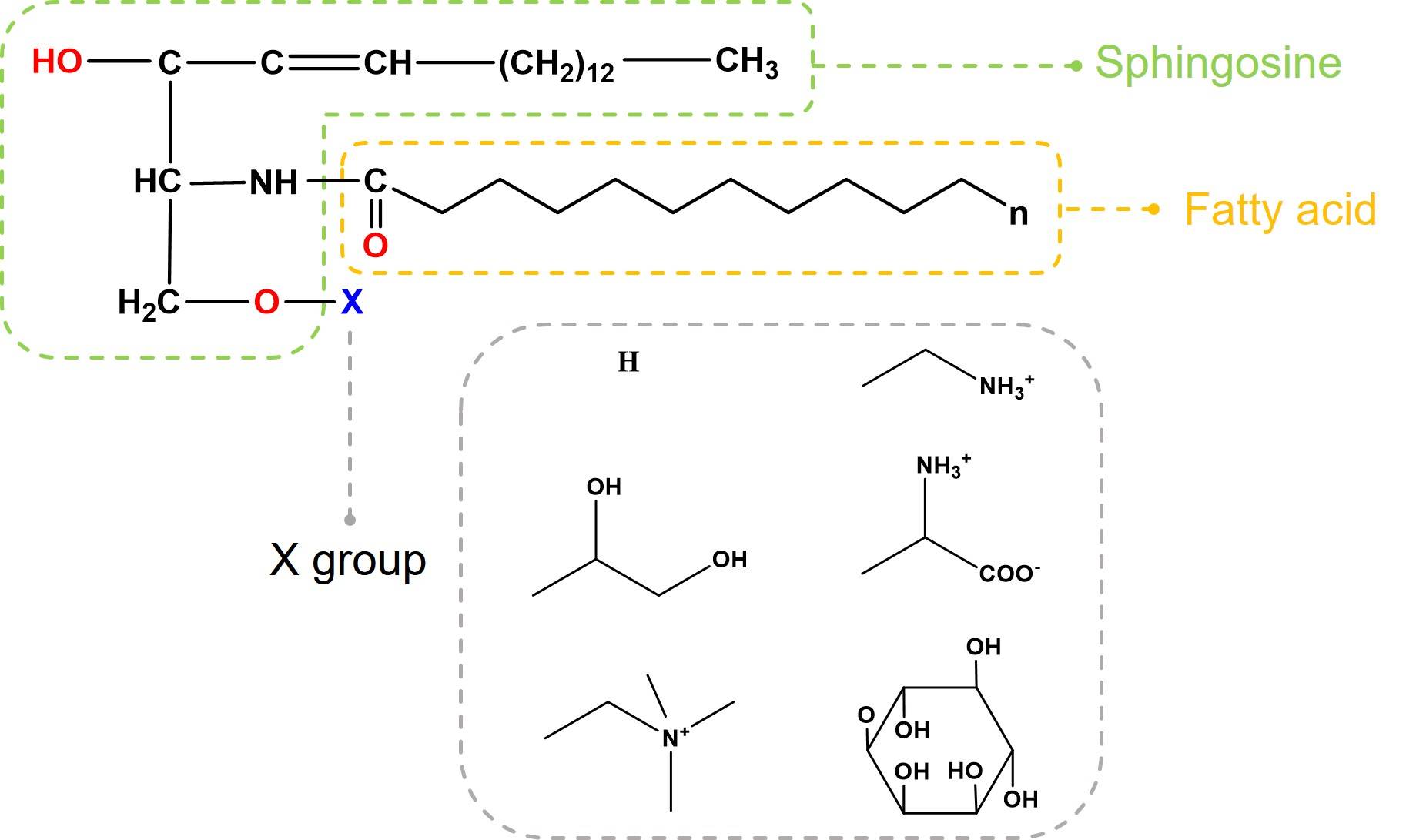 Fig.1 The structure of sphingolipids.
Ceramides are a subclass of sphingolipids formed by the union of one molecule of sphingosine and one molecule of fatty acid through an amide bond. Due to the differences in the carbon chain length, degree of unsaturation, level of hydroxylation of sphingosine, as well as the length, number, and position of double bonds and hydroxyl groups in the fatty acid component, ceramides exhibit considerable variability in their properties. Ceramides are important components of the stratum corneum, comprising 30% to 40% of its lipids. They possess various physiological functions, including moisturizing, maintaining the skin barrier, anti-aging, anti-allergic effects, and inducing apoptosis. Incorporating ceramides into liposomes as functional lipids can enhance membrane fluidity and improve fusion capabilities with dermal cells.
If your research involves ceramide liposomes, you can rely on Creative Biolabs to provide novel formulations that are adapted to your requirements, ensuring that your products perform optimally.
SM consists of a sphingosine backbone, a fatty acid molecule, and a phosphorylcholine polar headgroup. They are an important class of membrane lipids that contribute to the structural integrity, transport communication, and dynamic homeostasis of the plasma membrane.
Sphingolipids, such as ceramides, are neutral lipids that form tightly packed bilayer membranes, which are less permeable to substances. Compared to phospholipid membranes, these sphingolipid membranes are more stable and can circulate in the body for extended periods. Additionally, sphingolipids possess a higher degree of saturation in their hydrophobic regions, resulting in stronger interactions with cholesterol through intermolecular hydrogen bonding, which significantly enhances the stability of liposomes. Lipids associated with sphingolipids play a critical role in the fate of cancer cells, making sphingolipid-based liposomes a promising therapeutic strategy for tumor treatment.
Creative Biolabs has extensive experience in developing lipid-based delivery systems and has created a variety of liposomes based on different lipids. Partner with us to explore sphingolipid-based liposomes and elevate lipid-based delivery systems to new heights!
 For Research Use Only. Not For Clinical Use
Supports
Online Inquiry

Creative Biolabs is a world-leading liposome provider with extensive experience in liposome preparation, custom formulation development, and characterization.

© 2026 Creative Biolabs. All rights reserved.