Charged Liposome Development Services
Background Our Services Workflow Applications Why Choose Us Related Services & Products FAQs
Creative Biolabs is a pioneering leader in lipid-based drug delivery systems, specializing in the development and manufacturing of advanced charged liposomes. For two decades, we have partnered with researchers and pharmaceutical companies to overcome the most critical hurdles in drug and nucleic acid delivery—stability, targeting, and cellular uptake. Our extensive experience makes us the definitive expert in charged liposome systems for the life sciences industry.
Foundational Knowledge in Charged Delivery
What Are Charged Liposomes?
Charged liposomes are nanoscale lipid vesicles (typically 50 nm to 200 nm in diameter) that possess a net positive (cationic) or net negative (anionic) surface charge due to their unique lipid composition. This charge is critical: the positive charge of cationic liposomes enables strong binding to negatively charged nucleic acids (DNA/RNA) and cell membranes, while the negative charge of anionic liposomes provides different biodistribution characteristics, often leading to reduced systemic clearance. Their adaptability and biocompatibility make them indispensable as advanced drug carriers and gene delivery systems.
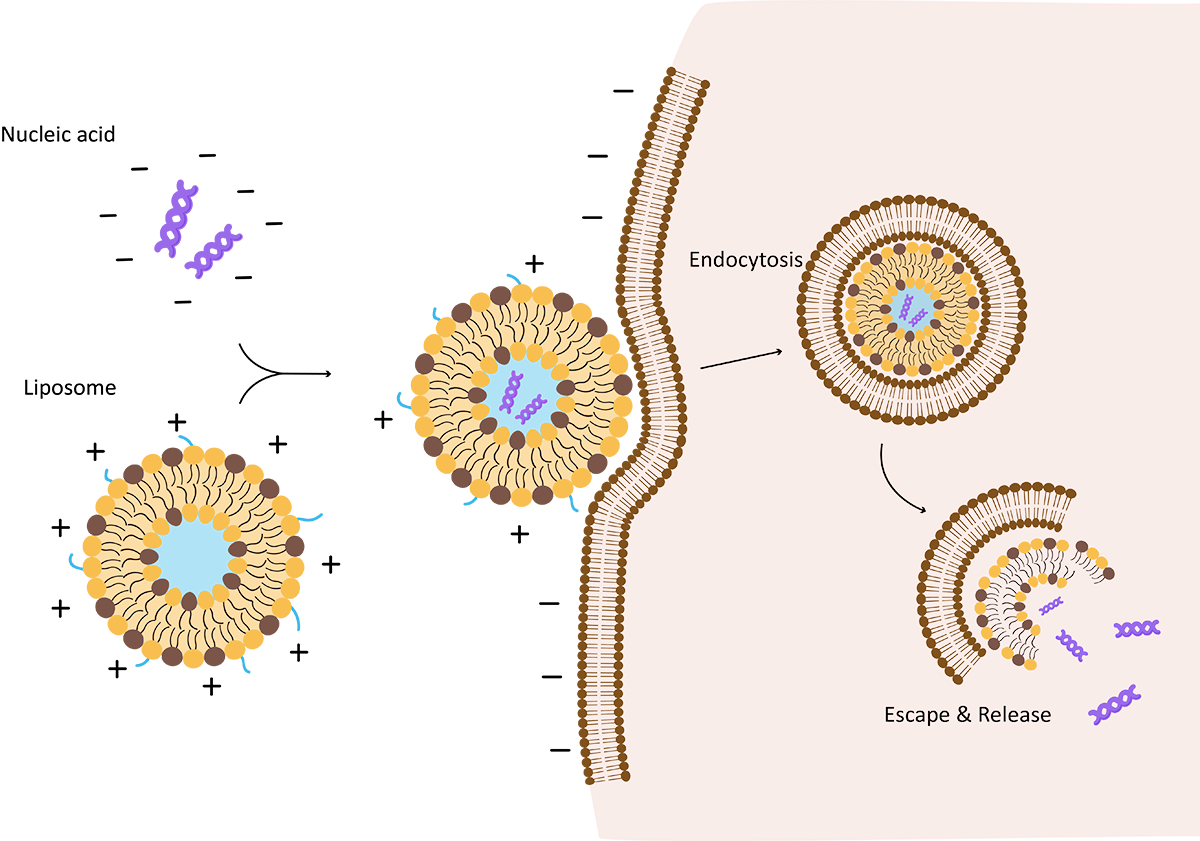 Fig.1 Proposed mechanisms of cationic liposome condensation and uptake
Key Components and Their Function
The performance of a charged liposome is entirely dependent on the precise molar ratio of its constituent lipids:
-
Structural Lipids (e.g., DSPC, HSPC): Form the bilayer matrix, dictating the phase transition temperature and rigidity of the vesicle.
-
Helper Lipids (e.g., DOPE): Often included to promote membrane fluidity and, critically, to facilitate endosomal escape by destabilizing the endosome under acidic conditions.
-
Charge-Inducing Lipids (e.g., DOTAP): The positively charged lipids responsible for forming lipoplexes with nucleic acids and driving cellular binding.
-
Stabilizers (e.g., Cholesterol): Essential for maintaining the structural integrity of the liposome and enhancing mechanical stability in biological environments.
Types of Liposome Formulations for Drug Delivery
The following table highlights key examples of lipid compositions used to create charged and neutral liposome systems, categorized by their net charge and primary application.
|
Liposome Type
|
Net Charge
|
Lipid
|
Primary Application
|
|
Neutral Liposome
|
Neutral
|
Cholesterol
DOPE
EPC
DPPC
DSPC
DOPC
|
Small Molecule Drug Encapsulation
General Carrier
|
|
Anionic Liposome
|
Negative (-)
|
L-α-phosphatidylcholine (PC)
Phosphatidyl ethanolamine (PE)
Phosphatidic acid (PA)
Phosphatidylglycerol (PG)
Phosphatidylserine (PS)
|
Targeted Delivery (Cell-Specific Ligands)
Reduced Systemic Toxicity
|
|
Cationic Liposome
|
Positive (+)
|
DOTMA
DOSPA
DOGS
DOTAP
DC-Chol
DODMA
DDAB
Octadecylamine
|
Gene Delivery (DNA, mRNA, siRNA)
Cell Transfection
|
Our Comprehensive Charged Liposome Development Services
Our services are meticulously designed to address the complex requirements of charged liposome formulation, ensuring reliability, scalability, and performance for research. Our extensive product catalog and custom formulation capabilities provide the flexibility your breakthrough research requires.
The molar ratio and choice of lipids are fundamental to liposome performance. We offer full customization of your system composition:
-
Cationic Systems: Optimization using key components like DOTAP, DOPE, and Cholesterol to fine-tune particle size and charge.
-
N/P Ratio Guidance: Precise calculation and iterative testing of the Nitrogen-to-Phosphate (N/P) ratio is crucial for achieving the ideal surface charge density for DNA/RNA binding and subsequent transfection.
-
Anionic & pH-Sensitive Lipids: Integration of anionic and fusogenic lipids for specialized delivery mechanisms and improved intracellular release kinetics.
A major challenge in nanotechnology is maintaining stability. Our solutions maximize product longevity without sacrificing performance:
-
Lyophilization Services: We specialize in developing robust, proprietary Lyophilized (freeze-dried) liposome formulations, utilizing validated Lyoprotectants (such as Trehalose) to prevent membrane damage during storage. This ensures superior, long-term shelf stability compared to liquid dispersions.
-
Stealth Technology Integration: Development of PEGylated (Stealth) liposomes to increase prolonged circulation time, minimize non-specific uptake, and reduce the risk of opsonization and systemic clearance.
Our commitment to quality ensures reproducible and scalable results, essential for translational research:
-
Analytical Characterization: Precise measurement of critical quality attributes (CQAs) including zeta potential, particle size distribution, and encapsulation efficiency.
Workflow
Applications of Charged Liposome in Modern Research
Charged liposomes are revolutionizing therapeutic and diagnostic fields. Creative Biolabs provides the tools needed for success across the entire spectrum of life sciences:
-
Gene Therapy & Vaccines: Efficient delivery of siRNA, mRNA, and plasmid DNA for gene silencing and expression, forming the backbone of next-generation vaccine and oncology strategies.
-
Oncology: Enhancing the therapeutic efficacy of traditional small-molecule drugs by exploiting tumor characteristics (e.g., the EPR effect) and overcoming multi-drug resistance.
-
Immunotherapy: Formulation of charged systems for vaccine adjuvants and highly specific delivery of immunomodulatory agents to immune cells.
-
In Vivo Tracking & Diagnostics: Integration of fluorescent tags and contrast agents for real-time cellular imaging, diagnostics, and precise biodistribution studies.
Why Choose Creative Biolabs for Charged Liposome Development?
Choosing Creative Biolabs means choosing a partner with an unmatched track record and specialized capabilities focused solely on lipid-based drug delivery systems.
-
Two Decades of Expertise: Over 20 years of specialized experience in lipid formulation science, minimizing the risk of costly development delays.
-
Proprietary Lyophilization Technology: Our proprietary process for creating robust lyophilized liposomes guarantees long-term stability and simplifies the logistics of storage and transport.
-
N/P Ratio Optimization Guaranteed: We eliminate the guesswork in gene delivery by providing precise calculations and validation for the crucial Nitrogen-to-Phosphate ratio.
-
Scalability: We provide seamless scale-up protocols, ensuring your successful laboratory formulation is ready for pilot-batch production.
-
Comprehensive Analytical Characterization: Our in-house quality control includes precise measurement of all Critical Quality Attributes (CQAs), including zeta potential, PDI, and encapsulation efficiency.
We are more than just a vendor; we are your dedicated scientific partner. Our expertise in lipid-based drug delivery systems, nanotechnology, and drug carriers is precisely aligned with the needs of academic and industrial developers. Contact Creative Biolabs today to leverage our twenty years of experience in Charged Liposome Development and bring your complex therapeutic agent to life.
Related Services & Products
Related Services
Related Products
|
Product Name
|
Description
|
Inquiry
|
|
DOTAP
|
It is standard for cationic liposome research.
|
Inquiry
|
|
DOPE
|
A key helper lipid to promote endosomal escape.
|
Inquiry
|
|
PEG-Lipid
|
Customizable DSPE-PEG lipids (e.g., PEG2000, PEG5000) for steric stabilization.
|
Inquiry
|
FAQs
What is the primary difference between Cationic and Anionic Liposomes?
Cationic liposomes have a positive charge, making them ideal for binding to and delivering negatively charged nucleic acids (DNA/RNA) and promoting cell internalization. Anionic liposomes have a negative charge, which is often used to achieve distinct biodistribution profiles or reduced toxicity in certain systemic applications.
Why is the N/P Ratio so important in Gene Therapy?
The N/P Ratio (Nitrogen-to-Phosphate ratio) dictates the ratio of positive charges on the cationic lipid (Nitrogen) to negative charges on the nucleic acid (Phosphate). Optimizing this ratio is crucial for forming compact, stable lipoplexes that are internalized efficiently and released successfully in the endosome.
Can you help us switch from liquid liposome suspensions to a lyophilized (freeze-dried) product?
Absolutely. Our specialty Lyophilization Services focus on identifying the optimal Lyoprotectant and formulation process to convert your aqueous suspension into a stable powder, dramatically extending shelf life without compromising particle size or encapsulation efficiency upon rehydration.
What is the "EPR effect" and how do charged liposomes utilize it?
The Enhanced Permeability and Retention (EPR) effect refers to the tendency of nanoparticles (like liposomes) to accumulate in tumor tissue due to leaky tumor vasculature and poor lymphatic drainage. PEGylated (Stealth) liposomes, which are often charged, are designed with prolonged circulation times specifically to maximize this passive targeting mechanism.
What regulatory support does Creative Biolabs offer?
We provide comprehensive documentation including Certificates of Analysis (CoA), ensuring the quality and consistency of your materials are ready for regulatory filings and eventual clinical translation.

For Research Use Only. Not For Clinical Use