
Ethosomes vs. Transfersomes:
A Guide to Enhanced Dermal Delivery
An in-depth analysis for formulators in Dermatology and Cosmetics seeking to overcome the stratum corneum barrier and maximize the delivery of bioactives.
The Challenge of the Stratum Corneum
In the realm of dermatology and high-performance cosmetics, the primary obstacle to efficacy is the skin itself. The stratum corneum, the outermost layer of the epidermis, acts as a formidable barrier against external substances, limiting the bioavailability of topically applied formulations. Conventional delivery systems often fail to penetrate deeper than the superficial layers, rendering many potent actives ineffective.
To address this, lipid-based vesicular systems have evolved significantly. While traditional liposomes represented the first generation of vesicular carriers, their rigid structure often confined them to the skin surface. This limitation led to the development of second-generation elastic vesicles: Ethosomes and Transfersomes. These advanced nanocarriers are engineered specifically to enhance transdermal permeation, yet they achieve this through distinct mechanisms.
Understanding the nuances between these two technologies is critical for formulators aiming to develop high-penetration topical products, whether for treating deep-seated dermatological conditions or for delivering anti-aging cosmetic actives.
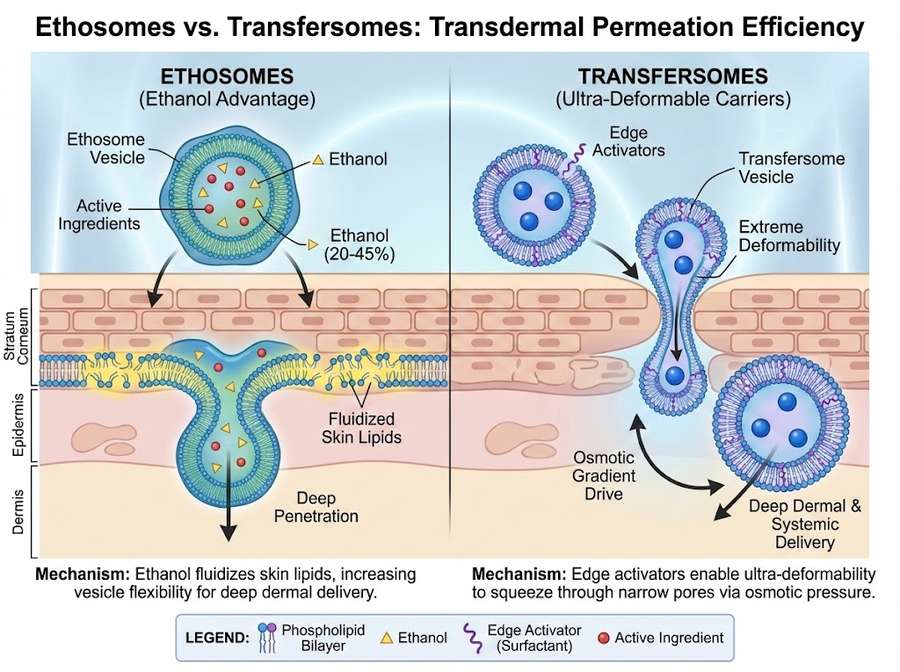
Ethosomes: The Ethanol Advantage
Ethosomes are soft, malleable vesicles composed of phospholipids, water, and a relatively high concentration of ethanol (20–45%). The key to their superior permeation lies in the synergistic effect of phospholipids and ethanol.
Mechanism of Action
- Fluidization: Ethanol interacts with the polar head groups of the lipid molecules in the stratum corneum, reducing the melting point of the stratum corneum lipids and increasing their fluidity ("fluidizing effect").
- Softness: The alcohol content imparts flexibility to the vesicle membrane, allowing it to squeeze through the disturbed skin lipid bilayers.
- Solubility: The presence of ethanol can also enhance the solubility of certain lipophilic and amphiphilic drugs, increasing encapsulation efficiency.
Key Characteristics of Ethosomes
Composition
Phospholipids (PC), Ethanol (20-45%), Water, Propylene Glycol (optional).
Permeation Efficiency
Very High. Penetrates deep dermis and potentially systemic circulation.
Best For
Delivery of both hydrophilic and lipophilic molecules; Anti-acne, anti-viral, and hormone therapies.
Key Characteristics of Transfersomes
Composition
Phospholipids + Edge Activators (Surfactants like Span 80, Tween 80, Sodium Cholate).
Elasticity
Extremely Deformable. Can pass through pores 1/10th of their diameter.
Best For
High molecular weight drugs (e.g., Insulin, Proteins); Non-invasive immunization.
Transfersomes: The Ultra-Deformable Carriers
Transfersomes are engineered to be ultra-deformable. Unlike ethosomes which rely on ethanol, transfersomes incorporate "edge activators"—single-chain surfactants that destabilize the lipid bilayers, vastly increasing their flexibility.
Mechanism of Action
The driving force for transfersome penetration is the osmotic gradient across the skin. Transfersomes are attracted to the higher water content in the deeper layers of the skin (xerophobia). Because of their extreme deformability, they can squeeze through the narrow intercellular pathways of the stratum corneum intact, without permanently disrupting the skin barrier structure.
This unique capability makes them ideal for carrying large macromolecules that would otherwise be unable to breach the skin surface.
Explore Transfersome Technology →Comparison Table: Which System is Right for You?
While both systems excel in transdermal delivery compared to conventional liposomes, their specific attributes dictate their suitability for different formulation goals.
| Feature | Ethosomes | Transfersomes |
|---|---|---|
| Key Component | Ethanol (20-45%) | Edge Activators (Surfactants) |
| Mechanism | Fluidizes skin lipids + Vesicle flexibility | Osmotic gradient drive + Extreme vesicle deformability |
| Encapsulation Efficiency | Generally higher for lipophilic drugs due to ethanol solubility | High for hydrophilic macromolecules; lower for highly lipophilic drugs compared to Ethosomes |
| Skin Permeation Depth | Deep dermal and systemic delivery | Deep dermal; excellent for localized delivery of large molecules |
| Stability | Ethanol stabilizes the vesicle size (negative charge), preventing aggregation | Susceptible to oxidative degradation; requires careful formulation |
| Toxicity Potential | Ethanol may cause skin irritation in sensitive individuals at high concentrations | Generally biocompatible, depends on surfactant choice |
Strategic Application in Cosmetics & Dermatology
For cosmetic formulators targeting anti-aging or skin brightening, the choice of carrier is pivotal. Liposomes for cosmetics have long been the gold standard, but newer elastic vesicles offer faster and deeper results.
When to choose Ethosomes:
Opt for ethosomes when formulating products for acne treatment (where ethanol adds antiseptic
value), delivery of hormones, or when high transdermal flux of lipophilic actives is required. Their
ability to fluidize the skin barrier makes them aggressive permeation enhancers.
When to choose Transfersomes:
Select transfersomes for non-invasive delivery of large biological molecules such as peptides,
proteins (e.g., collagen boosters, insulin), or when the goal is to deposit the drug deep within the
tissue without compromising the skin barrier integrity via chemical disruption.
Accelerate Your Formulation Development
At Creative Biolabs, we specialize in the custom engineering of lipid-based nanocarriers. Whether you need the ethanol-driven power of ethosomes or the stress-responsive elasticity of transfersomes, our team provides end-to-end development services.
- ✓ Pre-formulation screening for optimal lipid/surfactant ratios.
- ✓ Stability testing (physical and chemical).
- ✓ In vitro and Ex vivo permeation studies.
Frequently Asked Questions
Conventional liposomes are rigid and tend to stay on the skin surface. Ethosomes contain ethanol, which fluidizes the skin lipids and the vesicle itself, allowing for deeper penetration. Transfersomes contain edge activators (surfactants) that make the vesicle ultra-deformable, allowing it to squeeze through skin pores intact under the influence of water gradients.
Ethosomes contain a significant amount of ethanol (20-45%). While this enhances penetration, it can potentially cause irritation or drying in very sensitive skin types. However, proper formulation optimization and the inclusion of soothing agents can mitigate these effects. Patch testing is recommended during development.
Yes, this is one of the primary applications of transfersomes. Due to their extreme deformability, they can carry large macromolecules like insulin across the stratum corneum barrier, offering a potential non-invasive alternative to injections. Success depends heavily on the specific edge activator used and the stability of the formulation.
If you are formulating a product for rapid absorption of small, lipophilic actives (like Vitamin E or essential oils) or treating acne, Ethosomes are often superior. If you are trying to deliver collagen, hyaluronic acid, or other large biopolymers deep into the dermis for anti-aging effects, Transfersomes are likely the better choice. Creative Biolabs can perform a feasibility study to determine the optimal carrier for your specific active ingredient.
Online Inquiry
This site is protected by reCAPTCHA and the Google Privacy Policy and Terms of Service apply.