
Antibody‑Coupled Liposome Development Service
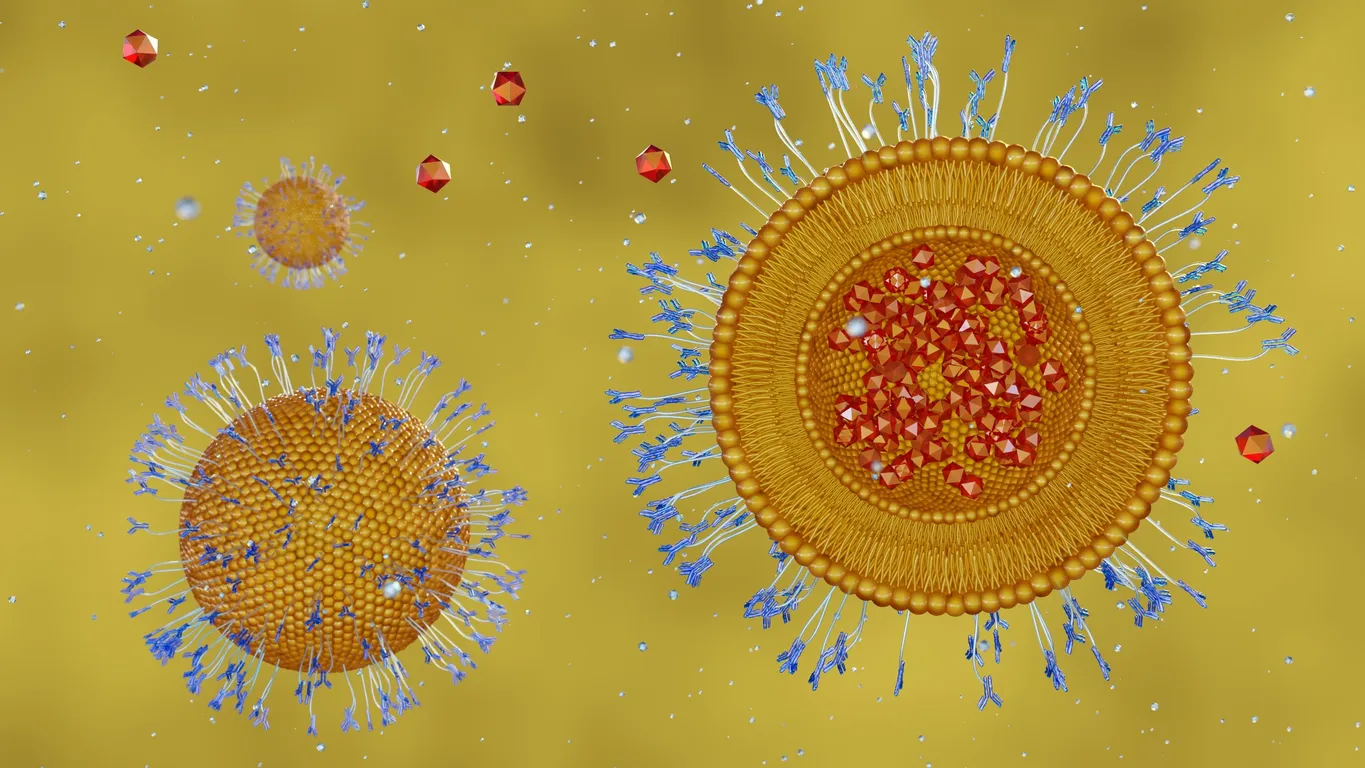
Creative Biolabs offers advanced antibody-coupled liposome development services, combining lipid-based nanocarriers with antibody engineering to create precision delivery systems for targeted research applications.
Partnered with Global Innovators
Recognized by leading biotechnology and pharmaceutical companies, Creative Biolabs delivers cutting-edge liposome functionalization solutions that meet the evolving needs of modern life science research.





Importance of Antibody-Coupled Liposomes
The integration of antibodies with liposomal nanocarriers is a pivotal advancement in targeted delivery and molecular interface engineering. Unlike conventional liposome encapsulation, antibody coupling allows for site-specific recognition and enhanced accumulation at target cell surfaces, improving delivery efficiency and specificity. This strategy is increasingly in demand for applications in drug targeting studies, biosensing platforms, and in vitro cellular interaction research.
With the rapid growth of precision medicine and targeted molecular delivery technologies, antibody-coupled liposomes are becoming indispensable tools for research teams aiming to study receptor-mediated uptake, targeted biomarker recognition, and cell-selective delivery.
Service Capabilities in Antibody-Coupled Liposome Development
Custom Antibody Selection and Preparation
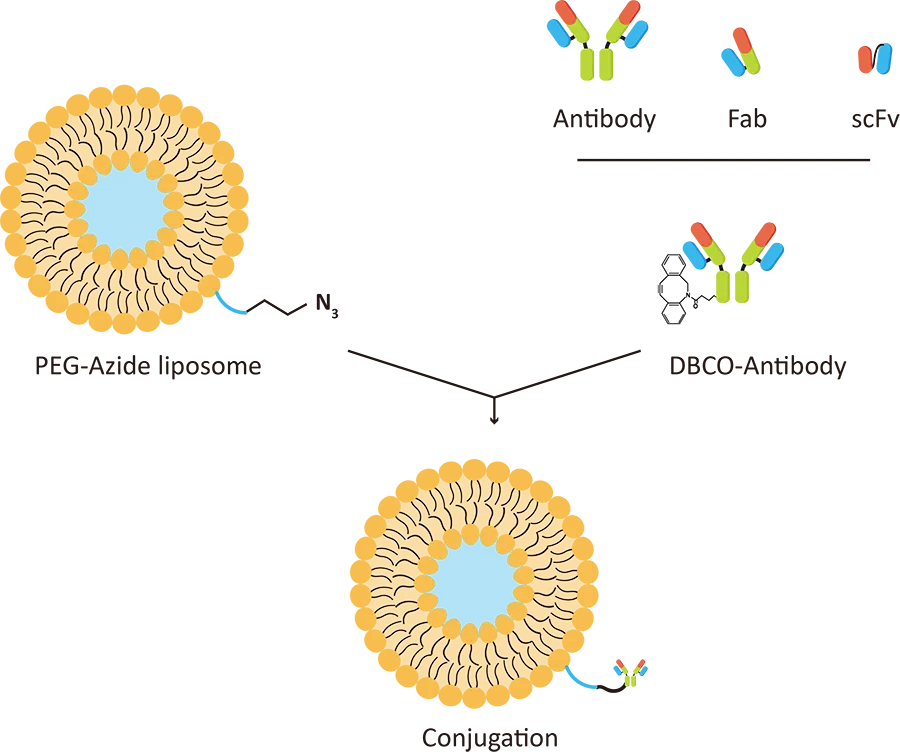
Our platform supports a wide variety of antibodies, including monoclonal, polyclonal, recombinant formats, and antibody fragments (Fab, scFv). We offer:
- Antibody purification and modification to introduce reactive groups without compromising structural integrity.
- Fragment engineering to reduce steric hindrance and enhance coupling efficiency.
- Affinity optimization to maximize binding strength toward target epitopes.
Liposome Design and Functionalization
Creative Biolabs customizes liposome composition and architecture to match project-specific needs:
- Lipid composition optimization for stability, membrane fluidity, and biocompatibility.
- Surface activation with maleimide, carboxyl, amine, or click-chemistry reactive moieties for efficient antibody conjugation.
- Particle size and lamellarity control via extrusion or microfluidic synthesis, ensuring uniformity in downstream applications.
Antibody–Liposome Coupling Strategies
We employ multiple well-validated conjugation methods, including:
- Covalent coupling (e.g., maleimide-thiol chemistry, carbodiimide-mediated amide bonds, click chemistry).
- Enzyme-mediated linkages for high specificity under mild reaction conditions.
- Non-covalent association via protein–lipid affinity interactions for reversible binding applications.
Each method is carefully selected based on the antibody’s stability, liposome surface chemistry, and intended application.
Antibody-Coupled Liposome Development Workflow
Project Consultation
Define target specifications, antibody source, and liposome requirements.
Antibody Preparation
Purify and functionalize the antibody for optimal conjugation.
Liposome Synthesis
Formulate liposomes with defined lipid compositions and surface functionalities.
Coupling Reaction
Perform controlled conjugation using the selected chemistry.
Characterization & QC
Assess particle size, polydispersity, zeta potential, conjugation efficiency, and antibody activity.
Delivery and Reporting
Provide the fully characterized product with a comprehensive data package.
Key Technical Parameters for Antibody-Coupled Liposome Development
| Category | Options & Notes | Typical Use in Research | Readouts |
|---|---|---|---|
| Conjugation | Maleimide–thiol, NHS–lysine, SPAAC click, Protein A/G capture, enzymatic tagging | Stable covalent linkages; orientation control; modular assembly | Coupling yield, LPP, binding ELISA/flow |
| Lipids | DSPC/Chol, DOPC variants, DOTAP/DOPA for charge, DSPE‑PEG‑X (2–5 kDa) | Stability vs. fluidity tuning; corona control; electrostatic guidance | DLS/PDI, ζ‑potential, cryo‑TEM |
| Size control | 80–150 nm (typical), custom larger vesicles | Receptor‑mediated endocytosis vs. phagocytic uptake | Uptake kinetics, imaging, flow cytometry |
| Payloads | Dyes, reporters, nucleic acids, peptides, hydrophobes | Readout amplification; intracellular tracing | Encapsulation %, leakage, functional response |
| Stability | Buffer optimization, serum exposure, freeze–thaw | Assay scheduling and storage planning | Size drift, binding retention, leakage |
(Table content is illustrative; your project is customized.)
Deliverables from Creative Biolabs
- ✓Fully characterized antibody-coupled liposome formulation.
- ✓Detailed analytical data (DLS, zeta potential, conjugation efficiency, functional assays).
- ✓Customized formulation notes and reaction parameters.
- ✓Optional stability and binding activity reports.
All services are strictly For Research Use Only. Not For Clinical Use.
Advantages of Our Antibody-Coupled Liposome Service
Tailored Design
Customized liposome composition and antibody format selection.
Broad Technical Expertise
Mastery of multiple coupling chemistries and liposome fabrication techniques.
High Conjugation Efficiency
Optimized protocols for reproducible, stable linkages.
Comprehensive Characterization
In-house analytical capabilities for structural and functional validation.
Flexible Scale
From small feasibility batches to scaled-up production.
Dedicated Scientific Support
Expert guidance from initial consultation to final delivery.
Applications of Antibody-Coupled Liposomes
Target validation & receptor biology
Use density‑tuned immunoliposomes to dissect receptor clustering requirements, endocytic route preferences, and competitive binding against native ligands in well‑controlled in‑vitro systems.
High‑content imaging of cell uptake
Combine fluorescently labeled lipids or encapsulated dyes with antibody targeting to quantify uptake kinetics, subcellular localization, and co‑localization with endosomal markers.
Ligand spacing and avidity studies
Systematically vary PEG‑spacer length and LPP to map how nanoscale spacing impacts avidity, off‑rate, and cell association under shear or serum exposure.
Payload shuttling & release behavior
Evaluate how antibody‑guided trafficking influences in‑cell release of nucleic acids, peptides, or reporters under defined pH or enzymatic triggers in organoid or co‑culture models.
Analytical and diagnostic method development
Deploy immunoliposomes as calibrators or capture reagents in surface binding assays, microfluidic sensors, or particle‑based immunoassays.
Comparator to other targeting ligands
Benchmark antibodies versus peptides, aptamers, or small molecules on the same liposomal backbone to inform ligand selection for your research designs.
Related Lipid-Based Delivery Services at Creative Biolabs
Creative Biolabs is committed to advancing research through high-performance lipid-based nanocarrier solutions. To complement antibody-coupled liposome development, Creative Biolabs also offers:
Frequently Asked Questions
Our service designs lipid vesicles conjugated with antibodies or Fab fragments, enabling precise recognition of cell-surface antigens. This targeted approach enhances delivery efficiency, improves payload accumulation at desired sites, and reduces off-target interactions in research applications.
Other Resources
References
- Torchilin, Vladimir. "Antibody-modified liposomes for cancer chemotherapy." Expert opinion on drug delivery 5.9 (2008): 1003-1025. https://doi.org/10.1517/17425247.5.9.1003
- Bulbake, Upendra, et al. "Liposomal formulations in clinical use: an updated review." Pharmaceutics 9.2 (2017): 12. https://doi.org/10.3390/pharmaceutics9020012
Online Inquiry
This site is protected by reCAPTCHA and the Google Privacy Policy and Terms of Service apply.